
India's duopoly in the domestic skies -- where IndiGo and Air India collectively control over 90 per cent of the market -- is highly skewed, leaving very little room for new players.
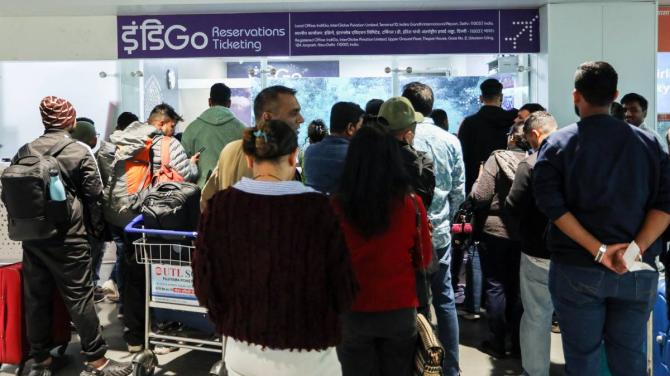
IndiGo's stranglehold on the domestic skies, with a 65.6 per cent share in October, is a rarity in the global aviation sweepstakes.
Airlines in key markets like the US, China, the UK, Brazil, Japan, Thailand and France do not have a single player that matches its domination in what is now the third-largest aviation market in the world.
Not only that, India's duopoly in the domestic skies -- where IndiGo and Air India collectively control over 90 per cent of the market -- is highly skewed, leaving very little room for new players compared to most other countries, with the exception of Australia (where Qantas and Virgin control 98 per cent), leading to regulatory and anti-competitive challenges.
In the US, American Airlines, the largest domestic carrier, has only a 21 per cent share, and the top three -- including Southwest and Delta -- control just 58 per cent, far lower than what one single airline holds in India.
And compared to the market duopoly in India, the top four players in the US (adding United) collectively control a reasonable 75 per cent, leaving room for over seven to eight other airlines to operate and thrive.
In China, where airlines are government-controlled, the largest domestic player, China Southern, has a mere 16 per cent of the market, followed by China Eastern at 14 per cent, and the top three players (including Air China) collectively hold 58 per cent -- again lower than what IndiGo alone controls in India.
The rest of the market is divided among smaller and regional carriers and low-cost airlines, which play a key role.
In Brazil, among the top five aviation markets in the world, the LATAM Airlines Group leads with a 38 per cent share, followed by GOL Linhas Aéreas (32 per cent) and Azul (30 per cent).
The three carve up most of the market but face tough competition among themselves.
In Thailand, while Thai AirAsia tops the list with a 37 to 41 per cent share, rival NokAir holds a decent 25 per cent in second place.
Of course, there are many countries where the top airline has crossed the halfway mark in domestic share, but it still doesn't dominate the market the way IndiGo does.
For instance, in the UK, easyJet holds 45 to 50 per cent, and together with British Airways the two command 70 to 80 per cent collectively -- still leaving enough room for other competitors.
The Australian government, however, has struggled with the strong domination of its top players.
In October 2023, it directed the Australian competition and consumer commission to actively monitor domestic passenger services for the next three years -- covering pricing, costs, and profits -- with powers to penalise airlines.
It has already taken action, including a $100 penalty on customers booked on flights that were cancelled but still sold.
The government has also restructured slot allocation to ensure competitors can survive.
In Indonesia, the KPPU (Komisi Pengawas Persaingan Usaha), which oversees anti-competitive practices, summoned airlines over alleged collusive pricing and asked them to inform the regulator before any fare increase.
Feature Presentation: Ashish Narsale/Rediff







 © 2025