
'At the heart of the strategic relationship between our countries are economic ties.'

The Indian economy is likely to grow at over 7 per cent in the current fiscal year, former Niti Aayog vice chairman Arvind Panagariya said on Wednesday, while observing that the growth rate should sustain next year too provided the forthcoming Budget does not have any negative surprises. Panagariya further said recessionary fears have been around for a while but so far neither the US nor the EU has gone into recession. "From the viewpoint of India, in terms of headwinds originating abroad, the worst is probably behind us," he told PTI.

'The Indian economy and the Indian financial sector today remain resilient and much better placed.'

In an interview, author and columnist Steve Hamm shared his thoughts on the Satyam episode, World Bank ban on Wipro et al.
The Congress on Thursday accused the central government of evading a debate on India-China border face-off and asked why the Modi government has been running away from the issue.

The next annual budget of India will have to be very carefully structured to sustain the country's growth momentum, Union Finance Minister Nirmala Sitharaman said on Tuesday, noting that it will also address inflation concerns. Visiting Washington DC to attend the annual meeting of the International Monetary Fund and the World Bank, the finance minister was responding to a question on the next year's Budget at a fire-side chat with eminent economist Eshwar Prasad at the prestigious Brookings Institute. "Specifics (of the next Budget) may be difficult at this stage because it's a bit too early. "But broadly, the growth priorities will be kept absolutely on the top. "Even as I speak about the concerns that inflation brings before me. So, inflation concerns will have to be addressed. "But then how would you manage growth would be the natural question," Sitharaman said.

For the banking system a new cycle starts in FY2024. It's fraught with fresh challenges on asset quality and profitability, warns Tamal Bandyopadhyay.

Pakistan was put in the inglorious list in 2018 for its failure to check risk of money laundering, leading to corruption and terror financing.

The rhetoric that we are fed daily needs to be measured against performance and the facts. That is not happening, points out Aakar Patel.

S&P Global Ratings on Monday cut India's economic growth forecast for current fiscal year to 7 per cent, but said the domestic demand-led economy will be less impacted by the global slowdown. S&P had in September projected the Indian economy to grow 7.3 per cent in 2022-23 and 6.5 per cent in next fiscal year (2023-24). "The global slowdown will have less impact on domestic demand-led economies such as India... India's output will expand 7 per cent in fiscal year 2022-2023 and 6 per cent in next fiscal year," S&P Global Ratings Asia-Pacific chief economist Louis Kuijs said.

Uttar Pradesh has the highest pendency with more than three-fourths or 77.77 per cent of the total POCSO cases that were filed between November 2012 and February 2021, according to the data.

Indian cities need $840 bn investment over 15 yrs, says World Bank report.

The airlines' losses globally are expected to be down from $52 billion in 2021 to $9.7 billion this year and industry-wide profit should be on the horizon in 2023, Director General of IATA Willie Walsh said in Doha on Monday. International Air Transport Association (IATA) represents some 290 airlines comprising 83 per cent of global air traffic. Walsh, in his inaugural speech at the 78th annual general meeting of IATA here, said that while the outlook for airlines globally is positive, the business environment remains challenging.

Fitch Ratings on Tuesday retained India's economic growth forecast at 7 per cent for the current fiscal, but cut projections for the next two financial years saying the country is not impervious to global developments. In its December edition of the Global Economic Outlook, Fitch projected India's GDP to grow at 7 per cent in the current fiscal, at a slower rate of 6.2 per cent in 2023-24 and at 6.9 per cent in 2024-25. In September, Fitch projected 7 per cent growth for the current fiscal, followed by 6.7 per cent in 2023-24 and 7.1 per cent growth in 2024-25.

Amid surging coronavirus cases in India, Finance Minister Nirmala Sitharaman on Tuesday made it clear that the government would not go for lockdowns in a big way and only resort to local containment. In a virtual meeting with World Bank Group president David Malpass, Sitharaman appreciated the initiatives of the World Bank to increase the lending space for India to enhance availability of finance for development.

The RBI refuses to classify a cryptocurrency as an asset since it doesn't have future cash flow and its value is always fluctuating because of speculation. There is also no consumer protection, observes Tamal Bandyopadhyay, and hence the e-rupee trial run.

After 2014, our growth has been average of around 5%. If this continues, we will remain here like Egypt, Brazil, South Africa and Bangladesh, points out Aakar Patel.
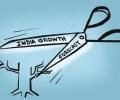
The International Monetary Fund (IMF) on Tuesday cut its projection of India's economic growth in 2022 to 6.8 per cent, as it joins other global agencies that have trimmed forecasts. The IMF had in July projected a gross domestic product (GDP) growth of 7.4 per cent for India in the fiscal year that started in April 2022. Even that forecast was lower than 8.2 per cent projected in January this year. India had grown at 8.7 per cent in 2021-22 fiscal (April 2021 to March 2022).

The rupee depreciated 39 paise to an all-time low of 82.69 against the US dollar in early trade on Monday as elevated crude oil prices and risk-averse sentiment among investors weighed on the local unit. Moreover, a negative trend in domestic equities and firm American currency sapped investor appetite, forex traders said. At the interbank foreign exchange, the rupee opened at 82.68 against the greenback, then slipped further to 82.69, registering a fall of 39 paise over its previous close.

India will grow at around 7.4 per cent in 2022-23 and continue at the same pace in the next year as well, Union Finance Minister Nirmala Sitharaman said on Friday. Sitharaman said there are risks on the external front and this is not the right time to throw caution to the wind, and also assured exporters of all the necessary support from the government as they face the headwinds. Speaking at the FE Best Bank Awards event here, Sitharaman said global agencies like IMF and the World Bank have taken cognisance of the strengths of the Indian economy by saying that it will be among the fastest growing ones in the next two years.

The rupee depreciated further by 13 paise to hit a new life-time closing low of 82.30 against the US dollar on Friday as a firm American currency and risk-averse sentiment among investors weighed on the local unit. Moreover, a negative trend in domestic equities and elevated crude oil prices sapped investor appetite, forex traders said. At the interbank foreign exchange market, the local currency opened at 82.19, then fell further to 82.43. It finally settled at an all-time low of 82.30 against the American currency, registering a decline of 13 paise over its previous close.

When was the last time we heard this government speaking of the disaster in primary education, rather than Ganga cruises and cheetahs? Less money -- Rs 88,000 crore -- was spent by the Union government on education in its last Budget than has been allocated to the Bullet train, notes Aakar Patel.

'When the average growth in the last three years was just 2.5%, how does that make us the fastest growing country?' 'They only tell you what has happened in the last 2 years; they are not taking into account what happened in FY21 on account of their mistakes.'

A prominent Indian Diaspora body, FIIDS, on Monday urged Finance Minister Nirmala Sitharaman to allow non-resident Indians and overseas citizens of India (OCI) card holders to invest in the Indian stock market. Such a move would boost the Indian economy further by attracting investment from the global Indian community, said the Foundation for India and Indian Diaspora Studies (FIIDS) USA. FIIDS is a US-based institute for US-India policy studies and awareness.

The government should not go in for an 'aggressive fiscal consolidation' in the upcoming Budget as global risks have not abated, RBI Monetary Policy Committee (MPC) Member Ashima Goyal said on Wednesday. Goyal further said subsidies are expected to come down as food and energy inflation moderates. WPI inflation in food articles in November was 1.07 per cent against 8.33 per cent in the previous month.
S&P Global Ratings on Wednesday cut India's growth projection for the current fiscal to 7.3 per cent from 7.8 per cent earlier on rising inflation and the longer-than-expected Russia-Ukraine conflict. In its Global Macro Update to Growth Forecasts, S&P said inflation remaining higher for long is a worry, which requires central banks to raise rates more than what is currently priced in, risking a harder landing, including a larger hit to output and employment. S&P had in December last year pegged India's GDP growth in the 2022-23 fiscal, which began on April 1, 2022, at 7.8 per cent.

Will G20 showcase an India that is inclusive, culturally rich, diverse and tolerant, asks Ramesh Menon.

India's economic growth is now 'extremely fragile' and needs all the support that it can get, as private consumption and capital investment are yet to pick up, RBI Monetary Policy Committee (MPC) member Jayanth R Varma said on Friday. Varma further said out of the four engines of growth for the economy, exports and government spending supported the Indian economy through the pandemic, but other engines need to pick up the baton now. " I like to think in terms of the four engines of growth for the economy: exports, government spending, capital investment and private consumption. "...while exports cannot be the main driver of growth because of the global slowdown, government spending is necessarily limited by fiscal constraints," he told PTI.
India can now, if required, borrow up to $30 billion a year, up from $6 billion, from the International Monetary Fund for a three-month period which can be renewed twice more in 3-month cycles.

Climate and sustainable development financing, multilateral institution reforms, regulation of digital assets, the spillover effect on developing economies from actions of western central banks, energy and food security in the backdrop of war in Europe, and sanctions on Russia and their impact on the global economy are some of the agenda items that India will take up as President of G-20, Finance Minister Nirmala Sitharaman said on Tuesday. India will take over as President of the powerful international grouping on December 1 for a year. There will be around 200 meetings throughout the country, with the summit Heads of State meeting expected to be held in New Delhi next September.

A combination of one of the lowest labour costs and a large surplus workforce, which will continue to grow until 2031, is one of the key competitive edges that India is leveraging to challenge its rivals in Southeast Asia in the race for a China-Plus-One strategy. Apart from India, the countries in the race to woo global companies that manufacture in China, as well as the supply chains to their country include Thailand, Indonesia, Malaysia, the Philippines, and Vietnam. On the labour front, India is a clear winner.

The Indian economy is likely to witness close to double-digit growth in the current fiscal year despite the second COVID-19 wave ravaging the country, Principal Economic Adviser (PEA) Sanjeev Sanyal said on Wednesday. The economy is slowly getting back to normalcy as the number of COVID-19 cases is declining, he said while participating in India Global Forum event. "We are probably going to see close to double-digit, if not double-digit (growth) in this financial year," he said.

'The Khalistanis get bulk of the money from abroad.' 'Where did Amritpal's Mercedes come from, which costs well over Rs 60 lakhs?' 'Where does his fleet of vehicles come from?' 'Local Punjabis can certainly not contribute this kind of money.'

It would be ludicrous to expect Modi, Erdogan or Biden to pay to keep blue ticks on their respective official accounts. It would be equally ludicrous to expect the Delhi Metro or the Income Tax Department to pay, points out Devangshu Datta.

Don't be surprised if growth in the second half of the financial year drops below 4%, which is where it was in the year before the pandemic, warns T N Ninan.

The Indian economy, severely hit by the coronavirus pandemic, is projected to contract by a massive 10.3 per cent this year, the International Monetary Fund said on Tuesday. However, India is likely to bounce back with an impressive 8.8 per cent growth rate in 2021, thus regaining the position of the fastest growing emerging economy, surpassing China's projected growth rate of 8.2 per cent, the IMF said in its latest 'World Economic Outlook' report.

"President of Sri Lanka Gotabaya Rajapaksa is still in the country, I made a mistake in the (BBC) interview," Speaker Abeywardena told ANI in a telephone call.

Finance minister Nirmala Sitharaman on Wednesday exuded confidence that inflation would further decline and the government is on track to meet its budgetary target for deficit and said that there is no fear of stagflation in India. Replying to the debate on first batch of Supplementary Demands for Grants 2022-23 in Lok Sabha, the finance minister said inflation has come down and it is now in the tolerable band of the RBI. Inflation has been declining since April 2022 and it is declining further, she said.
Reserve Bank Governor Shaktikanta Das on Thursday described cryptocurrencies as "clear danger" and said that anything that derives value based on make believe, without any underlying, is just speculation under a sophisticated name. The government is in the process of finalising a consultation paper on cryptocurrencies after gathering inputs from various stakeholders and institutions. Reserve Bank of India (RBI) has been flagging concerns about cryptocurrencies, which are seen as a highly speculative asset.
