
The Odisha government on Friday renamed the WheelerIsland in Bhadrak district as Abdul Kalam Island.

After being launched, the glide bomb steer towards the target using a highly accurate hybrid navigation scheme, the ministry said.

Although the credit for acquiring the technological skill must be given to India's outstanding nuclear scientists, the decision to go nuclear was a political one that entailed clarity of vision, courage and resolve, points out Rup Narayan Das.

The extended range of the missile which is part of the Strategic Forces Command will give a variety of options to the planners during times of conflict.

India on Monday successfully flight-tested its indigenously developed SMART torpedo system, which DRDO said will be a "game changer" in anti-submarine warfare, marking yet another milestone in strengthening the country's maritime strategic capabilities, defence sources said.

Changing sand patterns around India's lone missile test-firing range at WheelerIsland off Odisha coast is causing serious concern for Defence Research and Development Organisation and the agency is seeking assistance from Chennai-based National Institute of Ocean Technology to control the erosion.

India on Friday successfully test-fired the indigenously developed nuclear capable Agni-I ballistic missile, with a strike range of 700 km, as part of the Indian Army's user trial from a test range at Wheeler Island off Odisha coast.
China has well and truly cemented its position in the 'star wars' era. Gordon Arthur explains why.

It was the third user trial in the Agni-III series carried out to establish the repeatability of the missile's performance.
India on Sunday conducted a second test flight of its indigenously developed nuclear-capable Agni-V long-range ballistic missile, which has a strike range of more than 5000 km, from the Wheeler Island off Odisha coast.
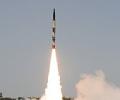
The surface-to-surface missile was test-fired from a mobile launcher at about 0830 hrs from launch pad-4 of the Integrated Test Range (ITR) at Wheeler Island, about 100 km from Balasore in Odisha, defence sources said.

The medium range nuclear capable Agni-II missile was on Sunday successfully test-fired with a strike range of more than 2,000 km from the WheelerIsland off Odisha coast.
Sharpening its missile teeth, India on Thursday successfully test-fired its medium range nuclear capable Agni-II missile with a strike range of 2000 km as part of a user trial by the army from the Wheeler Island off Odisha coast.
Two days after a perfect trial of the highly advanced Agni-IV weapon system, India on Friday successfully test-fired its nuclear-capable Agni-III missile with a strike range of over 3000 km from the Wheeler Island off the Odisha coast.
A high performance on-board computer with distributed avionics architecture and high speed reliable communication bus and a full Digital Control System were used to control and guide the missile to the target.
India on Thursday conducted the maiden test of its indigenously developed nuclear capable Agni V ballistic missile with a strike range of over 5,000 km, from the Wheeler Island off Odisha coast.
India on Thursday successfully test-fired the Agni-5 Inter-Continental Ballistic Missile, which was developed by the Defence Research and Development Organisation.The missile was test-fired from Wheeler Island in Odisha at 8.05 am.
India on Thursday successfully test-fired its nuclear capable Agni-I strategic ballistic missile, with a strike range of 700 km, as part of the Army's user trial from the test range at Wheeler Island off Odisha coast.
Agni 5 is not China-specific, as some have claimed. It is essential to India's overall security and should be followed by a submarine-launched version, says Premvir Das
The maiden test-firing of Agni-5 Inter-Continental Ballistic Missile, scheduled for Wednesday, was postponed at the last moment till Thursday due to bad weather conditions at the test range off the coast of Odisha in the Bay of Bengal.
The maiden test-firing of Agni-5 Inter-Continental Ballistic Missile, scheduled for Wednesday, was postponed at the last moment till Thursday due to bad weather conditions at the test range off the coast of Odisha in the Bay of Bengal.
Range preparation for the maiden test of India's indigenously developed nuclear capable 'Agni-V' ballistic missile with a strike range of over 5,000 km is "near complete" and the trial is likely to be held from Wheeler Island off Odisha coast this Wednesday.
Adding teeth to its nuclear deterrence, India on Tuesday successfully test-fired an advanced variant of nuclear-capable Agni-II ballistic missile with a strike range of 3,000 km from an island off Odisha coast.
After three successful ballistic missile tests during the last fortnight, the Defence Research and Development Organisation is finalising preparations for the big one.
India's nuclear-capable, surface-to-surface Agni-II ballistic missile, with a strike range of 2,000 kms, was on Friday test-fired as part of user trial by the army from the Wheeler Island off Orissa coast.

"The experimental launch of Agni-II missile experienced a trajectory deviation immediately after the lift off resulting in failure of the mission," a DRDO spokesman said in New Delhi.

The HSTDV is capable of powering missiles to attain a speed of around Mach 6 or six times the speed of sound, the officials said, adding only a very few countries like the United States, Russia and China have such a capability.

India on Monday successfully test-fired its nuclear-capable Agni-II missile intermediate range ballistic missile, with a range of 2000 kms, from the Wheelers Island off Orissa coast.
India on Thursday test-fired its nuclear-capable Agni-I strategic ballistic missile, with a range of 700 kms, as part of the army's user trial from the Integrated Test Range at Wheeler Island off Orissa coast.
"Agni-1, surface-to-surface single stage missile with 700 km range, will be taken up for test on Sunday," sources said, adding that Defence Research Development Organisation and operational strategic units of army and naval forces would jointly conduct the operation.

"It was a direct hit and grand success," defence sources said after the test launch.
The first-ever night trial of India's nuclear capable Agni-II Intermediate Range Ballistic Missile has failed to meet all the mission parameters, defence sources said on Tuesday.
India on Sunday successfully test-fired its indigenously developed, nuclear-capable, short range ballistic missile (SRBM) Agni-1 from the Integrated Test Range (ITR) at Wheeler Island, about 100 km from Balasore off Orissa coast.
India "successfully" test-fired its nuclear-capable Agni-III ballistic missile with a range of more than 3,000 km from the Wheeler Island off the Orissa coast, on Sunday.
The test of the indigenously built Intermediate Range Ballistic Missile was carried out from a mobile launcher at about 1006 hrs from launch pad-4 of Integrated Test Range at Wheelers Island near Dhamra, about 80 km from Balasore in Orissa, defence sources said.
"The success of the mission assumes significance as DRDO scientists were able to 'continuously track the missile and feed its trajectory into computers to launch its interception."

Describing the trial a "complete success", sources said that all the mission objectives were met during the test.

Describing the trial as a "complete success", they said all mission objectives were met during the test-fire. All radars, tracking systems and range stations tracked and monitored the flight performance of the missile, which was launched with support of a mobile launcher.
A mock air defence exercise relating to India's indigenously developed interceptor missile is carried out from Wheeler's island off the Orissa coast today.

With this second successful test-firing, India now joins a select group of nations having intermediate range ballistic missiles with range up to 3,000 km. The missile will give the nation the capability to target cities in China like Beijing and Shanghai. The success of Agni-III paves the way for India to build its truly intercontinental range missiles Agni-IV with a range of 5000 km in the near future.
 © 2026 Rediff.com - Investor Information - Advertise with us - Disclaimer - Privacy Policy - Sitemap - Feedback - About us - Terms of use - Grievances