
Within a few hours of Nitish Kumar leaving the NDA, entirely reasonable people were speculating as to how the CBI or ED could be used against him or his party, notes Mihir S Sharma.

On August 6 and August 9 of 1945, warfare changed forever when the United States dropped two atomic bombs on Japan, devastating the cities of Hiroshima and Nagasaki and killing more than 100,000 people. The attack on the people of Hiroshima at 8:15 a.m. on August 6, 1945, and the second attack on the city of Nagasaki at 11:02 am on August 9 killed and wounded hundreds of thousands of unsuspecting men, women, and children in a horrible blast of fire and radiation, followed by deadly fallout. In years that followed, those who survived -- the hibakusha -- suffered from the trauma of the experience and from the long-term effects of their exposure to radiation from the weapons. Before the blast, they were thriving cities. In a flash, they became desolate wastelands. Seventy-five years later, take a glimpse at the destruction.
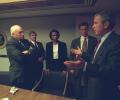
The United States National Archives has released never-before-seen photographs taken in the White House the day terrorists flew planes into the World Trade Centre that show how Dick Cheney and George Bush reacted as the horror unfolded.

Fifty years ago on July 20, 1969 with these words American astronauts Neil Armstrong, Michael Collins, and Edwin "Buzz" E Aldrin made history by becoming the first human beings to set foot on another world -- the moon. It was an event that was watched by millions on television and one that remains etched in all our memories. Collected here are 17 images of that historic mission, a "giant leap for mankind".

It has been a half-century since Neil Armstrong stepped out of a lunar module and onto the surface of the moon on July 20, 1969 and declared, "That's one small step for [a] man, one giant leap for mankind." The moment heralded a golden age of space exploration that was set in motion just eight years earlier in 1961, when United States President John F Kennedy promised before Congress to put a man on the moon before the decade was out. Here are some lesser-known facts about the historic first mission:

Kanika Datta visits the Cu Chi military tunnels -- a testimony to a plucky little country's 30-year war of resistance against, first, French colonisers and, then, the US.
 © 2026 Rediff.com - Advertise with us - Disclaimer - Privacy Policy - Sitemap - Feedback - About us - Terms of use - Grievances