
RBI Governor Shaktikanta Das on Wednesday defended the Reserve Bank's handling of the price situation, saying acting prematurely on inflation would have exerted a heavy cost on the economy and citizens. Acknowledging that the inflation target has been missed, Das said the RBI decided to support the economy by not introducing a rate hike in face of a spike in inflation. "We prevented a 'complete collapse of the economy' by keeping rates lower and stayed away from premature tightening," Das said speaking at the annual FIBAC conference of bankers in Mumbai.

Seven consecutive sessions of decline in the equity market has eroded the wealth of investors by a whopping Rs 10.42 lakh crore and the benchmark Sensex has tumbled more than 2,000 points during this period. Concerns over more rate hikes by developed economies, weak global equity markets and fresh foreign fund outflows from the domestic market have dented investor sentiments. On Monday, the BSE Sensex dropped 175.58 points or 0.30 per cent to end at 59,288.35 points, marking a decline for seven straight trading sessions.

The US Federal Reserve has raised its benchmark interest rate by 0.25 per cent, only the second increase in a decade.

All evidence suggests that the US Federal Reserve will raise interest rates soon.

The trend was visible in the early trade on Thursday as investors indulged in trimming their bets after the minutes of the US Federal Reserve's September meeting indicated a possible rate hike this year.

Investors have become poorer by over Rs 6.18 lakh crore as markets took a heavy beating on Friday. The 30-share BSE Sensex tanked 1,093.22 points or 1.82 per cent to settle at 58,840.79. During the day, it tumbled 1,246.84 points or 2 per cent to 58,687.17.

Continuing its heavy selling spree for the eighth consecutive month, foreign investors pulled out nearly Rs 40,000 crore from the Indian equity market in May on fears of an aggressive rate hike by US Federal Reserve that dented investor sentiments. With this, net outflow by foreign portfolio investors (FPIs) from equities reached at Rs 1.69 lakh crore so far in 2022, data with depositories showed. Going ahead, FPI flows will remain volatile in the emerging markets on account of rising geo-political risk, rising inflation, tightening of monetary policy by central banks, among others, Shrikant Chouhan, Head - Equity Research (Retail), Kotak Securities said.

Investors have turned cautious ahead of the policy meetings of central banks in Japan and the US

'Hope they don't tinker around with capital gains tax in any way.'

With the international markets facing uncertainty after Russia invaded Ukraine and Western nations retaliated with sanctions, Indian companies are putting their international fundraising plans on hold as they wait for the markets to recover. Bankers said apart from the geopolitical crisis, international rates are hardening in anticipation of interest rate hikes by the US Federal Reserve to control rising prices in the US. The Ukraine situation has implications for the market. In such a situation, international investors try to shift to safe haven assets by exiting from emerging markets.

Improvements in the labour market has triggered this sentiment.

Finance Minister Nirmala Sitharaman on Wednesday said the country's economic growth remains a priority for the government, as inflation has come down to a manageable level. Job creation and equitable distribution of wealth remain the other focus areas, she said at India Ideas Summit. "Some of course are red-lettered (priorities), some may not be. Red-lettered ones would of course be jobs, equitable wealth distribution and making sure India is moving on the path of growth.

'Such big falls are quite frequent these days, so do not try to time this market.' 'Use big dips to accumulate quality stocks.'

Benchmark indices bounced back on Wednesday after a two-day decline, with the Sensex and Nifty climbing nearly 1 per cent each, tracking a positive trend in European markets. Buying in IT and bank stocks also supported the recovery in equities. The 30-share BSE benchmark jumped 547.83 points or 0.99 per cent to settle at 55,816.32.

As regards India, FIIs have pumped in over Rs 34,400 crore in the Indian stocks in calendar year 2021.

'Over the next two quarters, markets will be guided by observing the earnings resilience of corporates during the second lockdown, progress of the monsoon and the damage, if any, to rural spending power due to the second wave.'

The wholesale price-based inflation eased to a 29-month low of 1.34 per cent in March on easing prices of manufactured products and fuel items, even though food articles turned expensive.

Continuing their selling spree for the sixth consecutive month, foreign investors pulled out a massive Rs 41,000 crore from the Indian equity market in March on anticipation of rate hikes by the US Federal Reserve and deteriorating geopolitical environment amid the Russia-Ukraine war. Further, flows from foreign portfolio investors (FPIs) are expected to remain volatile in the near term given the headwinds in terms of elevated crude prices and inflation, experts said. According to data available with the depositories, FPIs were net sellers to the tune of Rs 41,123 crore in the equity market last month.

The value of foreign portfolio investors' (FPI) holdings in domestic equities reached $654 billion in three months ended December 2021, a drop of nearly 2 per cent from the preceding quarter, according to a Morningstar report. This was largely on the back of a massive sell-off by foreign investors and a correction in the Indian equity markets, especially in the large and mid-cap sectors. "At the end of the quarter ended December 2021, the value of FPI investments in Indian equities fell to $654 billion, which was lower than $667 billion recorded in the previous quarter, a fall of around 2 per cent," the report noted.

'Market feels this Budget will promote all-round growth and that is what is giving it confidence.'

The rout in Adani Group stocks after US-based short seller Hindenburg Research released a report on January 24 has sparked a rebound in trading activity this month. The average daily trading volume (ADTV) for the cash segment (both NSE and BSE combined) so far in February stands at Rs 59,346 crore, and is around 15 per cent more than the previous month's tally of Rs 51,844 crore, which was the lowest in six months. The ADTV for the futures and options (F&O) segment rose to a record Rs 204 trillion (notional turnover) against Rs 202 trillion in January.

The US Federal Reserve has earned a whopping $14 billion profit on loan programmes made in the last two years, says a media report.

American President Barack Obama on Tuesday extended the tenure of US Federal Reserve Chairman Ben Bernanke by another term.

Equity benchmark BSE Sensex closed at an all-time high of 62,272.68 on Thursday, tracking a firm trend in global markets after the US Fed minutes indicated a slower pace of rate increase that bolstered investors' sentiment. Extending its rally to the third straight day, the 30-share BSE benchmark rallied 762.10 points or 1.24 per cent to settle at 62,272.68, its record closing peak. During the day, it jumped 901.75 points or 1.46 per cent to its lifetime high of 62,412.33.he broader NSE Nifty gained 216.85 points or 1.19 per cent to end at 18,484.10.

With the Nifty50 just about 3 per cent away from its all-time closing high of 18,812 points, analysts at BofA Securities suggest investors book profit. Their reasons for the advice include risks like the possibility of a cut in corporate earnings growth forecasts, high valuation (one-year forward P/E of 19.5x), interest rates staying elevated for longer-than-expected and credit tightening. Going ahead, they expect the Nifty50 index to drop to 16,000 levels - down nearly 12 per cent from the current level of 18,255 points, which they believe would be a good time to buy.

Reserve Bank Governor Shaktikanta Das on Wednesday said in the wake of appreciating US dollar, the movement of rupee has remained least disruptive as compared to its peers, and the size of foreign exchange reserve is comfortable. On a financial year basis (from April to October 2022), the rupee has appreciated by 3.2 per cent in real terms, even as several major currencies have depreciated, he said while announcing the latest set of bi-monthly monetary policy. "The story of the rupee has been one of India's resilience and stability," the Governor said while pointing out that the appreciation of the US dollar this year, which precipitated large-scale depreciation of all major global currencies including the Indian rupee, has drawn wide attention.

The re-opening of the Chinese economy, as it moves away from its zero-Covid policy, could help stabilise commodity prices, according to some of the country's top metal companies. They view this as a positive for demand, at a time when markets such as the US and Europe have been largely weighed down by slowdown concern now. "Most of us in the metals business are hoping the Chinese economy picks up because half of any metal demand, including demand for aluminium, comes from China.

Following are the highlights of the Economic Survey 2022-23 tabled in Parliament on Tuesday

The US faces the Czech Republic in the first round from April 26-27.

Elevated food price-led inflation could become a sore point for markets, which they seem to be ignoring at current levels, observe analysts. Retail inflation in India - as measured by the Consumer Price Index (CPI) - came in at a three-month high of 6.52 per cent in January 2023, compared with 5.72 per cent in December and 5.88 per cent in November 2022. The inflation print for February, according to Madan Sabnavis, chief economist at Bank of Baroda, will be critical for the Reserve Bank of India's monetary policy committee.
Macro-economic data from China and minutes of the US Federal Reserve's last meeting caused the turmoil as stocks tumbled around the globe.

'Earning expectations remain strong.'

Former New Jersey Governor Chris Christie and a Republican presidential aspirant have called his fellow rival Indian-American Vivek Ramaswamy a guy who sounds like ChatGPT and described him as an "amateur" Barack Obama.

Morgan Stanley on Thursday became the latest brokerage to question the valuations of Indian equities and downgraded them from 'overweight' (OW) to 'equalweight' (EW) and recommended taking some money off the table. "We move tactically EW on India equities after strong relative gains - we expect a structural multi-year earnings recovery, but at 24 times forward price-to-earnings (P/E) we look for some consolidation ahead of US Fed tapering, an RBI hike in February and higher energy costs," Morgan Stanley equity strategists, led by Daniel Blake and Jonathan Garner, said in a note on Asia Pacific markets. The brokerage has upgraded Indonesia to OW, while maintaining an EW stance on China and UW on Taiwan.
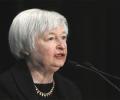
She will replace Ben Bernanke as the Chair of the Federal Reserve.
On one hand, the RBI will have to initiate measures to contain inflow of foreign capital -- which is expected to increase as an after effect of the Fed rate cut, on the other it will need to ensure that such inflows do not fuel inflationary pressures.

A strong and stable dollar is both in the American interest and in the interest of the global economy, US Federal Reserve Board chairman Ben Bernanke said on Wednesday.

The US Fed interest rate decision, domestic macroeconomic data announcements and ongoing quarterly earnings are some of the major factors that will drive the stock markets in a holiday-shortened week, analysts said. Besides, monthly auto sales numbers and the LIC IPO will also remain in focus, they added. Equity markets will remain closed on Tuesday for Id-Ul-Fitr (Ramzan Id). "The market is likely to kick off this week on a sombre note after a sharp fall in the US market then the focus will shift to the outcome of the US FOMC meeting, which is crucial amid record inflation and growth worries.

Strong currency and sagging oil prices are spooking policymakers.

Lok Sabha Speaker Om Birla on Monday warned members against referring to anyone's caste and religion in the House after a Congress MP alleged that Finance Minister Nirmala Sitharaman made certain remarks about his proficiency in Hindi because he belonged to a lower caste.
 © 2026 Rediff.com - Advertise with us - Disclaimer - Privacy Policy - Sitemap - Feedback - About us - Terms of use - Grievances