
Traders said sustained buying by stockists and jewellery fabricators for the ongoing marriage season mainly led to an upward trend in gold prices.

Gold in New York, which normally sets price trend on the domestic front, rose marginally by 0.02 per cent to $1,255.80 an ounce and silver by 0.18 per cent to $19.06 an ounce in Tuesday's trade.

However, silver held steady at Rs 42,600 per kg on scattered enquiries from industrial units.
Traders said sentiment bolstered after gold jumped to a one-month high in overseas markets as expectations the US Federal Reserve will sustain stimulus hurt the dollar, and raised demand for precious metals as an alternate investment.

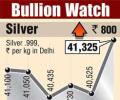
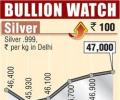
Silver maintained its rising streak for the fourth consecutive day and advanced Rs 100 to Rs 42,400 per kg on sustained buying by industrial units.

The rupee had closed with a gain of 12 paise on Friday.
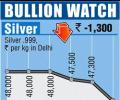
Silver also plunged by Rs 1,300 to Rs 46,000 per kg on poor offtake by jewellery fabricators and industrial units.

Traders said besides sluggish demand at prevailing higher levels, a weak global trend mainly led to fall in gold and silver prices.
Traders said increased buying by stockists and retailers mainly kept gold prices remain higher for the third day.

Traders said revival of buying by retailers at existing lower levels led the marginal recovery in gold prices.
Traders said scattered buying by retailers amid a firm global trend, where gold climbed to six-month high, and escalating tension in Ukraine mainly boosted demand for the precious metals as a safe haven.

Globally, gold in New York, which normally determines price trend on the domestic front, fell 1.18 per cent to $1,198.50 an ounce in Tuesday's trade as strengthening dollar curbed demand for the precious metal.

On the domestic front, gold of 99.9 and 99.5 per cent purity fell by Rs 30 each to Rs 28,445 and Rs 28,245 per 10 grams, respectively after gaining Rs 655 in last three days. Sovereigns, however, remained stable at Rs 24,400 per piece of eight grams in restricted buying activity.

Gold prices maintained an upward march for the third consecutive day by rising Rs 290 to Rs 30,490 per ten grams in the national capital on sustained buying by stockists amid a firm global trend.
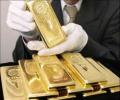
Traders said stockists selling against sluggish demand at higher levels mainly led to fall in gold and silver prices.

Traders said fall in demand due to ongoing 'Sharads', an inauspicious fortnight in Hindu mythology for making fresh purchases mainly pulled down the precious metals.

Traders said sluggish demand due to ongoing 'Sharads', an inauspicious fortnight in Hindu mythology to make fresh purchases, mainly kept the precious metals lower.
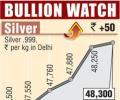
Traders said sentiment remained bullish as stockists increased their positions to meet the seasonal demand.

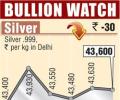
Silver, however, fell for the third straight session by losing Rs 200 to Rs 43,800 per kg on lack of buying support from coin makers and industrial units.

Traders said sluggish demand at prevailing higher levels and investors shifting their funds to surging equities mainly kept pressure on gold and silver prices.
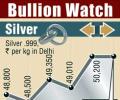
Traders said increased buying of gold by stockists and jewellers to meet the rising festive and marriage season demand, amid firming global trend, influenced the sentiment.

Weak global trend, where gold declined nearly to its lowest level in three months, further dampened the sentiment, they added.

The rupee's gains came even as most emerging Asian currencies eased as the yuan fell beyond 6.20 to the dollar for the first time since April last year amid market speculation that the central bank will keep the currency weak as economic growth slows.

Traders said sustained buying by stockists to meet the rising demand for the 'Navratras,' an auspicious week in Hindu mythology for making fresh purchases mainly pushed up the prices of the precious metals.

While gold fell by Rs 250 to Rs 30,250 per ten grams, silver lost Rs 475 to Rs 49,025 per kg on reduced offtake by jewellers and industrial units.

Traders said sustained buying by stockists and retailers for the ongoing marriage season mainly led an upward trend in precious metals.

Traders said sustained selling by stockists on the back of sluggish demand mainly kept pressure on both gold and silver prices for the second straight day.
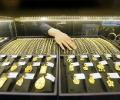
Traders said low-level buying by stockists and shifting of funds from weakening equity to rising bullion mainly boosted the sentiment.

Traders said sustained selling by stockists on the back of sluggish demand mainly kept pressure on precious metals.

To tackle the resultant inflation, the Indira Gandhi government had imposed price controls on manufactured products, including soaps and vanaspati, in 1973.
