'Price competition is fierce, with many companies selling at zero margin.' 'This pricing pressure is challenging smaller companies and will likely drive some out of the market over time.'

Under regulatory scanner, Bengaluru-based Ola Electric has witnessed an uptick in its sales after facing a decline during the last few months. The company's daily average sales rose to 1,154 units in October, according to Vahan data from the Ministry of Road Transport and Highways (MoRTH). With sales reaching 17,315 units between October 1 and October 15, the company has also boosted its market share to 34 per cent, up from 27 per cent in September, in the electric two-wheeler (e2W) segment.

The environment ministry is likely to soon issue regulations that will mandate automakers to recycle a specified percentage of steel from old vehicles, starting from the next financial year, according to people familiar with the matter. "We recently held a meeting with members of the Society of Indian Automobile Manufacturers (Siam). "The final regulations are likely to be issued in the next 10 days," a government source informed.
The new four-wheeler (4W) electric vehicle (EV) policy may spur the entry of global majors. The manufacturing policy cuts Customs duty to 15 per cent, given a minimum investment commitment. It calls for a minimum investment of Rs 4,150 crore (about $500 million) for making electric four wheelers (e-4Ws), with manufacturing to commence within three years of approval.

Bengaluru-headquartered electric two-wheeler manufacturer Ather Energy is all set to file its draft red herring prospectus within the second week of September to the Securities Exchange Board of India (Sebi) for its maiden initial public offering (IPO), in which it is expected to raise over $450 million. On Tuesday, the fourth-largest electric two-wheeler maker in the country by volume raised Rs 600 crore from its existing investor, the National Investment and Infrastructure Fund (NIIF), catapulting itself into a unicorn with a valuation of $1.3 billion.

Industry leaders on Thursday mourned the death of Ratan Tata saying with his demise India has lost a visionary who shaped its industrial and philanthropic landscape. Tata was a truly remarkable business leader who placed the country before business interests, and whose vision was truly transformational for a country and its people, TVS Motor Co Chairman Emeritus Venu Srinivasan said in a statement. "Mr Tata was a truly remarkable business leader, the likes of whom nations get only once in a century," he added.

Automobile (auto) retail sales in India grew by an impressive 14 per cent in July compared to the same period last year, driven by a surge in the rural economy, good product availability, and product launches. While passenger vehicles (PVs) saw a 10 per cent increase during this period, inventory levels have surged to a historic high of 67-72 days in PVs, equating to Rs 73,000 crore worth of stock, according to the Federation of Automobile Dealers Associations (Fada). This poses a risk to dealer sustainability. Inventory levels in July 2023 were only 50-55 days, equating to a stock worth Rs 49,833 crore. In June 2024, inventory was between 62 and 67 days, with a stock value of Rs 60,000 crore.

Leading automakers Maruti Suzuki, Hyundai and Tata Motors reported decline in wholesales in August as the companies curtailed vehicle dispatches amid drop in demand and to cut inventories at dealer level. Market leader Maruti Suzuki India said its total domestic passenger vehicle wholesales were at 143,075 units last month as compared to 156,114 units in the year-ago month, registering a dip of 8 per cent. Sales of mini segment cars, comprising Alto and S-Presso, declined to 10,648 units last month as against 12,209 units a year ago.

The proposed exemption in customs duty on import of lithium, cobalt and other rare minerals in the Union Budget 2024-25 is likely to lower the battery production cost and help in making electric vehicles more affordable for the buyers, auto industry leaders said on Tuesday.

Passenger vehicle wholesales saw a marginal growth of 4 per cent in June on account of high base effect and muted demand due to severe heatwave conditions in several parts of the country. Overall passenger vehicle dispatches last month stood at 340,784 units, a growth of 3.67 per cent compared with 328,710 units in June 2023.

With sentiment for the automotive (auto) sector turning positive, stocks of two-wheeler auto majors have been hitting their 52-week highs. Hero MotoCorp, Bajaj Auto, TVS Motor Company, and Eicher Motors recently reached their yearly highs on strong sales in the festival season and the expectation of faster growth rates ahead. Since the start of this month, listed two-wheeler majors have delivered returns in the 12-17 per cent range, compared to the 7 per cent gains for the S&P BSE Auto Index and 3 per cent for the benchmark S&P BSE Sensex.

Five firms, including ACC Ltd, HDFC Asset Management Company and FSN E-Commerce Ventures that runs Nykaa, will be dropped from Nifty Next 50 index from September 29. NSE Indices Ltd, an arm of the National Stock Exchange, on Thursday said that Indus Towers and Page Industries will also be dropped from the index. Punjab National Bank, Trent, Sriram Finance, TVS Motor Company, and Zydus Lifesciences will be included in the Nifty Next 50 index, NSE Indices said in a statement.
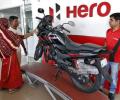
The two-wheeler segment has shown signs of recovery in the first half (H1) of calendar year (CY) 2024, largely driven by improving performance in rural areas. According to the Federation of Automobile Dealers Associations, rural contribution to two-wheeler sales surged by 57-60 per cent in the April-June quarter of 2024-25, indicating a rising demand in these regions. Experts believe that this trend will continue, supported by a favourable monsoon season and government initiatives aimed at rural development.

Passenger vehicle sales in India kicked off on a flat note in new fiscal 2024-25 with 3.38 lakh units sold in April, impacted by high base effect and muted demand due to the ongoing general elections. Dispatches of passenger vehicles from manufacturers to dealers were at 338,341 units in April 2024 as compared to 332,468 units in the same month last year, a growth of 1.77 per cent with major players Maruti Suzuki India, Hyundai and Tata Motors reporting marginal growth in their domestic wholesales.

The Ministry of Heavy Industries has approved 11 electric vehicle (EV) manufacturers, including Ather Energy, Bajaj Auto, Hero MotoCorp, Ola Electric, and Mahindra, to receive incentives under the recently introduced Electric Mobility Promotion Scheme (EMPS) 2024. "A total of 11 firms have been granted approval under the EMPS, with several more under consideration," informed a senior official of the ministry to Business Standard. The scheme aims to sustain the growth in EV sales, replacing the Faster Adoption and Manufacturing of Electric Vehicles - II (FAME-II) scheme.
India's incumbent two-wheeler players, led by TVS Motors, are flexing their muscles, having crossed the registration of 10,000 electric two-wheelers for the first time in November this year, according to data from Vahan, the website of the ministry of road transport and highways. The two key incumbent players, TVS Motors and Bajaj Auto, now account for around 15 per cent share of registrations in the month of November. The number will only go up with Hero MotoCorp now joining the bandwagon with its Vida range of electric scooters.

Passenger vehicle sales are expected to experience muted growth in the current financial year.

Tata Motors is likely to exit the S&P BSE Sensex and the Nifty50 indices once the demerger process of its commercial vehicle (CV) and passenger vehicle (PV) businesses is complete, analysts at Nuvama Institutional Equities said. They have compared the development with Reliance Industries (RIL) and Jio Financial Services, which got listed separately and eventually (in the next few days) got excluded from the domestic indices.

The Softbank-backed company has set a price band of Rs 72 to Rs 76 per share for the maiden share sale and is expected to test the appetite for new-age loss-making companies.

The US Federal Reserve's interest rate decision, global cues, macroeconomic data announcements and the ongoing quarterly earnings are the major triggers that will dictate trends in stock markets this week, analysts said. Besides, the trading activity of foreign investors and the movement of global oil benchmark Brent crude will also be tracked. "All eyes are on the outcome of the US Federal Reserve meeting scheduled for November 1, particularly due to the multi-year high levels of the US bond yields.

Leading automakers Maruti Suzuki, Hyundai and Tata Motors on Friday reported robust sales for February as demand for sports utility vehicles continued to remain strong. Mahindra & Mahindra, Toyota Kirloskar Motor and Honda Cars also witnessed higher vehicle dispatches to dealers last month. February turned out to be the third-best month for sales for the industry ever.

Founded by James Lansdowne Norton in Birmingham (in 1898), Norton Motorcycles is among the most popular British motorcycle brands of all time.

Tamil Nadu is leaving no stone unturned in marketing its upcoming global investors meeting on January 7 and 8. While business veterans are promoting the positives of the state's industrial climate through the 'Titans of Tamil Nadu" campaign, the state is narrating the human stories behind its robust industrial growth via the 'One Trillion Dreams' campaign. Among the industry bigwigs, who are showcasing Tamil Nadu to the world through this mega marketing initiative include Venu Srinivasan of TVS Motor Company, K M Mammen of MRF Ltd, Pratap Reddy of Apollo Hospitals, P R Venketrama Raja of Ramco Group, Mallika Srinivasan of TAFE; and Vellayan Subbiah of Murugappa Group.

Two-wheeler exports from India have decreased by 20 per cent year-on-year (Y-o-Y) to 1.69 million units in the first half (H1) of 2023-24 (FY24) due to a challenging geopolitical situation and foreign exchange (forex) crises in key markets such as South Asia, industry body Society of Indian Automobile Manufacturers (Siam) said on Monday. On the other hand, passenger vehicle (PV) exports in H1FY24 increased by 5 per cent to 336,754 units because the key markets are much more diversified worldwide, Vinod Aggarwal, president, Siam, told reporters during a press conference. The Russia-Ukraine war, which started in February 2022, has brought significant instability to global fuel prices.
Hero MotoCorp, India's largest two-wheeler maker, has seen a decline in its market share in rural areas since 2018, losing ground to major competitors such as TVS Motor Company, Bajaj Auto, and Honda Motorcycle & Scooter India (HMSI), according to data from JATO Dynamics reviewed by Business Standard. Hero's share of rural two-wheeler sales in India has dropped from 40.4 per cent in 2018 to 33.3 per cent in 2023. In contrast, Bajaj's share increased from 12.7 per cent in 2018 to 13.9 per cent, HMSI's from 21.8 per cent to 22.2 per cent, and TVS' from 15.5 per cent to 17.8 per cent. Suzuki Motorcycle India has also seen its share rise from 1.7 per cent to 2.5 per cent.
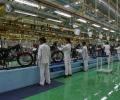
The $8.5 billion TVS Group received final approval for a family resettlement on February 4 from the National Company Law Tribunal (NCLT). It is an arrangement that is noteworthy because unlike many other corporate settlements this one was sorted out amicably and without any open conflicts.

Which entrepreneur would willingly part with her or his hard-earned money for grasping, self-serving politicians? asks Debashis Basu.

The company said the new model would be available for sale in sugarcane-producing Maharashtra, Uttar Pradesh and Karnataka, to begin with.
The restructuring, which will involve nine listed companies, including TVS Motor, Sundaram Clayton, Sundram Fasteners, TVS Electronics and TVS Srichakra, among others, will give each family group complete ownership of businesses they manage while scrapping the holding company.

Honda Motorcycle and Scooter India (HMSI), the country's second-largest two-wheeler manufacturer, is planning to launch its first electric vehicle (EV) here by March next year, said CEO & MD Atsushi Ogata on Monday. The company would also enter the low-end motorcycle market in March by launching a 100cc engine bike at a price that will "positively shock" customers, he said while speaking with reporters, after launching the Activa with Honda Smart Key. HMSI's first EV, an electric scooter, will have a fixed battery and the second model will have two swappable batteries, Ogata explained.

The two-wheeler segment is, however, still far from its H1FY19 peak of 9.7 million units
As part of the exercise, each family will get complete ownership of the businesses it manages while scrapping the holding company.
The two-wheeler sector has been underperforming its peers on the volumes front for over five quarters now. Even in the March quarter, Bajaj Auto and Hero MotoCorp posted a 17-24 per cent YoY decline in volumes, the sharpest in the listed auto universe. The ongoing impact of frequent price hikes, all-time high fuel prices, and muted rural sentiment has led to the lacklustre showing by two-wheeler makers. What has aggravated the situation for two-wheeler companies, which get almost all their sales from the internal combustion engine or ICE-based units, is the traction for electric two-wheelers (EV).
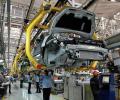
The K-shaped economic recovery in India from the pandemic slowdown shows in corporate results as well. The automobile sector, which represents big-ticket consumption, continues to do well and has increased its share in corporate revenues and profits while fast-moving consumer goods (FMCG) companies that sell low-ticket consumer goods are struggling with poor sales and earnings growth. The share of the automobile sector, including makers of auto ancillaries, in corporate net sales rose to a 10-quarter high of 10.05 per cent during July-September 2023 (Q2FY24) from 8.94 per cent a year earlier and 9.75 per cent in Q1FY24.

This is a good opportunity for long-term investors to pick quality small and midcap stocks at reasonable valuations.

The previous May peak was observed in 2018 when the domestic PV wholesales stood at 301,238 units.

With Housing Development Finance Corporation's (HDFC's) merger with HDFC Bank becoming effective on July 1, the merged entity is set to become the top weight in the benchmarks S&P BSE Sensex and the National Stock Exchange Nifty indices, dislodging the country's most valuable company, Reliance Industries (RIL), from its perch. HDFC will stop trading after July 13. At present, RIL has a weighting of close to 12 per cent in the Sensex and 10.3 per cent in the broad-based Nifty. Meanwhile, HDFC Bank and HDFC have weights of 9.9 per cent and 6.8 per cent in the Sensex and 8.8 per cent and 6 per cent in the Nifty, respectively.
Automobile manufacturers are likely to report strong numbers for the September quarter of Financial Year 2023-24 (Q2 FY24), riding on growth across segments and offset by a marginal drop in overall two-wheeler (2W) volumes. Higher average selling price (ASP) year-on-year (YoY), which was necessitated by price hikes taken by original equipment manufacturers (OEMs), and an improved product mix will also aid revenues and margins. Moreover, commodity prices are down on a YoY basis, leading to higher margins in earnings before interest, taxes, depreciation and amortisation (Ebitda).

Technology firm Wipro has a "high probability" of getting included in the benchmark Sensex, while two-wheeler major Bajaj Auto is the "most likely" deletion candidate, according to an analysis done by Brian Freitas, an analyst at independent research provider Smartkarma. The changes to the index will be announced mid-November, and will become effective from December 17. The December review uses the 6-month average market capitalisation and trading turnover data between May 1 and October 31 to determine changes.
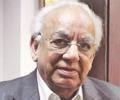
Venkataraman Krishnamurthy, who is considered as the turnaround man of several Indian corporate houses like BHEL, Maruti Udyog, SAIL and Gail (India), passed away on Sunday at the age of 97. Krishnamurthy is considered as "the father of public sector undertakings in India" by many in India Inc. Born in the temple town of Tamil Nadu's Karuveli, he started his career as an airfield technician during the Second World War.
 © 2026 Rediff.com - Advertise with us - Disclaimer - Privacy Policy - Sitemap - Feedback - About us - Terms of use - Grievances