
Overseas shipments at auto firms expanded at a brisk pace year-on-year (YoY) in March, bumping up the overall annual exports for FY22 and taking it to a record level for some like Maruti Suzuki India and Bajaj Auto. Amid a semiconductor shortage, a depreciating rupee and a strong demand in various export destinations, passenger vehicle makers diverted capacity meant for the local market in favour of the more-lucrative export market. Among the passenger vehicle makers, market leader Maruti Suzuki led the rally with its overseas shipments touching a record level of 238,376 units in FY22 - the highest for the company in any financial year.

Automotive retail sales saw a 14 per cent rise in March on a year-on-year (YoY) basis, according to data released by the Federation of Automobile Dealers Associations (FADA). For the whole of financial year 2022-23 (FY23), sales grew 21 per cent YoY. For both March and the financial year, all categories, except for tractors, and including two-wheelers, three-wheelers, passenger vehicles (PVs), and commercial vehicles (CVs), posted double-digit growth. However, the total retail sales of 22.1 million for the financial year were still 12 per cent lower than the pre-Covid (FY20) level of 25 million, owing to an 18 per cent dip in the two-wheeler segment.

The country saw a massive year-on-year surge in the demand for electric vehicles, with retail sales of electric two-wheelers rising by 58 per cent, passenger vehicles by 130 per cent, three-wheelers by 82 per cent, and commercial vehicles by 171 per cent in March 2023, according to the data shared by the Federation of Automobile Dealers Associations (Fada). According to a report by JMK Research, the EV segment as a whole grew by 157 per cent during FY23, to 1,180,597 units, from 458,746 units a year ago. Overall, EV sales in March 2023 rose by 82 per cent from the March 2022 figure, the JMK report added.

The limited availability of flexible (flex)-fuel vehicles in the Indian market and the slow rollout of ethanol-blended petrol by oil-marketing companies (OMCs) remain major obstacles to achieving widespread use of biofuels in the transportation sector in India. Recently, two Union ministers have emphasised India's biofuel potential, arguing that it has the capacity and potential to lead a transition towards widespread biofuel adoption. Road Transport Minister Nitin Gadkari signalled that this transition is well underway and urged car manufacturers to quickly adapt and introduce new biofuel-run vehicles, lest the government resort to taxing diesel vehicles.
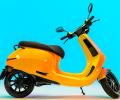
The entry of SoftBank-backed Ola into the electric scooter (e-scooter) segment is set to power up the overall market and perhaps fast-track the adoption of battery-operated vehicles. But for manufacturers of internal combustion engine (ICE)-powered two-wheelers, such as Bajaj Auto, Hero MotoCorp, and TVS Motor, it will be a double whammy. Not only will they have to contend with the aggressive pricing of Ola's scooter and incur a loss at each unit of the e-scooter sold, the volumes of their regular (ICE) models, too, could feel the squeeze, observed analysts. Ola is expected to price its e-scooter in the range of Rs 85,000-1.1 lakh.
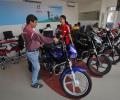
India's largest two-wheeler maker by volume - Hero MotoCorp (Hero) - posted a better-than-expected operating performance in the January-March (fourth quarter, or Q4) quarter of 2022-23 (FY23). Riding on higher average selling prices which were up 5 per cent year-on-year (YoY) and volume growth of 7 per cent, the company registered a 12 per cent growth in revenue to Rs 8,306 crore. The company sold 127,000 units in the quarter, largely driven by domestic sales which were up 11.6 per cent, while exports saw a sharp fall of 57 per cent over the year-ago quarter.

The National Stock Exchange (NSE) Nifty Next 50 Index could undergo large-scale changes if the proposed tweaks to its computation methodology get implemented. In a discussion paper floated recently, NSE Indices, which owns and manages a portfolio of over 350 indices under the Nifty brand, proposed that only stocks that are traded in the futures and options (F&O) segment can be part of the index. Currently, as many as 11 non-F&O stocks are part of the Nifty Next 50 Index, which, as the name suggests, represents the next rung of large and liquid securities after the Nifty50.
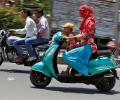
After lagging behind other segments in the automotive (auto) space over the past few years, two-wheelers are expected to reverse their volume underperformance. After witnessing a 36.3 per cent volume decline over the 2018-19 (FY19) through 2021-22 (FY22) periods, the sector staged a recovery in 2022-23 (FY23), with volumes rising 17 per cent. While volumes are still a quarter lower than the FY19 peak of 21 million units, a double-digit growth trajectory is expected to prolong.

Indian consumers are likely to get respite from rising prices just before the festival season. Some consumer companies, including automakers, have indicated that they are planning to pause price hikes just before demand picks up in August, while keeping a close eye on volatile raw material prices.
Two-wheeler exports from India fell by 17.8 per cent to 3.65 million units in 2022-23 (FY23), according to data released by the Society of Indian Automobile Manufacturers (Siam) on Thursday. This decline is due to a rise in global inflation and the weakening of economies and currencies in key export markets of Africa, Latin America (LatAm), and South Asia. In contrast to FY23, two-wheeler exports from India jumped 35.4 per cent to 4.44 million units in 2021-22 (FY22).

The automobile sector is considered a good indicator of economic health. It has a very long value chain, from primary materials, like metals, glass and plastic, to value-added high-end electronic components, specialised alloys, and software.

A clutch of automakers including Maruti Suzuki, Hero MotoCorp, Mercedes Benz India, Eicher Motors, TVS Motor, and Isuzu Motors India announced they had got the clearance from the governments of the states they operate in to resume operations.

TVS Motor Company on Monday re-launched Flame, a 125cc motorbike, with a single-spark plug ignition system. The move comes in the wake of the Madras High Court restraining the country's third largest two-wheeler maker from making and selling Flame for using the controversial twin-spark plug system.

Even as India overtakes Japan in automotive sales in 2022, moving to third place for the first time, oddly enough the country's biggest motor show is going to see some big hitters give it a clear miss. Some prominent automotive brands have cited high event costs, negligible returns on investment, poor event management, and unfavourable location as reasons for their reluctance to participate. Major pure-play electric two-wheelers, too, are riding past this year's edition of the Auto Expo.

Honda Motorcycle and Scooter India (HMSI), India's second-largest two-wheeler maker, on Wednesday revealed its electric vehicle (EV) roadmap, which includes setting up a dedicated EV factory, launching the first two EVs in 2023-24, and establishing 6,000 battery exchange points in the country. HMSI plans to establish a specialised unit for the manufacturing of electric vehicles (EVs), named 'Factory E', at its Narsapura plant located in Karnataka. Factory E will be created by converting an existing production line that currently manufactures internal combustion engine (ICE) vehicles, said Atsushi Ogata, HMSI managing director and chief executive officer.
Domestic passenger vehicle (PV) sales saw a significant growth in October due to increased availability of semiconductor chips and rising consumer confidence. The sales figures during the month - which coincided with the first post-Covid festival season - released by the top ten carmakers saw a jump of 30.7 per cent to 322,885 units in October. Auto companies count wholesales - units dispatched to dealers - as sales.
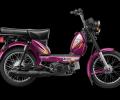
TVS Motor Company, the only company in India to manufacture mopeds, said domestic sales dropped by 25.58% in April-Oct and exports fell by nearly 40%.

As macroeconomic numbers continue to disappoint, reaching pre-Covid level is unlikely in FY21.

Various corporate houses and banks including TVS Motors, India Cements, Hyundai Motor India Limited and State Bank of India on Tuesday contributed a total of Rs 22 crore.
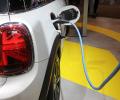
Electric vehicle retail sales in the country witnessed over three-fold jump last fiscal with two-wheeler offtake leading the segment, according to data compiled by automobile dealers' body FADA. Total electric vehicle (EV) retails reached 4,29,217 units in 2021-22, a rise of three-fold from 1,34,821 units in the financial year 2020-21, the industry body said. Total EV sales had stood at 1,68,300 units in the 2019-20 fiscal, it noted.
With this new product, TVS Motors intends to bridge the price gap between the company's range of mopeds and motorcycles.
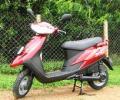
The company is currently carrying out test runs of about 50 electric scooters across various towns in the country.

TVS Motor Company plans to ramp up its manufacturing facility at Hosur in Tamil Nadu as part of meeting "huge" demand for its scooterette Wego. The company had showcased the scooterette in November 2009.
low-cost plans dovetail perfectly with the company's decision to make affordable new models.

With much sadness, so many of us woke up to the news that Vikram Kirloskar, vice-chairperson of Toyota Kirloskar Motor, had passed away late Tuesday. As I reminisce on the nearly 40 years I have known him, I can unequivocally say that he had such a rare and deep understanding and passion for automotive manufacturing that it would make Toyota, which pioneered the Toyota Way, proud. Many of us know Vikram as the man who brought the iconic Japanese carmaker Toyota to India. But few know the back story and hard work that went into creating a system of manufacturing that was everything Toyota could have hoped for and then some more because it was perfectly calibrated for manufacturing in India.
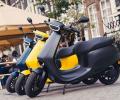
Electric two-wheelers have zipped past the half-a-million registration mark and achieved a market penetration of 4 per cent at the fag end of Calendar 2022, according to data released by VAHAN. According to VAHAN data for the year (until December 27), 560,000 two-wheelers were registered in the country, up a staggering fourfold over 2021, when only 136,000 were registered, and when electric vehicle penetration was a mere 1.05 per cent. The total number of two-wheelers (internal combustion engine, or ICE, and electric) registered so far in 2022 stands at 14.5 million, up only 12.7 per cent over the previous calendar year.

Ola Electric's technology team is working hard to iron out the technical kinks that marred the electric vehicle company's hyped online sale of its electric scooters (e-scooters) - the S1 and the S1 Pro - on Wednesday, said company sources. The SoftBank-backed firm is facing technical difficulties in making the website live for the purchase of its e-scooters. According to company sources, the website couldn't go live as there were integration issues.
The bench consisting of acting Chief Justice of Madras High Court S J Mukhopadhyaya and Justice Ibrahim Kalifula on Monday set aside the earlier order according to which TVS Motors was restrained from using the twin spark technology, which was patented by Pune-based, India's second largest two wheeler manufacturer Bajaj Auto.

The company, which started export of its three-wheelers a couple of months back, is also exploring to venture into new markets like Bangladesh, Mexico, Peru and Guatemala.

At Prestige Polygon Towers in Chennai's Teynampet, hectic preparations are on for a mega global investors' meet under the aegis of Guidance Tamil Nadu (the state investment promotion agency) scheduled for January 2024. Asked about the key focus areas of the meet, the agency's managing director and chief executive officer, V Vishnu, said the state was betting big on electric mobility. This is no surprise, given that the state has signed electric vehicle (EV)-related memorandums of understanding (MoUs) with several companies in the recent past that may bring in investments worth around Rs 33,000 crore with the potential to create over 43,000 job opportunities.
The new bike -- Flame SR 125 -- would be an advanced version of its existing model Flame, which has single spark CCVTi engine. Meanwhile, sources said Flame SR 125 would be available in showrooms from next week.
Upon completion, the factory will create almost 10,000 jobs and will initially have an annual capacity of 2 million units.

Mopeds are sought by people with smaller businesses, with their weight-carrying and haulage ability beside being lighter and easy to manoeuvre in traffic.

TVS should be prepared for a rough ride as Bajaj Dominar, Mahindra Mojo, Royal Enfield Classic 350 and many others are stepping on the gas for a slice of this category.
TVS Motors is exploring LPG and CNG enabled two wheelers. It is also ready to launch electric scooters.
The alternative fuel fever has caught up with Chennai-based TVS Motor Company, synonymous with 'TVS Scooty'. Having entered the electric scooter segment, the company is exploring LPG and CNG two wheelers.

Industry leaders, including Mahindra Group chairman Anand Mahindra, RPG Enterprises chairman Harsh Goenka and Biocon Ltd chairperson Kiran Mazumdar-Shaw on Monday came out in support of the Agnipath scheme, saying it has large potential for employment of youth in the corporate sector. Mahindra also expressed dismay over the violence against the scheme while asserting that the farm equipment to aerospace conglomerate welcomes the opportunity to recruit trained, capable and young people under the programme. The Agnipath scheme, announced on June 14, provides for the recruitment of youths between the age bracket of 17-and-half years to 21 for only four years with a provision to retain 25 per cent of them for 15 more years.
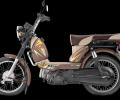
The prices will be decided during the time of launch, as TVS hopes that given the cost increase, the government may consider bringing down GST for two-wheelers.
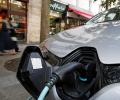
Automobile manufacturers, new and old, as well as ancillary suppliers are set to spend a combined Rs 70,630 crore over the next five years on either entering the electric vehicle segment or stepping up their presence in it. Data culled from announcements made by firms shows India, the world's fifth largest automobile market, is poised to receive one of the biggest capex pushes ever to fuel the transition from internal combustion engines to electric motors and batteries as part of a green drive. The EV push, egged on by the government's emphasis on electric mobility to meet its net zero targets, is expected to yield at least 25 electric vehicles - new ones as well as electrified versions of existing vehicles running on internal combustion engines.
The fight between TVS and Bajaj might remain out of court, but TVS Motor's stand spoke of the company's resolve infused by its chairman Venu Srinivasan.
 © 2026 Rediff.com - Advertise with us - Disclaimer - Privacy Policy - Sitemap - Feedback - About us - Terms of use - Grievances