
Indian equity benchmark indices Sensex and Nifty tumbled over 1 per cent for the third consecutive day, driven by a sharp rally in crude oil prices, massive selling in IT stocks, and unabated foreign fund outflows amid ongoing geopolitical tensions in the Middle East.

Stock markets rebounded on Friday with the benchmark Sensex closing higher by 316 points after heavy buying in banking and metal shares amid optimism over trade deal progresses and India's participation in Pax Silica.
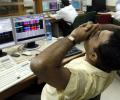
Indian benchmark equity indices Sensex and Nifty experienced a significant crash in early trade, triggered by a sharp increase in crude oil prices and escalating tensions in the Middle East.

The BSE Sensex plummeted 1,236 points, wiping out nearly Rs 7 lakh crore in investor wealth, driven by escalating tensions between the US and Iran and subsequent market selloff.

The latest spike in the Vix is a sign that investors are visibly rattled by global developments and fear a further drawdown in stock prices, experts said.

Under its new chairman Tuhin Kanta Pandey, the Securities and Exchange Board of India (Sebi) has gravitated towards greater transparency and ease of doing business, setting an objective of "effective and optimum" regulation. On Monday, during its first board meeting under Pandey, the regulator has decided to constitute a high-level committee (HLC) to review conflicts of interest and unveiled initiatives to simplify regulatory processes.

'Market corrections are a natural part of investing, so it's essential to remain focused on long-term financial goals.'

'Despite the current uncertainties, the long-term outlook remains constructive due to strong fundamentals, government initiatives, and a stable banking sector.'

'It is advisable to stay away from the markets for now and buy only on a dip.'

Investors' wealth jumped Rs 13.78 lakh crore on Monday as the benchmark equity index Sensex hit its lifetime high after exit polls predicted a massive win for the BJP-led NDA in the Lok Sabha polls. The 30-share BSE Sensex jumped 2,777.58 points or 3.75 per cent to hit a record peak of 76,738.89 in early trade. The benchmark finally ended at 76,468.78, registering a sharp rally of 2,507.47 points or 3.39 per cent.

Market chatter suggests that the BJP could win fewer than 300.

'Investors need to be stock specific and should not rush to buy stocks at the current levels.'

'We emphasise the importance of not basing investment decisions solely on electoral outcomes.' 'Instead, focusing on investing in high-quality businesses capable of prospering regardless of the political landscape is paramount.'

Sundararaman Ramamurthy has been an interesting choice for the publicly-listed BSE, which has seen its chief move to bigger rival -- the National Stock Exchange (NSE) -- in July. Having spent nearly two decades at the country's largest bourse, Ramamurthy is among the early architects of NSE and understands all the cogs of the exchange wheel like only a few others in the country. Just like NSE's core team, which includes its founder RH Patil, the 59-year-old Ramamurthy has worked at the Industrial Development Bank of India (IDBI) before moving to NSE in 1995.
The government may have to rework the valuation of Life Insurance Corporation of India (LIC) for its initial public offering (IPO) if the listing is pushed beyond May, an official said. The current embedded value of LIC, pegged at Rs 5.4 trillion as of September 30 and for the six-month period ended September, will have to be re-evaluated if the issue is pushed beyond May 12, as approved by the Securities and Exchange Board of India (Sebi). This would impact the market value of LIC, that is currently being internally estimated at 3-4 times of the embedded value.

Markets ended at fresh all-time closing highs, led by aggresive buying in capital goods and bank shares.

The volume of shares traded in the stock market had fallen 28 per cent in April. Turnover, or the value of securities changing hands, fell 12.6 per cent. This trend of falling volumes seems to have stabilised in May.

According to a report by BofA-ML, capital markets are 'usually jittery prior to the declaration of election results as it is uncertain about the outcome'.

Nifty advanced 46 points, at 5,833.

Other markets in Asia also ended in higher except Japan which closed flat due to uncertainty over the nuclear plant and economic recovery.

National Stock Exchange on Monday announced the launch of India VIX, a volatility index being disseminated on a real-time basis for the first time.

A majority of economists predicted RBI Governor Raghuram Rajan would leave policy rates unchanged on Tuesday and expected a dovish commentary, as crude oil prices and inflation cool off.

After the Franklin Templeton episode, investor confidence has been shaken. Known brands have become more relevant to investors, as long as this psychological impact lasts.

Both indices are down nearly 9 per cent from their all-time highs in mid-January. A sharp reversal seems difficult this time as the peak impact of the virus is yet to play out.

'People always short-change the resilience of the economy.'
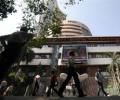
The bias for the Sensex is likely to remain bearish as long as the index sustains below 18,900-odd levels. On the downside, the index could slide to 17,300-odd levels

Major global indices like CAC 40, DAX Shanghai Composite, Hang Seng, Nikkei, Straits Times, Sensex, Nifty have lost 1% - 10% in a week

Running a SIP plan for more than six years almost completely eliminates the chances of earning negative returns.

If you ignore market upheavals and stay the course, you end up making money, says Larissa Fernand

Pharma major Lupin and mortgage lender HDFC were the top losers.

Several Sensex stocks hits 52-week low in intra-day trade on Monday with financials leading the decline.
 © 2026 Rediff.com - Advertise with us - Disclaimer - Privacy Policy - Sitemap - Feedback - About us - Terms of use - Grievances