
If India counts itself as a 'great power', it will have to play a role in framing and enforcing new global rules, says T N Ninan.

India should not allow millions to suffer the ill effects of a drought because of official apathy or sluggishness, says T N Ninan.

Mamata should travel to China to see how the Chinese railway system is expanding, says T N Ninan.

The RBI's mistake may have been in interpreting its mandate to maintain retail inflation at 4%, with 2% leeway in either direction, as being a mandate that permitted it to do nothing even when inflation was at or near the upper bound of 6%, observes T N Ninan.

Do the Thackerays really believe that Mumbai will not lose jobs if banks and companies lose the freedom to hire whom they choose.

The time may have come for India to stop thinking of five-year plans, and to focus instead on 10-and 20-year scenarios.

'The finance minister in her Budget speech should spell out how exactly she intends to get back to the 7% track, and the hard decisions she intends to take in order to adjust to the realities of a slowing economy until growth momentum returns,' suggests T N Ninan.

I am not joining the small minority which still argues that global warming is voodoo science; there is simply too much evidence of ice melting to argue from that standpoint. But I would suggest that there is hope on the global warming front, says T N Ninan.

India's share of world GDP is just 2 per cent, and of global poverty an embarrassing 30 per cent.
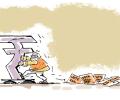
Perhaps the calculation is that economic recovery will have been achieved before the next general election comes around, but such assumptions can come unstuck if current directions are not reversed quickly, cautions T N Ninan.

'When growth drops precipitously from 7% to 4.5% in four quarters, it is for all practical purposes a recession' notes T N Ninan.

So, while it is great that India's numbers look relatively good, don't raise a cheer just yet, points out T N Ninan.

Pranab Mukherjee will have to stay lucky if he is to climb the big mountain that lies ahead.

There is a strong state-wise dimension to India's poverty question, and the first answers have to come from the governments of the concerned states.

Since jobs will remain scarce for the foreseeable future, an unemployment allowance should be the next big social-security initiative, suggests T N Ninan.

When turbans are allowed on school and college campuses, or sacred ash on the forehead, can one ban the hijab? asks T N Ninan.

For the group's top firms, return on net worth is now 27 per cent, compared with 17 a decade ago.

That such a deal can be greeted with celebration in the camps of both buyer and seller speaks volumes about the airline and its recent history, explains T N Ninan.
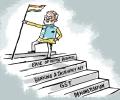
Three-quarters into the 10 years that Mr Modi had sought for transforming India, the 'output' numbers look impressive, but the key 'outcome' numbers don't show up much, if at all, observes T N Ninan.

It's hard to say because of the winner-take-all nature of new platform and network businesses, but Reliance has not been an efficient user of capital, and Adani numbers are varied, observes T N Ninan.

Modi's critics will say that he has put up cement and steel structures, but weakened the institutions of governance whereas Nehru strengthened them, observes T N Ninan.

You will need a sharper eye for stock picking and a greater appetite for risk than most retail investors possess, recommends T N Ninan.

There are two ways: Deliver a rapidly growing economic pie or reform GST and close corporate tax loopholes, suggests T N Ninan.

In a country that is often focused on the ways in which it falls short, the start of a year is a good time to remind oneself of such positives, observes T N Ninan.

There are instances -- both from national and state elections -- of economic under-performers being returned to power, and also of parties being thrown out despite good performance, observes T N Ninan.

China's debt is dangerously high at close to three times its GDP, with the ratio having nearly doubled in recent years, observes T N Ninan.

Should we not stop uncritically celebrating NRIs' elevation without regard to what kind of companies they are getting to run, and the nature of their products or business practices, asks T N Ninan.

The money stashed away in tax havens is estimated at between $5.6 trillion and $32 trillion, numbers to make your eyes pop, asserts T N Ninan.

If India is to urbanise successfully, it has to focus on Tier 2 cities with a population of one-five million, observes T N Ninan.

The government's programmes should be expected to generate some momentum, but the macro-economic numbers are not encouraging, observes T N Ninan.

The government has to focus on real solutions, not make a mockery of the crisis through 'vaccine festivals',' asserts T N Ninan.

Anyone within range of China's expanding navy will have to build capabilities faster and/or work more closely with the US, as Australia has just announced, asserts T N Ninan.

India is a market for low-priced cars with low running costs. The global majors don't have models that fit the bill; only Maruti and Hyundai have successful entry-level models, observes T N Ninan.

Economic performance is affected if large numbers of people are out of work, or at such low levels of income as to force under-consumption, observes T N Ninan.

The ineptness of successive American presidents, from Bush the Younger to Joe Biden the Old, combined with the cluelessness that Americans demonstrate in foreign lands, contrasts with the Chinese leadership's seemingly singular focus on the accumulation of wealth and power, asserts T N Ninan.

Nirmala Sitharaman is proving to be a better finance minister than her initial rookie status might have led people to expect, observes T N Ninan.

The Indian State's arbitrariness may have come to be accepted with resignation within the country, but when it behaves in the same manner with external players, it gets a push-back, observes T N Ninan.

While Nifty 50 reflects changes in 40 years, it also shows what is missing: Low-cost manufacturers at one end, and deep-value players at the other. Also missing are technology players, observes T N Ninan.

Based on whether you choose the aviation, Bhopal or LIC numbers, and on the official death toll (in the absence of any other verifiable number), the value of human lives lost in the pandemic would range from Rs 16,500 crore to Rs 94,000 crore, explains T N Ninan.

If the real estate sector is properly managed, it could drive not just finance but demand for a range of products and services, observes T N Ninan.
