Reserve Bank Governor Shaktikanta Das will hold a meeting with CEOs of public sector banks on Wednesday to discuss issues concerning slow deposit growth and sustainability of high credit demand. As per the Reserve Bank of India (RBI) data, deposits rose by 9.6 per cent as compared to 10.2 per cent on a year-on-year basis, while credit offtake witnessed a jump of 17.9 per cent as against 6.5 per cent a year ago. According to an agenda circulated for the meeting, sources said, sustainability, including pricing and slow growth of deposits, would be discussed.
Reserve Bank Governor Shaktikanta Das said on Monday that fair and impartial auditing is essential for a resilient economy as it instils confidence among citizens. Addressing officers at the National Academy of Audit and Accounts, Das said that audit is important for the country as public expenditure decisions are based on these reports. Observing that there is a need to improve the quality and depth of audit, he said the Reserve Bank has taken a host of steps in consultation with the Institute of Chartered Accountants of India (ICAI) for improving the audit of banks and financial institutions.

The Reserve Bank of India on Thursday kept the benchmark interest rate unchanged at 4 per cent and decided to continue with its accommodative stance against the backdrop of an elevated level of inflation.
The Reserve Bank of India's rate-setting panel will go for a 0.35 per cent hike in the key repo rate at its meeting next week, an American brokerage said on Wednesday. The hike will be accompanied by a change in the policy stance to "calibrated tightening", Bofa Securities said in a report published ahead of the Monetary Policy Committee (MPC) resolution which is set to be announced on August 5. RBI has hiked the rate by a cumulative 0.90 per cent in two tightening moves in May and June, responding to the runaway headline inflation which has consistently overshot the upper end of the target set for the central bank for many months.

Inflation to peak in the current quarter within tolerance band, moderating in the second half of next fiscal, says central bank.

The country's foreign exchange reserves declined by $7.541 billion to $572.712 billion in the week ended July 15 as the Reserve Bank continued to intervene in the market to curb the fall of the rupee. In the previous week ended July 8, the reserves shrunk by $8.06 billion to $580.25 billion, the Reserve Bank of India (RBI) data showed on Friday. On Friday, the rupee fell by 5 paise to close at 79.90 against the US dollar.

"We will raise Rs 300 crore via bonds of two-, three- and five-year tenures. This will be our maiden bond issuance and is part of our effort to widen funding sources," says Vimal Bhandari, executive vice-chairman and chief executive officer (CEO), Arka Fincap. The firm, a subsidiary of Kirloskar Oil, is only five years old and small (assets of around Rs 5,000 crore with an "AA" rating), but the response to this float will be closely watched: It would be the first by a non-banking finance company (NBFC) after Mint Road upped the risk weights on bank exposures to them by 25 percentage points. The move by the Reserve Bank of India (RBI) has caught NBFCs off guard even though the issue had been flagged by Governor Shaktikanta Das with their corner-room occupants (and that of banks) in July and August 2023 - on consumer credit and the dependency on bank borrowings.
The RBI raked in a massive net income gain from foreign exchange currency sales as a buffer for the rupee during tumultuous geopolitical upheavals last year owing to Russia's invasion of Ukraine.

The Reserve Bank has found gaps in banks' corporate governance despite issuing guidelines on the matter, Governor Shaktikanta Das said on Monday. Addressing directors of bank boards, Das said such gaps, which have been mitigated, could have caused "some degree of volatility". He also hit out strongly against "smart accounting" to conceal stress and bloat financial performance.

While the fiscal year has just begun, any windfall surplus will be welcomed by the government as it bids to meet the fiscal deficit target of 5.9 per cent of GDP, amidst lack of clarity on exactly to what extent will recession in the West impact India's trade and tax collections.

In the June quarter of FY24, 51 per cent of consumers who took small-ticket personal loans already had more than four credit products at the time of accessing yet another new loan, compared with just 17 per cent in the June quarter of FY20, points out Tamal Bandyopadhyay.

Reserve Bank Governor Shaktikanta Das on Wednesday said in the wake of appreciating US dollar, the movement of rupee has remained least disruptive as compared to its peers, and the size of foreign exchange reserve is comfortable. On a financial year basis (from April to October 2022), the rupee has appreciated by 3.2 per cent in real terms, even as several major currencies have depreciated, he said while announcing the latest set of bi-monthly monetary policy. "The story of the rupee has been one of India's resilience and stability," the Governor said while pointing out that the appreciation of the US dollar this year, which precipitated large-scale depreciation of all major global currencies including the Indian rupee, has drawn wide attention.

She said I treated her like a bachchi. At another moment, she said I had gone to various people and 'bitched' about her. She also threatened to bring the entire matter to the PM's notice. A revealing excerpt from Subhash Chandra Garg's We Also Make Policy: An Insider's Account of How the Finance Ministry Functions.

In its scheme of things, tackling inflation now comes ahead of ensuring growth in the world's sixth largest economy, points out Tamal Bandyopadhyay.

RBI Governor Shaktikanta Das said that early containment of the pandemic could impart an "upside" to the economic growth outlook.

Reserve Bank of India on Thursday said a centralised portal would be ready in three to four months wherein depositors and beneficiaries can access details of unclaimed deposits across various banks. As of February this year, about Rs 35,000 crore of unclaimed deposits were transferred to RBI by public sector banks in respect of deposits which were not operated for 10 years or more. "In order to improve and widen the access of depositors/beneficiaries to such data, RBI has decided to develop a web portal to enable search across multiple banks for possible unclaimed deposits based on user inputs," RBI Governor Shaktikanta Das said while announcing the first bi-monthly monetary policy for the current financial year.

Reserve Bank of India (RBI) on Wednesday upped inflation projection for the current fiscal to 6.7 per cent from 5.7 per cent forecast in April. RBI Governor Shaktikanta Das said the upside risk to inflation persists and the recent spike in tomato prices would fuel food inflation. Also, high global crude oil prices would add to the upside pressure on inflation. The upward revision in inflation projection comes as domestic retail inflation has remained above RBI's comfort level of 6 per cent for four months in a row, mainly due to the Russia-Ukraine war which has impacted the prices of commodities across the globe.
Reserve Bank Governor Shaktikanta Das on Friday said the rupee is holding up relatively well when compared to the currencies of emerging market peers and advanced economies. Days after the domestic currency breached the 80-level against the dollar, Das said Reserve Bank of India (RBI) has zero tolerance for volatile and bumpy movement in the rupee and added that the central bank actions have helped in smoother movement. He said RBI has been supplying US dollars to the market to ensure adequate supply of liquidity and also clarified that the central bank does not target a particular level for the currency.

The Reserve Bank on Wednesday allowed inbound travellers from G20 nations arriving at select airports to use the popular UPI for making payments in the country. Later, the RBI also proposes to extend the Unified Payments Interface (UPI) facility to travellers from all countries. UPI is a system that powers multiple bank accounts into a single mobile application, merging several banking features, seamless fund routing & merchant payments into one hood.

Small queues were witnessed at some bank branches on Tuesday for the exchange of Rs 2,000 notes against smaller denominations as part of the withdrawal exercise. As per the RBI guidelines issued on Friday, the exchange of Rs 2,000 facility is available from Tuesday. A person can exchange up to a limit of Rs 20,000 at a time without filling any form or requisition slip.
Though the economy has steadily gained momentum and remained resilient since the second quarter of the current fiscal, the Omicron variant of coronavirus remains the major challenge along with rising inflation pressures, says the Reserve Bank in its second financial stability report. In the foreword to the report released on Wednesday, RBI Governor Shaktikanta Das notes that after the destructive second wave in April-May 2021, the growth outlook has progressively improved, though there are headwinds from global developments and more recently from the Omicron virus. A stronger and sustainable recovery hinges on the revival of private investment and shoring up private consumption, which unfortunately still remain below their pre-pandemic levels, he notes.

In order to further enhance customer convenience, and to leverage the 24x7 availability of real-time gross settlement (RTGS), NACH which is currently available on bank working days, is proposed to be made available on all days of the week effective from August 1, 2021, RBI's Shaktikanta Das said.

In FY23, the State Bank of India (SBI) reported a 57.4 per cent jump in its net profit to Rs 55,684.17 crore. But the chairman of the country's largest bank, Dinesh Khara's annual pay for this creditable performance was just Rs 37 lakh (his peers at state-run banks are no better off). Look at his private bank rivals - most pocketed in excess of Rs 7 crore annually - plus stock options.
Reserve Bank of India governor Shaktikanta Das on Monday said payments through UPI (unified payment interface) have grown exponentially in the past 12 months with daily transactions crossing 36 crore, which is up 50 per cent from 24 crore in February 2022. In value terms, these transactions are worth Rs 6.27 lakh crore, registering a growth of 17 per cent from Rs 5.36 lakh crore in February 2022, the governor told reporters while launching the Digital Payments Awareness Week at the RBI headquarters in Mumbai this afternoon. He also said the overall monthly digital payment transactions crossed over Rs 1,000-crore-mark each month during the past three months.
Chief Economic Advisor V Anantha Nageswaran on Thursday expressed hope that the economy will maintain the trend growth rate of 6.5 per cent and above for the rest of the years in the current decade. The economy will close the current fiscal logging in a growth of 6.5-7 per cent, he said, citing the projections of private sector analysts, Reserve Bank of India (RBI) and international agencies like OECD and the IMF. "This appears to be reasonable at this point in time although we will get the data on the fiscal second quarter in a few days, which will give more clarity on these numbers.
Government's focus on infrastructure is the biggest positive for the Indian economy, followed by the improvement in tax collections and good consumption recovery.
Reserve Bank will have to constantly re-assess the "dynamic and fast changing situation" and tailor its actions accordingly, Governor Shaktikanta Das said during the recent meeting of the Monetary Policy Committee (MPC) which decided to maintain status quo on key interest rate. According to the minutes of the six-member MPC meet released by Reserve Bank of India (RBI) on Friday, the five other members had also expressed a similar opinion amid the ongoing Russia-Ukraine conflict's impact on the global and domestic economies. MPC, which held its meeting from April 6-8, unanimously decided to keep the borrowing costs unchanged at a record low for the 11th time in a row in a bid to continue supporting economic growth despite inflation edging higher in the aftermath of Russia-Ukraine conflict.

Among the Sensex firms, Bajaj Finance emerged as the biggest gainer by climbing 2.95 per cent. Tata Motors, Bajaj Finserv, IndusInd Bank, Sun Pharma, Mahindra & Mahindra, State Bank of India, Larsen & Toubro, HDFC, HDFC Bank, Maruti, Reliance Industries and Bharti Airtel were the other major winners. HCL Technologies, Axis Bank, ICICI Bank, Tech Mahindra and Titan were among the laggards.

Enthused by higher than expected GDP numbers in the fourth quarter of 2022-23, Chief Economic Adviser (CEA) V Anantha Nageswaran on Wednesday said India's economic growth may exceed the initial estimate of 6.5 per cent in the current fiscal and the country can look for another year of solid economic performance.

'There are occasions when the prices of individual items like food raise inflation; then supply-side measures must be taken.' 'But if there is continued inflation, it means liquidity is aggravating the situation.'
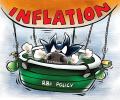
The Reserve Bank of India on Friday raised the retail inflation target for the current financial year to 5.7 per cent on the back of rising global prices amidst the ongoing geo-political tensions, even as it expected the prices of cereals and pulses to soften on prospects of good winter crop harvest. "Global food prices along with metal prices have hardened significantly. "Economy is grappling with a sharp rise in inflation... Inflation is now projected at 5.7 per cent in 2022-23 with Q1 at 6.3 per cent; Q2 at 5 per cent; Q3 at 5.4 per cent and Q4 at 5.1 per cent," RBI Governor Shaktikanta Das said while unveiling the first monetary policy review for the current fiscal year.
Monetary Policy Committee keeps key interest rate (repo) unchanged at 4% for 7th consecutive time; Consequently, reverse repo rate too remains unchanged at 3.35%; Bank rate also remains same at 4.25%;
Higher for longer' may be the narrative in the developed markets, but interest rates might not stay high for very long in India, with a section of the market expecting rate cuts to begin this year. The six-member Monetary Policy Committee of Reserve Bank of India (RBI) decided to keep interest rates unchanged at 6.5 per cent in the April review - after hiking the policy repo rate in six previous meetings. RBI Governor Shaktikanta Das emphasised that the pause was only for the April policy and that the central bank was ready to act if the situation demanded.

Ahead of the 2023-24 Union Budget, the thinking at the top level of the central government is clear: Gross domestic product (GDP) growth of 6-6.5 per cent is a comfortable enough target for FY24 and the focus should be on fiscal consolidation to ensure that the sovereign cost of borrowing does not become prohibitively expensive in a high-interest rate environment, according to people in the know. Those aware of deliberations between the Prime Minister's Office (PMO) and the Ministry of Finance said while the Budget would look to strike a balance between infrastructure investment and welfare schemes, it is unlikely to be populist, though it will be the last full-year Budget before the 2024 Lok Sabha election. Incidentally, 6-6.5 per cent GDP growth is what the upcoming 2022-23 Economic Survey is expected to project for FY24.
The Reserve Bank on Wednesday increased the benchmark lending rate by 40 basis points (bps) to 4.40 per cent in a bid to contain inflation, which has remained stubbornly above the target zone of 6 per cent for the last three months. The decision follows an unscheduled meeting of the Monetary Policy Committee (MPC), with all six members unanimously voting for a rate hike while maintaining the accommodative stance. While the inflation has remained above the targetted 6 per cent since January, RBI Governor Shaktikanta Das said the inflation print in April is also likely to be high.
The Reserve Bank of India's rate-setting panel on Wednesday began its three-day deliberations on the next bi-monthly monetary policy amid expectations of at least a 35-basis-point hike in the interest rate to check high inflation. If raised, it will be the third consecutive hike in the repo rate -- the short-term rate at which the RBI lends money to banks. The central bank has already announced to gradually withdraw its accommodative monetary policy stance.
The Reserve Bank of India (RBI) on Wednesday raised the benchmark lending rate by 35 basis points to 6.25 per cent in a bid to tame inflation, which has remained above its tolerance level for the past 11 months. With the latest hike, the repo rate or the short-term lending rate at which banks borrow from the central bank now has crossed 6 per cent. This is the fifth consecutive rate hike after a 40 basis points increase in May and 50 basis points hike each in June, August and September.

As the RBI moves ahead for the launch of the central bank digital currency (CBDC), Governor Shaktikanta Das on Wednesday marked out cyber security and digital frauds as the main challenges in the new system. Deputy Governor T Rabi Sankar said there are two types of CBDCs - wholesale and retail - and a lot of work has happened in the former while the latter was termed as a "complicated" aspect which will take time. The RBI had earlier this year announced that it has started work on the CBDC, in line with other major central banks of the world which are looking at a fiat digital currency.
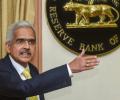
Financial markets are under stress and require steps by the central bank for market stability and revival of economic growth, he said while announcing the decisions taken by the Monetary Policy Committee in Mumbai.

The RBI has doubled the limit of maximum balance that an individual customer can hold with payments banks to Rs 2 lakh from Rs 1 lakh earlier with immediate effect to expand the ability of such lenders to cater to the needs of MSMEs and other businesses.
 © 2026 Rediff.com - Investor Information - Advertise with us - Disclaimer - Privacy Policy - Sitemap - Feedback - About us - Terms of use - Grievances