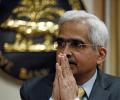
RBI Governor Shaktikanta Das on Friday said the government and the central bank are in discussion with South Asian countries to have cross-border trade in rupee. He also said the central bank digital currency (CBDC) is in trial phase and the RBI is moving very carefully and cautiously on digital rupee launch. After the successful launch of the wholesale pilot, the Reserve Bank of India (RBI) on December 1, last year, began its retail CBDC pilot project.

The Reserve Bank of India on Wednesday expectedly left interest rates unchanged and maintained an accommodative stance as the economy faces a renewed threat to growth due to the resurgence of coronavirus cases.

UCO Bank, Bank of Maharashtra, Bank of India, Indian Overseas Bank, Indian Bank, and Central Bank of India don't have a non-executive chairman.

After raising interest rate by a cumulative 250 basis points in 11 months, the Reserve Bank of India (RBI) on Thursday unexpectedly kept benchmark rate unchanged as global banking woes added uncertainty to the economic outlook. Five out of six members of MPC voted to remain focused on the withdrawal of accommodation to ensure inflation aligns with target while focusing on growth, RBI Governor Shaktikanta Das said on Thursday. The Monetary Policy Committee of the central bank decided to take a pause after a rate hike seen in previous six consecutive policies.

The RBI Board on Friday approved the transfer of Rs 57,128 crore as surplus to the central government for the accounting year 2019-20, the central bank said in a statement.

Vegetable rates may ease from September, led by tomato prices, which have started showing signs of correction on the back of increased supply, Reserve Bank of India (RBI) Governor Shaktikanta Das said on Wednesday. "Looking ahead, the spike in vegetable prices in July is starting to see a correction, led by tomato prices. "New arrivals of tomatoes in mandis are already softening the prices, coupled with proactive supply management in the case of onions.

The finance ministry has cautioned that global and regional uncertainties and domestic disruptions may keep inflationary pressures elevated in the coming months, warranting "greater vigilance" by the government and the Reserve Bank of India (RBI). "Russia's decision to terminate the Black Sea grain deal, along with dry conditions in major wheat-growing areas, caused a price spike in cereals. Domestic factors like white fly disease and an uneven distribution of monsoon exerted pressure on vegetable prices in India," the ministry said in its latest Monthly Economic Report for July, released on Tuesday. However, the report maintained, the recent price surge in certain food items "is expected to be transitory". "Tomato prices are likely to decline with the arrival of fresh stocks by the end of August or early September.

Retail inflation jumped to a 15-month high of 7.44 per cent in July as prices of vegetables and other food items spiked, according to official data released on Monday. The Consumer Price Index (CPI) based inflation was at 4.87 in June and 6.71 per cent in July 2022. Previously, high inflation was recorded at 7.79 per cent in April 2022.
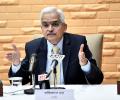
Key lending rate (repo) raised by 50 basis points to 4.9 per cent; 2nd increase in 5 weeks

Finance Minister Nirmala Sitharaman on Tuesday asked banks and other financial institutions to ensure that their customers must update nominees to help resolve the problem of unclaimed money in future. "I want the banking system, the financial ecosystem including the mutual funds, stock markets to keep in mind that when someone deals with his (customer's) money, the organisations will have to think about the future and ensure that customers nominate their heirs, give the name and address," Sitharaman said speaking at the Global Fintech Fest (GFF) in Mumbai. According to a report, the banking system alone has more than Rs 35,000 crore of unclaimed deposits, while the overall quantum of the unclaimed money is said to be more than Rs 1 lakh crore.

Reserve Bank of India Governor Shaktikanta Das on Friday said the country's economy is an island of stability despite two Black Swan events and multiple shocks. "In an ocean of high turbulence and uncertainty, Indian economy is an island of macroeconomic and financial stability," Das told reporters during the post policy press conference. He said the financial stability, macroeconomic stability and resilience of growth is being witnessed despite two Black Swan events happening one after the other and multiple shocks.

Growing up in the Mumbai of 1970s, Uday Kotak aspired to be a cricketer and trained under legendary coach Ramakant Aachrekar. However, it was an on-field injury which resulted in a shift to finance. He started off with bill discounting, turned to lending and successfully applied to start a universal bank in the first decade of the millennium, as India was warming up to private play in banking.

Reserve Bank Governor Shaktikanta Das on Wednesday said that RBI is monitoring the situation regularly with regard to the withdrawal of Rs 2,000 currency notes and expressed confidence that the entire exercise will be completed in a non-disruptive manner. The Reserve Bank of India (RBI) on Friday announced the withdrawal of Rs 2000 denomination banknotes as part of its currency management and permitted the exchange of Rs 2000 currency notes up to Rs 20,000 in one go from Tuesday onwards. The exchange or deposit window is available until September 30, 2023.
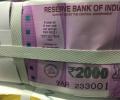
The Reserve Bank on Monday advised banks to provide shade from the sun and water to customers waiting to exchange or deposit Rs 2,000 notes. It can be noted that during the note ban in 2016, there were allegations of customers dying while waiting in queues to exchange bank notes. Following Friday's announcement of withdrawing Rs 2,000 notes -- the notes continue to be legal tender unlike demonetisation exercise -- there were concerns about customers facing inconvenience, especially given the summer being at its peak.
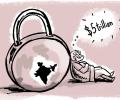
India decisively withstood global headwinds in 2023 and is likely to remain as the world's fastest-growing major economy on the back of growing demand, moderate inflation, stable interest rate regime and robust foreign exchange reserves. Despite widespread pessimism witnessed among the developed nations and the worsening geopolitical situation, India recorded a gross domestic product (GDP) expansion of 6.1 per cent in the March quarter. The growth moved up to 7.8 per cent in the June quarter and was 7.6 per cent in the September quarter. For the first six months of this fiscal, the growth was 7.7 per cent.

'Data-dependence means you can raise or drop rates. The present stance is only for raising rates.'

Kotak Mahindra Bank was the biggest loser in the Sensex pack, sliding 2.68 per cent, followed by Tech Mahindra, Mahindra & Mahindra, Axis Bank, Hindustan Unilever, Tata Motors, Tata Consultancy Services, Bajaj Finserv, Bajaj Finance, Nestle and Titan. In contrast, NTPC, Power Grid, Larsen & Toubro, HDFC, Reliance and HDFC Bank were the gainers.

The Reserve Bank on Wednesday allowed credit cards to be linked with the unified payments interface (UPI), which will enable more people to make payments using the popular platform. At present, UPI facilitates transactions by linking savings or current accounts through users' debit cards. "...it is proposed to allow linking of credit cards to UPI," RBI Governor Shaktikanta Das said while announcing the regulatory moves, along with the bi-monthly policy review.

From the Sensex pack, Mahindra & Mahindra, Bajaj Finserv, IndusInd Bank, Tata Motors, Tata Steel, Larsen & Toubro, Axis Bank and NTPC were among the major laggards. UltraTech Cement, Infosys, Asian Paints, Kotak Mahindra Bank, Sun Pharma and Bharti Airtel were the winners.
RBI Governor Shaktikanta Das on Wednesday replied to the 'history major central bank governor' taunt faced by him, questioning if Argentinian football legend Lionel Messi is also a post-graduate in history. An interviewer anchoring a fireside chat at a summit organised by Business Standard compared his position to an opponent facing Messi at a football arena in Qatar, to which Das replied with wit. "Don't mind it, but was Messi also a post-graduate in history? Not often, but I am sometimes reminded by people that I am supposed to have done history," Das said.

Reserve Bank of India (RBI) on Friday said its board has approved a dividend payment of Rs 30,307 crore to the government for the financial ended March 2022. The board approved the transfer of Rs 30,307 crore as surplus to the central government for the accounting year 2021-22 while deciding to maintain the Contingency Risk Buffer at 5.50 per cent, RBI said in a statement. The decision on the dividend payment was made in the 596th meeting of the Central Board of Directors of RBI, headed by Governor Shaktikanta Das, held on Friday.

Between March 2022 and September 2023, HDFC Bank added 56,310 employees.

The Reserve Bank on Thursday said it will come out with a framework allowing borrowers to switch to fixed interest rate from floating interest rate, a move that would provide relief to borrowers of home, auto and other loans reeling under the impact of high interest rate. Unveiling the bi-monthly monetary policy, Reserve Bank Governor Shaktikanta Das said under the framework, to be put in place shortly, the lenders will have to clearly communicate with the borrowers about tenor and EMI. "The supervisory reviews undertaken by the Reserve Bank and the feedback and references from members of public have revealed several instances of unreasonable elongation of tenor of floating rate loans by lenders without proper consent and communication to the borrowers," he said.

Here are the highlights of the monetary policy announced by RBI governor Shaktikanta Das on Friday.

In August, the Reserve Bank of India Governor Shaktikanta Das held a meeting with chief executive officers/ managing directors (CEOs/ MDs) of large non-banking financial corporations (NBFCs). The discussions included diversifying borrowing sources for NBFCs and housing finance companies (HFCs) to contain increasing reliance on bank borrowing, risks associated with high credit growth in retail segment in unsecured loans, prioritising IT upgrades and cyber-security, improving provisioning, monitoring of stressed exposures and slippages, ensuring robust liquidity and asset-liability management, ensuring transparency in pricing, creating robust grievance redress mechanisms.

The Indian rupee, which has depreciated 1.1 per cent so far in August, is expected to decline further on the back of a strengthening US dollar and a weakening Chinese yuan, according to a Business Standard poll of analysts. The Indian rupee hit an all-time low recently, closing at 83.15 per dollar. Five of the 10 respondents said the Indian currency might touch 83.5 per dollar in August itself, while others said the worst could be over.

Has Vijay Shekhar Sharma given up on the bank? For now, he seems to be on a save-OCL mission. The bank will face its logical end, observes Tamal Bandopadhyay.
The Reserve Bank of India has postponed the meeting of its interest rate setting Monetary Policy Committee by a day to August 3 due to administrative exigencies. The RBI said the decision of the MPC will be known on August 5 as against the earlier schedule of August 4. "Due to administrative exigencies, it has been decided to reschedule the MPC meeting from August 2-4, 2022 to August 3-5, 2022," RBI said in a statement on Thursday.
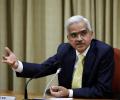
RBI Governor Shaktikanta Das on Wednesday defended the Reserve Bank's handling of the price situation, saying acting prematurely on inflation would have exerted a heavy cost on the economy and citizens. Acknowledging that the inflation target has been missed, Das said the RBI decided to support the economy by not introducing a rate hike in face of a spike in inflation. "We prevented a 'complete collapse of the economy' by keeping rates lower and stayed away from premature tightening," Das said speaking at the annual FIBAC conference of bankers in Mumbai.
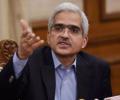
The Reserve Bank of India on Thursday decided to keep policy rate unchanged for third time in a row as it maintains heightened vigil on inflation. The rate increase cycle was paused in April after six consecutive rate hikes aggregating to 250 basis points since May 2022.

The Reserve Bank of India on Wednesday retained its growth projection at 7.2 per cent for the current fiscal on the back of improvement in urban demand and gradual recovery in rural India. Unveiling the third monetary policy for the current fiscal, RBI Governor Shaktikanta Das said the Indian economy remained resilient, and the central bank will continue to support growth. The RBI expects growth in the first quarter of the current fiscal at 16.2 per cent, which will taper to 4 per cent by the fourth quarter.

The highlights of the RBI's fourth monetary policy review of fiscal year 2022-23 announced by Governor Shaktikanta Das.

...why are the government is running away from a Joint Parliamentary Committee
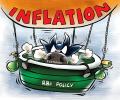
The Reserve Bank on Wednesday projected inflation to come down below the upper threshold level of 6 per cent by March quarter of the current fiscal. RBI Governor Shaktikanta Das said the central bank will keep 'Arjuna's eye' (focus) on the evolving inflation dynamics and will remain 'nimble and flexible' to deal with the price situation. Global commodity prices, including crude oil, have undergone some downward correction, but uncertainty continues to surround the near-term outlook in view of the prolonging geo-political hostilities. Moreover, the resurgence in domestic services sector activity could also lead to price increases, especially as firms pass on input costs.
Following are the highlights of the RBI's first monetary policy statement of 2022-23 unveiled by Governor Shaktikanta Das: Policy repo rate unchanged at 4%; marginal standing facility rate & bank rate too remain unchanged at 4.25%. Monetary stance to be accommodative with focus on withdrawal of accommodation to keep inflation within target. GDP growth projection for FY'23 slashed to 7.2% from 7.8%; growth projections based on assumption of crude oil (Indian basket) price at $100 a barrel during FY'23. Inflation forecast hiked to 5.7% for FY'23 from 4.5%.

The Reserve Bank is likely to maintain status-quo on the key interest rates for the third time in a row in its upcoming bi-monthly policy review despite the US Federal Reserve and the European Central Bank hiking benchmark rates, as domestic inflation is within the RBI's comfort zone, say experts. The borrowing cost which started rising in May last year has stabilised with RBI keeping the repo rate unchanged at 6.5 per cent since February when it was raised from 6.25 per cent. In the previous two bi-monthly policy reviews in April and June the benchmark rate was retained.

For the banking system a new cycle starts in FY2024. It's fraught with fresh challenges on asset quality and profitability, warns Tamal Bandyopadhyay.

A plea that the banking regulator's stress should be on the strategic role of boards and an increase in the remuneration of independent directors were among the issues put forward to the Reserve Bank of India's (RBI's) top brass in its interaction with the full boards of state-run banks held on Monday. The meeting, the first leg of first-of-its-kind interactions with the boards of state-run banks, will now be followed by those of private banks in Mumbai on May 29. The RBI's press release, issued late on Monday, did not refer to the specific points that found mention in the deliberations, but top sources told Business Standard the twin concerns were taken up in the open-house interaction with the banking regulator's brass.

The governor made it clear that the RBI is aware of what's happening and acts accordingly, but doesn't make a noise about that, points out Tamal Bandyopadhyay.
Uncertainty is emerging as the only certainty, said RBI Governor Shaktikanta Das as he emphasised on continued policy support at the December MPC meet during which members expressed concerns over spread of the Omicron variant of coronavirus, as per the minutes of the rate-setting panel released on Wednesday. After three days of deliberations, the six members of the Monetary Policy Committee (MPC) on December 8 unanimously voted for status quo on policy rates for the ninth consecutive time. At the meeting, the RBI Governor said risks stalking the global economy have amplified with rapid spread of the virus mutations, including the Omicron variant, leading to countries scrambling for restrictions.
 © 2026 Rediff.com - Investor Information - Advertise with us - Disclaimer - Privacy Policy - Sitemap - Feedback - About us - Terms of use - Grievances