
Actor Amitabh Bachchan has paid up GST of Rs 1.09 crore on sale of non-fungible tokens (NFTs) worth Rs 7.15 crore following a notice by the Directorate General of Goods and Services Tax Intelligence (DGGI), people aware of the matter said. Though Bachchan has deposited the amount, investigations by tax authorities continue, they said. Bachchan had entered into an agreement with Rhiti Entertainment Pte. Ltd, Singapore, for conversion of his content into NFTs by way of an auction.

It will also be new Revenue Secretary Sanjay Malhotra's first GST Council meeting. He will take charge after the incumbent Tarun Bajaj retires on November 30.

At Prestige Polygon Towers in Chennai's Teynampet, hectic preparations are on for a mega global investors' meet under the aegis of Guidance Tamil Nadu (the state investment promotion agency) scheduled for January 2024. Asked about the key focus areas of the meet, the agency's managing director and chief executive officer, V Vishnu, said the state was betting big on electric mobility. This is no surprise, given that the state has signed electric vehicle (EV)-related memorandums of understanding (MoUs) with several companies in the recent past that may bring in investments worth around Rs 33,000 crore with the potential to create over 43,000 job opportunities.

'Each state and central government body may be asked to update its system to ensure PAN is used as a common identification to access its services.'

Packed frozen 'paratha' is not 'roti or chapatti' as it requires further cooking before consumption and despite wheat flour being the 'common thread' there are other ingredients used in making parathas, said an order by the Gujarat Appellate Authority for Advance Ruling. Such parathas, whether named Malabar, Mixed vegetable, Onion, Methi, Alu, Laccha, Mooli or Plain, have ingredients like margarine, salt, emulsifying agent, oil, potato, peas, cauliflower, coriander powder, bread improver and water, apart from wheat flour, which make 'quite different' from plain roti or chapatti and hence are not eligible for 5 per cent Goods and Services Tax (GST) rate, the ruling said. The percentage of wheat flour used by Vadilal Industries, which had approached the AAAR, in the eight varieties of paratha manufactured and supplied by it ranges from 36-62 per cent, whereas the ingredient for plain roti or chapatti is wheat flour apart from water.

The Union Cabinet on Thursday approved a revision in the formula for pricing of natural gas and imposed cap or ceiling price to help cut CNG and piped cooking gas prices by up to 10 per cent. Natural gas produced from legacy or old fields, known as APM gas, will now be indexed to the price of imported crude oil instead of benchmarking it to gas prices in four surplus nations such as the US, Canada and Russia, Union I&B Miniser Anurag Thakur told reporters after a meeting of the Cabinet. APM gas will be priced at 10 per cent of the price of basket of crude oil that India imports (Indian basket of crude oil).
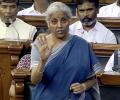
India is facing no risk of recession or stagflation as macroeconomic fundamentals of the economy are strong, Finance Minister Nirmala Sitharaman said on Monday. Replying to a debate on price rise in the Lok Sabha, she said the GST collection and Purchasing Managers' Index (PMI) are indicating that the Indian economy is getting more robust. The GST collection rose 28 per cent to touch the second-highest level of Rs 1.49 lakh crore in July. GST, introduced in July 2017, touched a record high of Rs 1.68 lakh crore in April 2022.

Ahead of the Union Budget 2023, insurers are hoping that the Centre will act on their recommendations, which includes increasing the limit for tax deduction under 80D of the Income Tax Act. Also among them are issuance of long-term bonds, tax incentives for home insurance premiums, and a separate section to claim deduction for term-insurance premium, among others. These suggestions would help improve the penetration of insurance in the country.
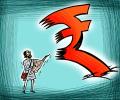
The Centre is staring at a combined shortfall of up to Rs 1 trillion in excise and Customs revenues in the current financial year (FY23) compared to the Budget estimates (BE), mainly because of duty cuts on edible oil and petroleum products. The government set a target of Rs 3.35 trillion for excise and Rs 2.13 trillion for Customs mop-up for FY23 while presenting the Budget in February. "As excise duty collection is mainly driven by diesel volumes, we might see a clear gap in the level budgeted for FY23, following the reduction in cesses on petrol and diesel in May. We are expecting somewhere between Rs 80,000 crore and Rs 1 trillion dip in excise and customs duty collections," a senior government official told Business Standard.
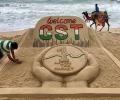
GST collections touched a record of Rs 1.40 lakh crore in January on rapid economic recovery, Finance Minister Nirmala Sitharaman said on Tuesday. In her 2022-23 Budget speech, the minister said there has been a remarkable progress made in the Goods and Services Tax (GST) regime, but still a few challenges remain. "Gross GST collection in January at record Rs 1,40,986 crores; this has been possible due to rapid economic recovery," she said while presenting the Budget in the Lok Sabha. January is the seventh straight month when the GST collection has crossed the Rs 1 lakh crore mark.

Ahead of the Union Budget for 2023-24, Budget makers have welcomed the global consensus view that India will remain one of the bright spots in calendar year 2023. But there is some alarm over the grim global situation and how that might impact the Centre's projections and assessments for next financial year. The big global headwinds include a deep and sustained recession in the West, including India's biggest trading partners in North America and Europe, continuing volatility in commodity markets, and renewed Covid-19 fears, as lifting of strict curbs by China could potentially lead to a massive spread again.

Chairman M Venkaiah Naidu has expressed disappointment saying "obstruction is destruction of parliamentary democracy".

Finance Minister Nirmala Sitharaman will present the Union Budget for 2023-24 in Parliament on February 1. The Budget is a statement of the government's estimated receipts and expenditures for a fiscal year (April 1 to March 31). It's divided into Revenue and Capital Budget. The Revenue Budget includes the government's revenue receipts and expenditures while the Capital Budget includes its capital receipts and payments.

The Director General of Goods and Services Tax Intelligence (DGGI) has slapped its heftiest tax notice of Rs 21,000 crore on Bengaluru-based Gameskraft Technology (GTPL) for allegedly evading GST on the betting amount. Gameskraft has dubbed the notice a "departure from the well-established law of the land". The company is accused of promoting online betting through card, casual and fantasy games like Rummy Culture, Gamezy and Rummy Time.

GST revenue for May stood at nearly Rs 1.41 lakh crore, a 44 per cent increase over the same month last year, the finance ministry said on Wednesday. Bucking the month-on-month increasing trend of the last two months, the Goods and Services Tax (GST) revenues came in lower than the record high collection in April at Rs 1.68 lakh crore. In March GST revenues were at Rs 1.42 lakh crore, while in February it was Rs 1.33 lakh crore.

The remarks by the CJI came against the backdrop of the recent remarks by Vice President Jagdeep Dhankhar who questioned the landmark 1973 Kesavananda Bharati case verdict that gave the basic structure doctrine.

The richest one per cent in India now own more than 40 per cent of the country's total wealth, while the bottom half of the population together share just 3 per cent of wealth, a new study showed on Monday.
The Centre has cleared the entire GST compensation payable till date by releasing Rs 86,912 crore to states, the finance ministry said on Tuesday. Of this, Rs 25,000 crore is released from the GST compensation fund and the balance Rs 61,912 crore is being released by the Centre from its own resources pending collection of cess. Of the total compensation released, Rs 17,973 crore is towards April and May dues, Rs 21,322 crore towards February-March dues and Rs 47,617 crore is the balance of compensation payable up to January 2022.

'They would not have had to impose GST on wheat, rice, buttermilk etc. if they had not toppled governments. People do not have to face inflation'

The finance ministry has said that the Goods and Services Tax will not apply on room rents of 'sarais' (inns) or properties managed by religious and charitable institutions. The clarification was issued by the Central Board of Indirect Taxes and Customs (CBIC) on Thursday evening to clear the confusion with regard to the levy of GST on room rents. This clarification by the Finance Ministry came following a demand from various quarters including AAP MP Raghav Chadha that the GST on rooms rented by religious institutions be withdrawn.
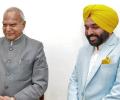
The governor's approval came a day after the AAP government informed him about the issues to be taken up during the session.

The central government is on track to meet its fiscal deficit target of 6.4 per cent of the GDP for 2022-23 on the back of strong growth in revenue collections, the World Bank said in its India Development Update on Tuesday. High nominal GDP growth in the first quarter supported strong growth in revenue collection, especially Goods and Services Tax (GST), despite tax cuts on fuel. Notwithstanding an increase in spending due to expanded fertilizer subsidies and food subsidies for vulnerable households in response to the commodity price shock, the government is on track to meet its FY22/23 fiscal deficit target of 6.4 per cent of GDP and the general government deficit is projected to decline to 9.6 per cent from 10.3 per cent in FY21/22 and 13.3 per cent in FY20/21.

'Given the worries about sluggish growth, rising interest rates and likely volatility, it's quite logical to infer that the SIP route could be the preferred way of investing.'

Both prime ministers believed in crafting schemes to help the common man. Modi used quite effectively the instruments Dr Singh introduced. In assessing Modi's success with many schemes, Dr Singh's fundamental work should not be ignored, points out A K Bhattacharya.

The Supreme Court on Thursday ruled that the Goods and Service Tax (GST) Council's recommendations are not binding on Union and State but have a persuasive value as the country has a cooperative federal structure.

The price of aviation turbine fuel has increased by 50 per cent since January and the situation has adversely impacted IndiGo, its CEO Ronojoy Dutta said on Wednesday. He said the government should bring aviation turbine fuel (ATF) under the Goods and Services Tax (GST) and make flying affordable for consumers and viable for airlines. IndiGo is India's largest airline and with around 55 per cent share in the domestic passenger market.

7 key areas that the Budget must address to re-energise the infrastructure sector, suggests Vinayak Chatterjee.

The richest one per cent in India now own more than 40 per cent of the country's total wealth, while the bottom half of the population together share just 3 per cent of wealth, a new study showed on Monday. Releasing the India supplement of its annual inequality report on the first day of the World Economic Forum Annual Meeting in Davos, rights group Oxfam International said that taxing India's ten-richest at 5 per cent can fetch entire money to bring children back to school. "A one-off tax on unrealized gains from 2017-2021 on just one billionaire, Gautam Adani, could have raised Rs 1.79 lakh crore, enough to employ more than five million Indian primary school teachers for a year," it added.

The commerce ministry is proposing a host of direct and indirect incentives such as deferral of import duties and exemption from export taxes to revamp Special Economic Zones through a new legislation, an official said. In the Union Budget this year, the government proposed to replace the existing law governing Special Economic Zones (SEZs) with a new legislation to enable states to become partners in 'Development of Enterprise and Service Hubs' (DESH). The official said the commerce ministry has sought views of different ministries, including finance, on the new bill.

For every rupee in the government coffer, 58 paise will come from direct and indirect taxes, 35 paise from borrowings and other liabilities, 5 paise from non-tax revenue like disinvestment and 2 paise from non-debt capital receipts, according to the Budget documents for 2022-23. According to the Union Budget 2022-23 presented in Parliament by Finance Minister Nirmala Sitharaman on Tuesday, goods and services tax will contribute 16 paise in every rupee revenue, while corporation tax will contribute 15 paise to each rupee earned. The government is also looking to earn 7 paise for every rupee from Union excise duty and 5 paise from customs duty. Income tax will yield 15 paise to every rupee collection.

Total number of GSTR-3B returns filed up to January 30, 2022 is 1.05 crore that includes 36 lakh quarterly returns, the finance ministry said. January is the fourth straight month when Goods and Services Tax collection has crossed Rs 1.30 lakh crore.
Industry body CII has pitched for a reduction in personal income tax rates, decriminalisation of the goods and services tax and a relook at the capital gains tax rates as part of its agenda presented to the government for the forthcoming Budget. Arguing that the GST law already contains adequate penal provisions for deterrence against evasion of taxes, CII has suggested decriminalisation of GST law. Also, the applicability of prosecution provisions should not be based on the absolute amount of tax evasion but should be based on real intent to evade the taxes and a certain percentage of the tax payable, it stated.

The government expects indirect tax collection to be lower than the Budget Estimate (BE) of Rs 13.38 trillion this fiscal year, despite prospects of netting goods and services tax (GST) in large amounts, Revenue Secretary Tarun Bajaj has said. "Indirect tax collection may see lower realisation than budgeted on account of cuts in excise and customs duties. "We could see a shortfall of about Rs 1.5 trillion on account of those," he told Business Standard.

Exporters on Thursday demanded fiscal incentives, tweaking in customs duties on certain products and credit at affordable rates in the forthcoming Budget to boost exports and create jobs. In a pre-budget virtual meeting with Finance Minister Nirmala Sitharaman, the Federation of Indian Export Organisations (FIEO) said the depreciation of the rupee against the US dollar is affecting exports' competitiveness and the sector requires more support. "Creation of employment is the biggest challenge faced by the country...We would urge the government to provide fiscal support to units which provide additional employment in the export sector," the exporter's body said.

'This resilience should be viewed as reflecting the strength of the structural story.'

The results of the assembly elections in Gujarat and Himachal Pradesh are likely to play out during the winter session of Parliament beginning Wednesday.

Chaudhary also said that 66 per cent of government-sponsored health insurance schemes in the country are being run by the central government. "When the COVID-19 pandemic started, a decision was made for sale of all medicines at the GST rate between 5 and 12 per cent and the GST rate for COVID-19 related medicines and instruments has been reduced to five per cent," he said during the Question Hour.

'The government is scared of this Congress yatra, that is why various orders and letters are being issued'
As taxpayers face technical glitch on the GST portal, the government on Tuesday said it is considering extending the April tax payment deadline and has directed Infosys for early resolution of the problem. The Central Board of Indirect Taxes and Customs (CBIC) said a technical glitch has been reported by Infosys in generation of April 2022 GSTR-2B and auto-population of GSTR-3B on portal. "Infosys has been directed by Govt for early resolution. Technical team is working to provide GSTR-2B & correct auto-populated GSTR-3B at the earliest," the CBIC tweeted.

Online skill-based gaming industry has made a case for retaining the service under 18 per cent GST slab instead of putting it into the highest 28 per cent tax rate category, saying the move will badly hit the $2.2-billion sector. The increase in taxation would not only have catastrophic impact on the industry but also encourage offshore operators who would circumvent Indian tax jurisdiction by hosting games in some other country, Games24x7 Co-CEO Trivikraman Thampy said. "It would be a triple whammy -- the industry loses out, the government loses out on tax revenue and players loses out as they would be exposed to unscrupulous operators," he said.
 © 2026 Rediff.com - Advertise with us - Disclaimer - Privacy Policy - Sitemap - Feedback - About us - Terms of use - Grievances