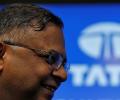
Tata Sons Private Limited, the holding company of the Tata group, witnessed a precipitous drop in its net debt to Rs 5,656 crore in the 10 months ended January this year, as its cash reserves burgeoned to Rs 9,516 crore during this period. Eight years ago, in 2015-16, Tata Sons reported a net debt of Rs 5,132 crore; from March 2017 until March 2023, this figure was above the Rs 14,700 mark, peaking at Rs 27,437 crore at the end of March 2019, according to data sourced from Capitaline. The company's gross debt nearly halved to Rs 15,173 crore until January 2024 on a standalone basis, down from a peak of Rs 31,363 crore reported in the financial year ended March 2019.

During the visit to the gurudwara, some pro-Khalistan elements shouted questions about Khalistani separatist Hardeep Singh Nijjar, killed in Canada in June this year.
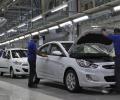
Domestic passenger vehicle sales could touch a record level of nearly 40 lakh units this year on strong demand and companies finding ways to enhance production despite semiconductor shortage, a senior Maruti Suzuki India official said on Monday. Even as the chip shortage issue has improved compared to a year back, the industry is estimated to have a pending order of around 7.5 lakh units of passenger vehicles with Maruti Suzuki India (MSI) alone having around 4.18 lakh units, company senior executive officer, marketing and sales, Shashank Srivastava told PTI. "I think it would be slightly below 4 million (units mark).

'It feels like Assam is good just as a tourist spot and not a place to earn and live.'

Tata Group is in discussions with some major international companies, including those from Taiwan, for its foray into the semiconductor chip business. The Union government had earlier tried to bring in Taiwanese manufacturers Taiwan Semiconductor Manufacturing Company (TSMC) and United Microelectronics Corporation (UMC) for chip manufacturing in India. A person close to the development said the Tatas have now opened a separate channel for a possible tie-up. Currently, India mostly imports chips, which are fabricated and assembled to put into various applications, including automobiles, renewable power, mobile phones, televisions, and other electronic items.

External Affairs Minister S Jaishankar on Tuesday targeted Jawaharlal Nehru and claimed that past mistakes were responsible for the problems such as Pakistan Occupied Kashmir (POK) and occupation of some parts of the Indian territory by China.

Nearly 40 per cent of IITians sitting for placements in 2024 are yet to receive job offers, showing a doubling of the 'unplaced' in the last three years from 19 per cent in 2021-2022 to 38 per cent in 2023-2024.

This is the full text of the address to the nation by President Droupadi Murmu on the eve of India's 78th Independence Day.

Despite the robust growth in this country, Apple's India share in its overall global sales remained modest -- constituting 1.5 per cent of its overall turnover of $389 billion in FY23.

Driven by mega investment proposals from Tata Power, Adani group, Singapore's Sembcorp Industries and Leap Green Energy, among others, the two-day Global Investors Meet 2024 in Tamil Nadu is expecting an infusion of around Rs 6.64 trillion. This is likely to create around 2.69 million direct and indirect jobs in the state. "Due to our tireless efforts and your participation during this Global Investors' Meet, we have attracted an unprecedented Rs 6.64 trillion of investments.

'Investing abroad helps mitigate currency risk for foreign-currency denominated goals, such as children's higher education and international travel.'
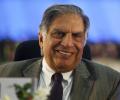
'I think some of us, like Mukesh Ambani, myself and those of us who head industrial units, ought to really focus on what we can really do to make the world a safer place, maybe 50 or 100 years from now.' 'For instance, how can we deal with climate change and global warming, right now?' 'The effects of it may not be felt now; in fact, we may pay a price for it today, but it will help the generations to follow.'
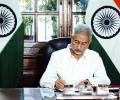
Signalling both change and continuity, India's new government, headed by Prime Minister Narendra Modi for a third consecutive term, got into work gear on Tuesday with cabinet ministers and ministers of state filing into their respective offices to assume charge.

The Taiwanese foreign minister said the time has come for all democratic countries to find ways to deal with China's expansionist agenda and its military muscle flexing, especially in the maritime domain.
The Tata group is looking to make a foray into semiconductor (also known as chips) manufacturing and it has set up a business to seize the opportunity, Chairman N Chandrasekaran said on Monday. "At the Tata group, we have already pivoted into a number of new businesses like electronics manufacturing, 5G network equipment as well as semiconductors, in all probability," he said while speaking at the annual general meeting of the IMC Chamber of Commerce and Industry. Chandrasekaran said global supply chains, currently heavily dependent on China, would see a big change in a post-pandemic world with businesses shifting their reliance to other countries.
Dixon Technologies right now is a beehive of activity. It is building a new facility in Noida to make 1.3 million laptops for Taiwanese PC maker Acer. The facility must be up and running in four months. The pace of activity will only increase. Last week Dixon won a similar contract from Lenovo, the Chinese personal computer maker and the third largest information technology (IT) hardware brand in India, to assemble laptops and notebooks. Though the clientele in these two cases is Taiwanese and Chinese, Dixon is a company reaching for the stars with its feet planted firmly in the Indian government's policy.

I hope those who underestimate Rajeev Chandrasekhar will be proved wrong in this fight for Thiruvananthapuram's future, notes Rajeev Srinivasan.
If the concerns over risking political capital are overcome, the long-term gains for the Indian economy will be immense, asserts A K Bhattacharya.

Here are list of some of the big ticket announcements.

Prime Minister of the Netherlands Mark Rutte on Monday said the G20 New Delhi declaration was clearly a compromise, which is always the case with such a multilateral forum, but he was happy with the fact that there were some key elements in it, and that India was able to broker it.

The previous May peak was observed in 2018 when the domestic PV wholesales stood at 301,238 units.

National security advisor Ajit Doval on Friday suggested that various central armed police forces of the country should have "jointness" and interoperability among themselves like the ongoing plan for the defence forces.

The Vedanta team held a meeting with Shinde, Fadnavis and top officials on July 26, he said.

The Lok Sabha contest in Thiruvananthapuram is shaping up to be a significant battle involving key candidates like Shashi Tharoor, Rajeev Chandrasekhar, and Panniyan Ravindran. This three-cornered fight highlights the political dynamics in Kerala's capital city, with each candidate bringing their own vision and promises for the region's development, notes Rajeev Srinivasan.

Allowing 12-hour shifts for all and night-time work for women was meant to benefit software firms, but is said to have clinched Foxconn's Rs 80 billion investment.

Lou also spoke about China's tensions with neighbouring countries without directly mentioning the eastern Ladakh border standoff with India since May 2020 which resulted in the Galwan Valley clash in June of that year.
Foxconn means serious business in India. Its delegation to India was led by its Chairman Young Liu who met Prime Minister Narendra Modi.

India and the US on Friday said they have started talks to put in place a strategic framework for human space flight by year-end as they plan to send an Indian astronaut to the International Space Station in 2024.

Tata Motors recently cut the sales forecast of its luxury car brand, JLR, due to chip shortages, scaling down its production numbers from the earlier 120,000 units to 60,000-65,000 units by September, and leading to an almost 10 per cent fall in the company's stock. In May this year, Bosch India, too, had stated that chip shortfalls would impact its production, as supply chains were getting disrupted.

'India is the sixth-largest market for the Kia Corporation, and contributes 8 to 9 per cent to our global sales.' 'We are eyeing 10 per cent market share over the next few years depending on customer demand and new product innovations.'

'In terms of semiconductors, challenges do remain in the pan industry, but I think we are much better than where we were a year or so back.'

The top 25 global technology (tech) firms, including Apple, Microsoft, Amazon, Tencent, Samsung, Oracle, and Accenture, collectively lost over $600 billion in market capitalisation (m-cap) during the July-September quarter (third quarter, or Q3) of calendar year 2023 (CY23), reveals a recent report by GlobalData, a London-based analytics and consulting company.

The Indian equity markets have significantly increased in importance within the emerging market (EM) basket of stocks in recent years. Since 2018, India's weighting in the Morgan Stanley Capital International (MSCI) EM Index - tracked by passive funds with assets of nearly $500 billion - has doubled, while the number of domestic stocks has grown by almost 70 per cent.
Prime Minister Narendra Modi on Monday expressed confidence that the NDA will get more than 400 seats and the BJP will win at least 370 seats in the Lok Sabha elections.

'...which is possible through flexicap and multicap funds.' 'The latter has a better balance between large, mid and smallcap stocks.'
The Nationalist Congress Party, the main opposition outfit, accused the neighbouring state, ruled by the Bharatiya Janata Party, of 'snatching morsel from Maharashtra's mouth.'

Prime Minister Narendra Modi's call to make this decade a "techade" for India and the push for 5G, semiconductors and transformation through digital services is going to boost the technology sector in the country, industry players said on Monday. Modi, in his speech on the 76th Independence Day, touched upon all-round development of technology in the country, from 5G to push for electronic chips, laying of optical fibre cable (OFC) network across villages and enablement of digital entrepreneurship in villages through Common Services Centres, making the present decade as "techade" for India. Homegrown mobile devices maker Lava International's Chairman and Managing Director Hari Om Rai said electronics and technology sectors create about $4 trillion of revenue.

Technology can play a big role in helping India overcome infrastructure challenges as well as resource deficiencies.
State industries minister Uday Samant alleged the previous Maha Vikas Aghadi dispensation was responsible for the loss as it sat on the project offer for seven months whereas the new government approved incentives worth Rs 38,831 crore in July.
Domestic passenger vehicle retail sales declined eight per cent in February as the companies continued to suffer production loss due to chip shortage, automobile dealers' body FADA said on Friday. The passenger vehicle (PV) sales dropped to 2,38,096 units last month, down 7.84 per cent from 2,58,337 units in February 2021. "Even though the passenger vehicle (PV) segment saw some launches and slight respite in supply due to better production, it was not enough to meet customer demand. "Vehicle waiting period thus remains similar to what it was in the past few months," FADA president Vinkesh Gulati stated.
