
Investor wealth eroded by Rs 6.59 lakh crore on Monday as equities tanked after the UK reported a new strain of the COVID-19 virus. The 30-share BSE Sensex plunged 1,406.73 points or 3 per cent to close at 45,553.96. The benchmark hit an all-time high of 47,055.69 during the session. Following the sharp selling, the market capitalisation of BSE-listed firms plummeted by Rs 659,313.65 crore to Rs 1,78,79,323.05 crore.

In terms of market capitalisation, Zee alone has a market cap of Rs 24,000 crore compared to Rs 15,000 crore of the merged Reliance entity.

The market's sensitivity to the US Fed's balance sheet changes makes it vulnerable to the possible tapering of the bond buying programme and the resulting stagnation or even shrinkage in the balance sheet.

Participating in the debate on the budget, leaders of parties like the Congress, Bahujan Samaj Party, Aam Aadmi Party and Left launched an all-out attack on the BJP government for allegedly selling off the country's assets and PSUs to big industrialists.

Wall Street brokerage Goldman Sachs has flagged a slew of concerns on the surging COVID-19 caseload that has been hitting new records everyday, coupled with the rising lockdowns, forcing it to downgrade India's GDP growth forecast for the full year to 10.5 per cent from 10.9 per cent, apart from pegging down stock indices valuation and earnings. In a detailed note on Tuesday, Goldman Sachs' house economists led by Sunil Koul said these record number of pandemic cases and a host of key states announcing stricter lockdowns of late have fuelled serious growth concerns, leaving investors worried about the risks to macro and earnings recovery.

SBI was the top gainer in the Sensex pack, spurting over 2 per cent, followed by TCS, Tech Mahindra, HUL, Bajaj Finance, Kotak Bank and Titan. On the other hand, IndusInd Bank, PowerGrid, Bharti Airtel, Asian Paints and HDFC Bank were among the laggards.

SBI was the top laggard in the Sensex pack, shedding over 4 per cent, followed by Bajaj Finance, Asian Paints, Axis Bank, Kotak Bank and ICICI Bank. M&M, PowerGrid, ONGC and Reliance Industries were among the major gainers. NSE Nifty fell 87.90 points or 0.95 per cent to close at 9,205.60.

The US dollar strengthened against the world currencies after the Turkish lira dived almost 8 per cent, sparking a sell-off in global markets.

However, they put in Rs 2,744 crore in the debt markets during the period under review.

The Nifty Bank index has come off 15 per cent from its peak in February, underperforming the benchmark Nifty which is down 6%.
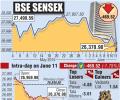
The 30-share Sensex closed after shedding 470 points to 26,371.

The listing day gain-to-loss ratio for FY21 was 71 per cent, the highest since FY17, when it was 85 per cent.

The broader NSE Nifty closed below the 10,200-mark by slumping 99.85 points, or 0.98 per cent at 10,124.905.

In an apparent message to the G23, Congress chief Sonia Gandhi on Saturday said she is a full-time, hands-on party president and there is no need for leaders to speak to her through the media.
The sell-off was probably aggravated by computer-driven traders

The dozen firms to have listed following their IPOs have seen an average listing day gain of 49 per cent. IPO applicants have made money on all the deals, barring two, which saw modest declines on listing day.

Markets suffered after other Asian indices closed in the red, tracking record-breaking losses at the Wall Street overnight.

M&M was the top laggard in the Sensex pack, cracking over 7 per cent, after the home-grown auto major on Saturday reported 73 per cent decline in consolidated quarterly net profit.

Many believe that the surge in the markets defy economic reality and is being fuelled by aggressive monetary easing by central banks across the world.

'Hope they don't tinker around with capital gains tax in any way.'

The chairman of the Essel Group says he has settled 91.2 per cent of the estimated Rs 11,000 crore debt on the group's books.

Claiming that Shah is getting "frustrated" by "poor turnout" at his rallies, Banerjee also alleged that the Bharatiya Janata Party is plotting conspiracies to kill her as her security director Vivek Sahay was removed by the Election Commission after she sustained injuries last week in Purba Medinipur's Nandigram.

Top laggards among the Sensex pack included Yes Bank, SBI, HDFC, Axis Bank, Kotak Bank, ITC, RIL, M&M, Tata Motors and ICICI Bank, losing up to 3.61 per cent.

Emerging from a meeting with Banerjee at the state secretariat, Yadav said that the first priority of his party was to stop the Bharatiya Janata Party's progress in West Bengal.

This was the one Budget that required radical departures on all these fronts, when it had none, asserts, Shreekant Sambrani.

'When the government wants to sell these assets, even if one set of assets gets caught in any quagmire, the whole process will fail.' 'The entire world is watching us.'

All Sensex components ended in the red, with Tata Steel cracking 6.39 per cent, followed by ONGC, Maruti, Titan, ICICI Bank, HDFC and Bharti Airtel.

Equity markets braved all odds this fiscal and rewarded investors with high returns as the benchmark Sensex surged more than 66 per cent despite COVID-led disruptions and concerns over its impact on the economy. Market analysts termed FY 2020-21 as a roller coaster ride for not only Indian markets but also for equity indices globally due to the pandemic. In an unprecedented come back, the 30-share BSE Sensex has jumped 19,540.01 points or 66.30 per cent so far this fiscal. This extraordinary rally holds significance as markets faced volatile trends this fiscal.

Vedanta, Tata Steel, Tata Motors, ONGC, M&M, Maruti, NTPC and HUL too fell up to 4.06 per cent.

More cos could join the likes of Burger King and Antony Waste in giving listing another shot.

While we wait for Batra's latest to drop on Amazon Prime Video on February 11, Sukanya Verma looks at how Bollywood has dealt with affairs of the heart over the years.
Nestle India was the top loser in the Sensex pack, shedding 2.20 per cent, on its first day as part of the index.
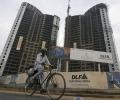
In mid-2020, when Kushal Pal Singh, the undisputed king of India's vast real estate market, relinquished the top post at the country's largest realtor, he left behind an empire that is best compared to the Greek myth of the Phoenix. Once the leader of Delhi's organised real estate market, DLF's steep decline in the 1970s and its majestic rise since has often been cited as a business resurrection story. Now, a year after his departure from the helm of affairs, history seems to be repeating itself at the real estate major. In the 1970s, it was the government prohibitions that had forced DLF to venture into uncharted territory; some five decades later, the Delhi-headquartered firm has set its eyes on another growth trajectory that holds immense potential.

NSE Nifty sank 127.80 points, or 1.03 per cent, to 12,224.55. According to traders, besides stock-specific action, domestic investors were also seen booking profits at record peaks.
Top losers in the Sensex pack included SBI, HDFC twins, Bajaj Auto, ONGC and Tata Steel, falling up to 2.49 per cent.

Markets

Despite the 3 per cent gain in September 2019, the FPI sell-off during the quarter has seen the benchmark indices - the S&P BSE Sensex and the Nifty 50 register negative returns in Q3CY19.

The NSE Nifty settled at 10,454.95, down 121.90 points, or 1.15 per cent.

The political economy of the IPO market involves regulators empathising with intermediaries, and designing a bridge that systematically takes wealth away from founders, VC and PE funds, and business houses, explains Ajay Shah.
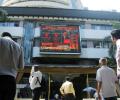
'There is a weak link between the economy and the stock market.'
