
'The economy is clearly at a very soft spot, and earnings growth is disappointing every day.' 'After three great years, the Indian economy has hit a rough patch.'

Global trends, trading activity of foreign investors and domestic macroeconomic data announcements would dictate terms in the equity market in a holiday-shortened week ahead, analysts said. Equity markets would remain closed on Wednesday for Gandhi Jayanti. "Looking ahead, it will be interesting to monitor Foreign Institutional Investors (FIIs) and their flow into India.

Union Finance Minister Nirmala Sitharaman on Monday said people are finding current interest rates "very stressful" and urged banks to make them affordable. Speaking at an event organised by State Bank of India, the finance minister said that at present, India requires industry to ramp up and invest in new facilities, and added that lowering lending rates can help achieve the "Viksit Bharat" aspiration.

With 7 per cent economic growth, India is not creating enough jobs as reflected by the number of applicants for vacant posts in some states, Reserve Bank's former governor Raghuram Rajan said and suggested the government needs to focus on promoting labour-intensive industries to generate employment. Rajan further said some Indians, especially those at upper level, are comfortable and have high incomes, but consumption growth from the lower half of the country has still not recovered to pre-pandemic level.

From the 30 Sensex firms, Mahindra & Mahindra, JSW Steel, Maruti, Tata Steel, Larsen & Toubro, ICICI Bank, Power Grid, Nestle, Bharti Airtel and Adani Ports were the biggest gainers. Tata Consultancy Services emerged as the only laggard.

India Inc on Friday said it is looking forward to a repo rate cut in future as cost of funds has to come down in coming times, and expects continuation of accommodative policy stance by the Reserve Bank of India (RBI). The RBI decided to leave the benchmark interest rate unchanged at 4 per cent but maintained an accommodative stance, as the economy faces the brunt of the second COVID-19 wave. Sanjay Aggarwal, president of PHD Chamber of Commerce and Industry, said the RBI has maintained an accommodative stance as long as necessary to revive and sustain growth on a durable basis and to mitigate impact of COVID-19, apart from an aim to keep inflation within the target.
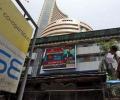
On the Sensex chart, Bajaj Finserv, Maruti, Larsen & Toubro, Bajaj Finance, Infosys, Axis Bank and ICICI Bank were the biggest gainers. Hindustan Unilever, JSW Steel, Titan, NTPC and Tata Motors were among the laggards.

In a falling market, the value of your investment keeps going down. However, the reduction in value is purely a notional loss if you remain invested. When you redeem in a falling market, the notional loss becomes a permanent loss, explains Anamika Pareek.

'Investors with foreign currency-denominated goals, such as foreign education or foreign travel, should go for US equity funds.'

The Reserve Bank of India (RBI) abstained from selling any US dollars throughout February, for the first time in nine months. The decision comes amid increasing pressure on the rupee, as expectations of rate cuts by the US Federal Reserve keep pushing back. The last time the RBI did not sell dollar over a month was in May 2023.

Analysts at Barclays pitched for a 0.25 per cent cut to generate demand advising the central bank to throw caution to the wind.

Bharti Airtel was the biggest gainer in the Sensex pack, rising 1.63 per cent, followed by Tata Steel, ICICI Bank, Titan, Asian Paints and Ultratech Cements. On the other hand, M&M, NTPC, Tata Motors, TCS and PowerGrid were the major losers.

Titan Company, Axis Bank, NTPC, Tata Motors, ITC, Tech Mahindra, Bajaj Finserv, ICICI Bank, HDFC Bank and Bajaj Finance were the other laggards. Bharti Airtel, Power Grid, Infosys and Larsen & Toubro were among the gainers.

Gold prices tumbled by Rs 3,350 to Rs 72,300 per 10 grams in the local market in New Delhi on Tuesday amid subdued demand by jewellers after the government announced the customs duty cut on the yellow metal and silver to 6 per cent.

Foreign portfolio investors (FPIs) have net sold domestic shares worth over $10 billion so far this month amid a shift to China, which not only offers attractive valuations compared to India but has also announced several measures to support the economy and the stock market in recent weeks. If the trend doesn't reverse, this will be the first time that overseas funds will yank out more than $10 billion from Indian equity markets in a month.

India's stock markets are experiencing a shift in investor sentiment, with a 30 per cent surge in Chinese stocks, prompting investors to move money from domestic markets to China. This reversal of fortunes is a notable change from the past three years, where China's losses benefited India.

Quarterly earnings of corporates, trading activity of foreign investors and inflation data are the key factors that are expected to drive the momentum in the equity markets this week, analysts said.

Among the 30 Sensex firms, Bajaj Finserv, Bajaj Finance, HCL Tech, IndusInd Bank, ITC, UltraTech Cement, Axis Bank and Infosys were the biggest gainers. On the other hand, Tata Motors, NTPC, Mahindra & Mahindra, Bharti Airtel, Larsen & Toubro and Power Grid were among the laggards.

Mutual funds (MFs) managed a record Rs 66.2 trillion in assets during the July-September quarter, marking a 12.3 per cent increase over the previous three-month period - the highest quarterly jump in MF assets in at least five years. During the April-June period, the average assets under management (AUM) stood at Rs 59 trillion. The sharp rise in AUM, according to experts, is driven by a robust equity market rally and record inflows into equity schemes.

A Rs 525-crore contingency provision during the July-September period led to a 19 per cent fall in IndusInd Bank's share price on Friday (October 25). Contingency provisions are generally made when a lender expects more bad loans in the coming quarters. Shares of the bank on Tuesday (October 29) declined 1.53 per cent to settle at Rs 1,038.2 apiece on the BSE.

While rate cuts may increase churn between banks, these may not boost credit offtake meaningfully.

Foreign portfolio investors (FPI) have pulled out $3.5 billion from India's equity markets so far this month. The selling comes on the back of election-induced volatility and the rotation of flows from India to China, where stocks are available at half the valuations. If the selling pressure remains at the current level, this will be the highest FPI pullout since January 2023.

The rupee has remained largely stable against the US greenback in the current calendar year (CY 2024), depreciating by just 0.59 per cent so far. However, it has considerably weakened against the euro and pound. The local currency has depreciated by 1.6 per cent against the euro and 5.6 per cent against the pound, as both currencies strengthened against the dollar during this period.

Among Sensex firms, Tata Consultancy Services, HCL Technologies, Tech Mahindra, Infosys, Mahindra & Mahindra and Tata Motors were the biggest gainers. UltraTech Cement, JSW Steel, Tata Steel, Adani Ports, Power Grid and Bajaj Finserv were among the laggards.

'Like every Budget, this time, too, there is chatter around tinkering with the long-term capital gains tax.' 'Investors may not want to jump into the markets until there is clarity on this front.'

'When interest rates rise, the NAVs of these funds will fall.' However, they won't fall as much as longer-duration funds.

'The problem is that the bubble may not only be in valuations, but also in investors' minds.'

India's largest IT services firm TCS on Thursday reported a 4.99 per cent increase in its September quarter net profit at Rs 11,909 crore. The Tata Group company had reported a net profit of Rs 11,342 crore in the year-ago period, while in the preceding quarter, it had a post tax net of Rs 12,040 crore, a company filing said.

The RBI expects CPI inflation to fall from 5.8% in Jan '16 to 4.8% in Jan-Mar '17.

Among the Sensex firms, Titan, Asian Paints, ITC, Hindustan Unilever, Nestle India, Bajaj Finserv and Bharti Airtel were among the gainers. In contrast, UltraTech Cement, Tech Mahindra, Tata Steel, Power Grid, HDFC Bank, HCL Technology, State Bank of India and ICICI Bank were the laggards.

From the Sensex basket, Sun Pharma, Maruti, Power Grid, Titan, JSW Steel, Tech Mahindra, Larsen & Toubro and State Bank of India were the major laggards. Tata Motors, Tata Consultancy Services and Nestle were the gainers.
With the earnings season drawing to a close, stock markets will take cues from global trends and foreign investors' trading activity this week, analysts said. The US FOMC (Federal Open Market Committee) minutes will be the major highlight this week, experts said. "This week, there are fewer cues on the macro and micro fronts, as the Q1 earnings season has concluded.

By taking the mutual fund route, investors can take exposure to gilts with small amounts. Over a decade or more, returns from these funds tend to be sound.

Although there is headroom for further monetary policy action, at this juncture it is important to keep our arsenal dry and use it judiciously: RBI's Das.

he hike in service tax rate from 12.5 per cent to 14 per cent will increase the costs of buying

A potential risk to the rupee's appreciation trajectory lies in the event of a delay in the Federal Reserve's rate cut cycle, particularly if core inflation in the US remains elevated.

Reserve Bank of India (RBI) Governor Shaktikanta Das has said the decision on interest rate moderation will be based on long-term inflation trajectory and not monthly data. The Monetary Policy Committee (MPC) headed by the RBI Governor is scheduled to meet between October 7 and 9 and take call on interest rate. The RBI kept the repo rate unchanged at 6.5 per cent for the ninth time in a row amid risks from higher food inflation.

Among the 30 Sensex companies, Kotak Mahindra Bank, Asian Paints, Reliance Industries, ITC, Sun Pharma, ICICI Bank, Axis Bank and JSW Steel were the major laggards. Larsen & Toubro, Tata Motors, Maruti, NTPC, Mahindra & Mahindra and UltraTech Cement were among the gainers.

Inflows into gold exchange-traded funds (ETFs), which manage a total of Rs 37,390 crore, have surged sharply in recent months. This trend is likely to continue, especially after the reintroduction of long-term capital gains tax (LTCG), which is likely to attract smart money into mutual fund offerings amid a robust outlook for the yellow metal. Smart money, also known as opportunistic flows, refers to strategic investments that are generally of a short-term horizon.

Monetary transmission has been an issue for the Indian banking sector.
 © 2026 Rediff.com - Investor Information - Advertise with us - Disclaimer - Privacy Policy - Sitemap - Feedback - About us - Terms of use - Grievances