
The forthcoming Budget could think of maintaining public capital expenditure at 3 per cent so that domestic resources are available for private investments, points out N R Bhanumurthy.

In a double-dose bid to boost growth and employment prospects, the Union Cabinet on Tuesday approved a Rs 2.07 trillion outlay for a research development and innovation (RDI) Scheme to fund private sector innovations, and an employment-linked incentive (ELI) to create over 35 million new jobs over the next two years.

'They are also sitting on huge public sector assets without many returns.'

The Union government could target a fiscal deficit of 5.8-6 per cent of nominal GDP for 2023-24, and it should continue its capital expenditure push and look to simplify the personal income tax regime, economists recommended Finance Minister Nirmala Sitharaman and her team during their pre-Budget interaction on Monday. Starting last week, Sitharaman had eight pre-Budget consultations this time. More than 110 invitees representing seven stakeholder groups participated in these meetings, the finance ministry said in a statement. The stakeholder groups included representatives and experts from agriculture and agro-processing industry; industry, infrastructure & climate change; financial sector and capital markets; services and trade; social sector; trade unions and labour organisations; and economists.

The number of times public sector undertakings (PSUs) have held conference calls with investors, their capital management, and debt financing are among the parameters that the Centre will use to judge their performance for the first time, a senior official in the know said. The government will evaluate PSUs for FY22 based on new parameters that were finalised by the Department of Public Enterprises (DPE) in consultation with the Department of Investment and Public Asset Management (DIPAM) last year, the official said. The government had included more conditions in the memorandum of understandings (MoUs) - used to set annual targets - that public sector enterprises sign with the DPE every year. These included a consistent dividend policy, which seeks to transfer dividends by PSUs every quarter; and market capitalisation or share price improvement over the sectoral index on an annual average basis for listed companies.

'This plan is basically to allow some of the government assets for rent, and surely not for sale.' 'There is a difference between selling a house and renting out a house.'

With the disruption caused by the second wave of Covid-19 pandemic, the 'fear of unknown' is looming over the government's privatisation drive. Although there is a lot of uncertainty and unpredictability on how things will unfold, the government is hopeful of completing the transactions listed in the Budget with a delay of one to two months, said a top government official. However, "there are many unknown factors now, and we do not know whether there could be a third wave. But we are trying to carry on with our work", the official said." Since there is a lot of uncertainty, the estimates will have to be revised as rating agencies are revising their outlook for growth.

Measures that quickly boost demand and increase employment are needed to push up growth. Moreover, without announcing new planss, the government should strengthen schemes such as PM KISAN, MNREGA and programmes to build rural roads.
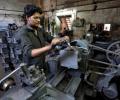
The fall in investment rate is not surprising. But putting it together with rising share of wages in GVA, it shows that the focus is more on productivity, rather than adding new capacity, says Pronab Sen, former chief statistician of India.

'How low GDP would have been, we don't know.' 'It raises serious questions because so many indicators are pointing to such a sharp decline and GDP estimates are still showing 4 per cent growth.'

State-owned companies have been set stiff targets to increase accountability as they get ready for divestment. Nikunj Ohri explains why meeting them will be challenging.

The oil crisis could not have come at a worse time for the Modi government as its tax collection has fallen short of its 2020-2021 target by Rs 5.2 lakh crore.
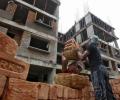
Data on the new series given by a panel on real sector statistics shows that GDP grew by 10.23 per cent in 2007-08 and 10.78 per cent in 2010-11. There are some years for which the new figures show a deceleration in growth as well. The new series has 2011-12 as the base year while the earlier series had 2004-05 and 1993-94.
The government had no option but to cut spending to meet its borrowing targets.

Modi had campaigned with promises of jobs, infrastructure and development.
Modi's government plans to support domestic demand

Officials said the government had no option but to cut spending.

The Modi government has handled inflation far better than any government in the past two decades. Both the stock market and currency indices have begun to show confidence in the economy, despite the mounting global headwinds of trade.
N R Bhanumurthy, professor of economics at the National Institute of Public Finance and Policy, and the author of the series, presented in a report to the National Statistical Commission, explains to Abhishek Waghmare various aspects of the methodology.

The finance minister may stagger some of the recommendations.

The National Democratic Alliance won 64 seats.

The finance minister chided the central bank on Tuesday over its focus on fighting inflation, saying the Reserve Bank of India (RBI) also needed to abide by the government policy to promote economic growth.

'If some measures are implemented quickly, they can help revive growth.'

Politically, it will not be easy for Modi to take hard decisions such as raising fuel prices in the first budget, given the risk of higher inflation.

'We are looking at the Budget with the hope that it will address all issues even at the cost of exceeding the fiscal deficit target.'

Corporate India at present is more indebted than all state govts put together.
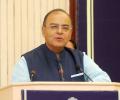
Last week, the government had introduced a fresh round of austerity measures, including bans on first class travel, creation of new posts and holding meetings in five-star facilities.
 © 2026 Rediff.com - Investor Information - Advertise with us - Disclaimer - Privacy Policy - Sitemap - Feedback - About us - Terms of use - Grievances