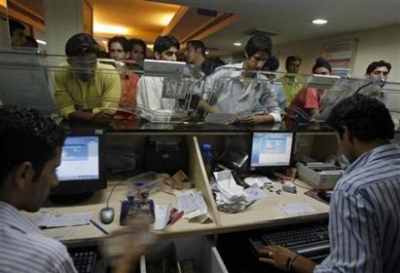
Bringing down government stakes would augment their capital.

"The life of a Finance Minister is not easy. Various players, including policy makers, politicians, agriculturists and business houses, participate in the making of the economy."
The government said it will provide capital support of Rs 15,888 crore (Rs 158.88 billion) to public sector banks and financial institutions during the next fiscal to strengthen their capital base.

Bankers seem to be pleased with the government for keeping its promise of not interfering in operational matters, but are apprehensive about the intense scrutiny of their functioning.

The NITI Aayog has recommended privatisation of state-owned insurer United India Insurance Company as the government aims to move ahead with its new public sector enterprise (PSE) policy for Atmanirbhar Bharat. The policy think tank has suggested that the public sector insurer be considered for privatisation in the banking, insurance and financial services sector, which has been classified as 'strategic' in the PSE policy, said an official. The policy proposes the "bare minimum" presence of government-owned companies in strategic sectors, and privatisation, merger or closure of remaining public sector undertakings (PSUs).

The strike by bank employees is part of the one-day all-India general strike, called by major central trade unions.
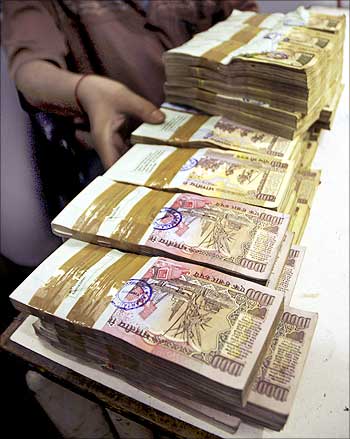
Bad loans in public sector banks more than tripled.

In a recent communication to the bank chiefs, the ministry has said all such loans to the corporate sector can be sanctioned only after board approval and need to be backed by securities within six months of sanctioning, failing which the loan would need to be phased out.
Finance Minister P Chidambaram on Wednesday said public sector banks plan to hire 50,000 persons and open 10,000 branches in the current fiscal.

It will be headed by Secretary, Department of Financial Services.

The challenges before the government, he said, is to put public sector banks back on track and continue to operationalise stalled infrastructure projects

Norms governing investments by provident funds bar these from depositing funds in a commercial bank in case the NPAs of that bank exceed two per cent of net advances.

India's equity markets are on a roller-coaster ride, after delivering spectacular returns for two consecutive years - in 2020 and 2021. The benchmark National Stock Exchange's (NSE's) Nifty50 is down 1.5 per cent in the first nine months of the current calendar year 2022 (CY22) as foreign portfolio investors sold Indian stocks due to rising bond yields in the US and across global markets, including India. The sell-off in the Indian equity markets has, however, not been broad-based and largely limited to sectors facing earnings headwinds from rising interest rates, lower commodity and energy prices, and likely economic recession in advanced economies.

Options include fresh capital infusion by the management and/or some new investors.

"A very easy solution to suggest is tax-payers must pay because the private sector has defaulted," Jaitley said, adding that bank recapitalisation, where the government puts in more capital in public sector banks to shore up their books, effectively amounted to that. "Therefore, I think let's try and make the private sector pay for their debts or allow somebody else to step in."

The 'bad bank' -- which will help banks clear their balance sheets by transferring the NPAs to special purpose vehicles -- has been one of the most debated ideas for stressed asset resolution.

Sentiment got a leg-up after the Lok Sabha on Thursday gave its approval for Rs 80,000 crore recapitalisation bonds for strengthening public sector banks, traders said.
The sharp rise in home loan rates of private sector banks is forcing their customers to switch loyalties.
The Centre is planning to raise the ceiling on foreign equity holding in public sector banks to enable them to mop up the required capital for meeting higher capital requirements and to fund growth.

Loans for Indian airlines have dried up as banks have become cautious to lend to the sector.
Clearing operations are likely to be affected as over 500,000 employees of public sector banks, barring the State Bank of India

The country's economy will start witnessing a growth of 6.5 to 7 per cent from fiscal 2023 onwards, helped by various reforms undertaken by the government so far and also as COVID-19 vaccination drive progresses, Chief Economic Advisor Krishnamurthy Subramanian said. He said the second wave of COVID-19 is unlikely to have a very significant on the economy. The country's economy contracted by 7.3 per cent in fiscal 2020-21. "Together with the reforms and focus on vaccination, I expect growth to start hitting close 6.5 to 7 per cent from FY23 onwards and accelerate from there on," Subramanian said at a virtual event organised by Dun & Bradstreet.

The agency said that over the next two years new NPL formation rates would witness a gradual decline.

As public sector bank employees started a two-day strike on Monday seeking higher wages, Finance Minister P Chidambaram said the profit of banks cannot be used only to enhance salaries because there are other obligations.

A few state-owned banks such as IDBI Bank, Union Bank, Indian Overseas Bank have announced results for FY14.

Avoid preparing new topics on the final days before the exam. Rather focus on practicing what you have learned till date, suggests Arun Singh Rawat, an educator at Unacademy.

'We feel there is definitely something murky in the system.' 'Will anyone believe that Nirav Modi will go to a branch and bribe a low-level officer?' 'Just look at the people with whom he had moved around.'

Replying to a query in Rajya Sabha, Finance Minister Nirmala Sitharaman said there was no delay by the Centre in taking action after identification of fraud by the State Bank of India following the forensic report from Ernst & Young.

The Ministry of Home Affairs amended its guidelines on October 12 to include the chairman, managing director or chief executive officer of each public sector bank on the list of authorities who can issue requests for opening look-out circulars against whom an FIR is yet to be filed.

'There are deeper, underlying, forces at work and we need institutional arrangements to guard against them.'

Banks have collected about 1,500 kg of gold from temples and trusts under the Gold Monetisation Scheme (GMS) since its launch last November.
Because of lower ratings, these companies would have to pay higher rates if they raised money directly.

The share of public sector undertakings (PSUs) in the total market capitalisation of listed companies--at an all-time low of 10 per cent currently --- may get a leg-up from the government's divestment push. Recently the government announced the successful sale of national carrier Air India to Tata Sons, India's first privatisation of a PSU since 2002-03. The transaction is expected to be completed by December.
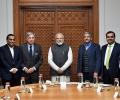
Further stimulus measures are expected in the upcoming Budget where the focus is likely to be on reforms, including some structural measures such as reducing red tape and boosting foreign direct investment. The meeting with industrialists is in the series of discussions that Modi has had during the last couple of weeks to seek suggestions to revive growth.

Rajnish Kumar was on Wednesday appointed the new chairman of the largest public sector bank, State Bank of India (SBI), replacing Arundhati Bhattacharya who completes her one-year extended term on Friday.

Top losers in the Sensex pack included ICICI Bank, Tata Steel, Vedanta, HDFC IndusInd Bank, Tata Motors, RIL and ONGC -- falling up to 4.45 per cent.

Indeed, there were frauds, and the politician-banker-industrialist nexus played a role in the rise of NPAs, but governance issues in Indian banking are far more nuanced and complex, reveals Tamal Bandyopadhyay.

Finance Minister Nirmala Sitharaman will present the much-awaited 2022-23 Union Budget on February 1. While there has been strong recovery in some sectors, touch services like hospitality, tourism and leisure continue to suffer after two Covid-19 waves. Household savings have been hit due to increased spending on health care. Consumption has still not reached pre-pandemic levels.

There is a case for analysing the fiscal deficit, separately for expenditure and investment.
 © 2026 Rediff.com - Advertise with us - Disclaimer - Privacy Policy - Sitemap - Feedback - About us - Terms of use - Grievances