
An accident insurance cover of Rs 1 lakh is also given to all individuals who open a bank account under the Jan-Dhan Yojana.

Uttar Pradesh Chief Minister Mayawati may have spent thousands of crores from the state government's exchequer to fund the massive memorials, statues and parks paying tribute to her mentor Kashiram and herself, but she has no plans to offer any monetary compensation to the families of those killed in Thursday's stampede at an ashram in Pratapgarh.Most victims of the stampede, which claimed 63 lives, belonged to families living below the poverty line.
Even as Prime Minister Manmohan Singh offered monetary compensation of 2 lakh ruppes to each to the families of those who died in Thursday's stampede in Pratapgarh, Uttar Pradesh Chief Minister Mayawati has no plans to offer any relief to them.

Expanding its commitment to provide subsidised foodgrain to the poor, the Manmohan Singh government is looking at a host of social sector initiatives along with its soon-to-be-unveiled Food Security Bill.
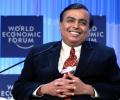
'The top 11 billionaires in India added so much to their wealth during the pandemic that it would have sustained MNREGA for 10 years or the ministry of health for 10 years.'

"A recent Columbia University study that supports that death is prevented by earlier lockdowns bears the fact that Narendra Modi's government has done an excellent job in clamping lockdown," Tennessee-based Dr Indranill Basu Ray said in a statement.
The government has earmarked Rs 100 crore (Rs 1 billion) to establish 'a comprehensive system of unique identity for the resident population of the country'. The project will focus on border areas with illegal immigration in mind. It will also facilitate speedy and efficient transactions between individuals and service providers.
In what could lead to an overhaul of policy, the Union government is looking at a new sugar subsidy mechanism as part of its decontrol proposal. It plans to rope in state governments for the purchase and distribution of sugar to below-poverty-line consumers at market prices.
National estimates of the percentage of the population falling below the poverty line are based on surveys of sub-groups, with the results weighted by the number of people in each group.

India will mark its 63rd birthday on August 15 this year. Today, India is one of the fastest growing economies in the world and is on its way to becoming a considerable force on the global stage.
The government may table the two key Bills on women's reservation and food security soon in Parliament to take the wind out of the Opposition sails.The Women's Reservation Bill, aimed at providing one-third reservation to women candidates in state Assemblies and Parliament, is bound to split the Opposition. The Food Security Bill, which will provide 25 kg of rice or wheat at Rs 3 per month to families below the poverty line, will be showcased as the government's effort.
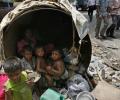
Angus Deaton's Nobel Prize should spark off more research on the measurement and usefulness of poverty percentages.
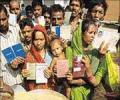
In a drastically new approach to identifying Below the Poverty Line families, the Manmohan Singh government may resort to a three-pronged approach.

The attorney general told the apex court that the invasion of privacy was very minimal in Aadhaar and it may not even be considered as an invasion.
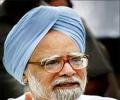
The prime minister said the country's economy was likely to grow by 7 per cent or a little more in the current financial year.

Never have I been so thankful for my decision to quit my life in Mumbai and shift to Santiniketan as I have been in these times of the coronavirus.

The Delhi high court's division bench has stayed the single bench order favouring the emergency award against the Future-Reliance deal and imposing a Rs 20 lakh fine on Kishore Biyani & other respondents. including FRL and FCPL.
The proposal aimed to provide pension for life to widows and persons with severe and multiple disabilities belonging to families below the poverty line, irrespective of age. Expenditure Secretary Sushma Nath argued that if there was no age cap, it would become "open ended" and "send the wrong message" to society. The Cabinet conceded Nath had a point and adopted the revised plan, which includes an age limit.

Various estimates of the extra cost to the government for an improved food security Bill are doing the rounds, but many agree the Union government's proposed food subsidy bill would double.
'The poor must be allowed to self select themselves. A poor family must be given a ration card on demand and the government must accept responsibility for providing subsidised food grain.'

The Delhi high court on Thursday upheld the Singapore Emergency Arbitrator's (EA) order restraining Future Retail Ltd (FRL) from going ahead with its Rs 24,713 crore deal with Reliance Retail to sell its business, which was objected to by US-based e-commence giant Amazon.

The survey took the poverty line at Rs 356 per person per month in rural areas and at Rs 538 in urban areas for 2004-05.
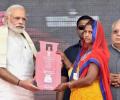
One of the major challenges before the government is that the annual average refill by a PMUY consumer is 3.28 cylinders compared to seven for others.
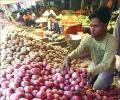
Agriculture Minister Radha Mohan Singh said whenever BJP came to power, prices of essential commodities saw a fall.

Continuing his tirade against the Congress leaders, he said that like others, he never compromises when it comes to patriotism and self-respect.
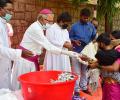
'The COVID-19 pandemic is going to send an unprecedented number of low-income households deep into poverty,' says Geetanjali Krishna.
Employment generation in the midst of a global meltdown will be the central idea of the Interim Budget that the United Progressive Alliance will present on February 16, just ahead of the general elections.
This is an increase of $1.1 billion over the previous year, the World Bank said on Thursday, adding that it invested $6.6 billion in 89 projects to promote economic growth, fight poverty and assist private businesses. This includes nearly $2 billion in infrastructure financing, a critical sector to provide the foundation for rapid recovery from the crisis and job creation.
The party also promised to would provide salt at 25 paise per kg to BPL families, state unit president Raghuvar Das said while releasing the manifesto in the presence of Chhatisgarh Chief Minister Raman Singh. Construction of three lakh houses to be allotted to those not having accommodation and ration cards to every family within three months was also among the promises held out.
The Centre had earlier in July 2008 launched the scheme to supply subsidised oil to the poor, which was valid till March 31, 2009. The government could not take a view on the scheme because of the general elections. With the United Progressive Alliance coming to power with an increased majority, sources said the scheme may be re-introduced in this year's Budget to benefit poor households. Moreover, they added, subsidy outflow is not likely to be very high.
The Centre has begun consulting states on implementing its Rs 3 per kg rice/wheat scheme for the poor, but discussions got stuck on what would be the basis for defining the beneficiaries.

The development is being seen as a blow to the opposition Congress which was planning to forge a grand alliance in Chhattisgrah to unseat the ruling BJP.
"There are several ways in which poverty can be measured . . . the National Sample Survey is the basis for calculating poverty on headcount basis. However, when minister of state for planning V Narayansamy said 'poverty line is being assessed', there was an uproar in the House and Joshi was joined by CPI-M- MP Brinda Karat, who wanted a satisfactory reply from the minister.
The government is actively considering bringing 355 life saving drugs under price control and take a few additional measures to help the poor and below poverty line (BPL) families, once the Union Cabinet approves National Pharmaceutical Policy.
'Pay Rs. 30 and insure free treatment up to Rs. 30,000.' That is the latest slogan of the Manmohan Singh government, which has provided such a unique insurance cover to those below the poverty line (BPL) for the first time in the history of the country.
The government on Monday said it will soon introduce a Bill to enact a Food Security law that will provide 25 kg of rice and/or wheat at Rs 3 to each family below the poverty line - a key poll promise of the Congress that heads the ruling coalition.
Telugu Desam president N Chandrababu Naidu launched his campaign for the next elections with a slew of populist promises offering goodies to different sections. Addressing a huge public meeting, marking the conclusion of his 117-day-long Mee Kosam Yatra (For You Yatra) at Anantapur on Friday evening, Naidu promised 13-hour-free electricity supply to farmers, against the supply of seven hours now.
It proposed that smart cards be issued to BPL families for supply of subsidised kerosene in urban and semi-urban areas to cut diversion of the fuel to unintended users. The panel also suggested a cash transfer system, whereby funds can be transferred to BPL families through a banking or postal system for purchasing of kerosene, instead of supplying the fuel much below the market price.
Montek Singh Ahluwalia appealed to the Indian Diaspora at the PBD gathering to support health care ventures of the Indian government, for people below the poverty line.
