
The Indian services sector expanded at the strongest rate in 12 years in February supported by favourable demand conditions and new business gains, a monthly survey said on Friday. The seasonally adjusted S&P Global India Services PMI Business Activity Index rose from 57.2 in January to 59.4 in February -- its highest level in 12 years. For the 19th straight month, the headline figure was above the neutral 50 threshold. In Purchasing Managers' Index (PMI) parlance, a print above 50 means expansion while a score below 50 denotes contraction.

'Rhetoric and chest-thumping are running high on India's recent growth record.'
'But will the giant waves developing elsewhere allow us to sail smoothly into fair winds?' asks Debashis Basu.

The government had in May last year disallowed $1.005 billion expense of RIL on the flagging KG-D6 gas fields for not implementing the approved field development plan.

Uttarakhand saw the sharpest decline (of 11 per cent) in the "total persons engaged" in manufacturing in the worst-hit pandemic year of 2020-21 as industrial units shut shop, according to the latest Annual Survey of Industries (ASI) data, released by the Ministry of Statistics and Programme Implementation (MoSPI). This was followed by the decline in the workforce in states such as Jharkhand (8.9 per cent), West Bengal (8.3 per cent), Kerala (8 per cent), and Karnataka (7.8 per cent). The "total persons engaged" in an enterprise is defined as the sum of directly employed workers, supervisory or managerial workers, and the unpaid family members who might be engaged in the enterprise.

As per the first advance estimates of national income released by the National Statistical Office (NSO) on Friday, the manufacturing sector output is estimated to grow to 6.5 per cent in the current fiscal compared to 1.3 per cent in 2022-23. Similarly, mining sector growth is estimated at 8.1 per cent in the current fiscal against 4.1 per cent in 2022-23.

SII would be scaling up its AstraZeneca-Oxford vaccine manufacturing capacity to 200 million doses a month from 100 million a month now, reports Sohini Das.

Coal, electricity and cement production in particular, along with an uptick in demand for India's products abroad, are also expected to have contributed to overall factory output growth in September.
Rising production from OPEC as well as the US also weighing on prices

Consumer goods firms and auto companies are witnessing an upturn in rural demand, which had been lagging for most of FY24. Expectations of a bumper rabi crop harvest have helped turn the tide. The Reserve Bank of India's (RBI's) Monetary Policy Committee kept the repo rate unchanged last week, noting that as rural demand catches up, consumption is expected to support economic growth in 2024-25.

The Indian economy is projected to grow at 6.3 per cent in current financial year aided by investment and domestic demand. According to a World Bank report released on Tuesday, India continues to show resilience against the backdrop of a challenging global environment. In India, which accounts for the bulk of South Asia region, growth is expected to remain robust at 6.3 per cent in 2023-24, India Development Update of the World Bank said.

The "composed" set of newcomers in the Indian team don't need frequent advice, they need just a supportive environment to excel, said skipper Rohit Sharma after the young guns played a major part in the hosts' series-sealing win over England in the fourth Test in Ranchi on Monday.

Industrial output expanded 1.4 per cent in April after two months of decline, leading experts to predict that the economy had bottomed out. A return to 8-plus per cent industrial expansion was, however, some time away, they added.
The decline has been mainly on account of a fall in manufacturing, the output of which contracted by 3.3 per cent during March. The sector, which accounts for almost 80 per cent of the index, registered an increase of 5.7 per cent during the same month in 2008.
ArcelorMittal is likely to have to make permanent cuts of up to 10 per cent in its steelmaking capacity as the industry reels from the impact of the worst global recession in decades, industry observers have warned.
Mumbai High during normal days produces 2,42,000 barrel per day (bpd) of crude oil while another 70,000 bpd is contributed by Heera and Neelam fields. The rest comes from South Bassein field, all lying off the west coast. Natural gas production from these fields had fallen to almost nil, impacting supply to industry and city gas operations in Mumbai.
India's industrial production rose 4.9 per cent year-on-year in April, the first month of the current financial year, the official Central Statistical Organisation said on Thursday.

Stock markets will be largely driven by global trends and macroeconomic data announcements in a holiday-shortened week which may see volatility amid monthly derivatives expiry, say analysts. Equity markets will remain closed on Monday for Gurunanak Jayanti. Trading activity of foreign investors and the movement of the rupee against the dollar will also be tracked by investors.

India will not tailor its policies to suit US EV maker Tesla, and its laws and tariff rules will be formulated to attract all-electric vehicle manufacturers from across the world to set up a base in the world's fastest-growing economy, Commerce and Industry Minister Piyush Goyal said. Tesla has been seeking an initial tariff concession that would allow it to offset 70 per cent customs duty for cars priced less than $40,000, and 100 per cent for cars of higher value.

Sugar prices are hovering near six-year highs, leaving a bad taste in Indian consumers' palates but sweetening the portfolios of investors in related stocks at Dalal Street. Shares of sugar manufacturers such as Piccadily Agro, DCM Shriram, Magadh Sugar, and Bajaj Hindustan have rallied up to a whopping 200 per cent so far in the financial year 2024 (FY24) as deficient monsoon rains in major sugarcane producer states like Maharashtra and Karnataka are expected to lead to a shortfall in sugar output ahead. In comparison, the BSE Sensex has modestly gained 11 per cent during this period.
His comments assume significance as this is the first time that a senior government official has spoken on the possible impact of below normal rains on agriculture production.

The latest PMI showed inflation pressures ebbed further last month with both costs of raw material and prices charged rising at a slower pace than March.

Manufacturing's share in the profit pool of companies had declined before the pandemic.

Private sector output in India expanded for the first time in 8 months in February as slump in the services sector moderated and manufacturing grew at a stronger pace, an HSBC survey said.
Despite severe drought in fiscal 2002-03, India's agricultural output is enough to sustain the country, Union Agriculture Minister Ajit Singh said on Thursday.
The two nations doubled their GDP per capita in 16 and 12 years respectively while US took 50 years.

Reliance Industries, which has seen output from its prolific KG-D6 fields fall by 15 per cent, can raise production to 67-68 million cubic metres of gas a day by next month if it can drill additional wells.

'Everyone confuses GDP to be a measure of output, when it is actually a measure of income.'
India's agricultural output declined during the year 2002-03 to 183 million tonne compared to 212 million tonne produced in previous year, a drop of 13.9 per cent, according to Centre for Monitoring Indian Economy.

'Our unsecured loan is not exactly unsecured. It is backed by cash flow of customers.'

The argument that India is going towards a 'Hindu rate of growth' is "ill-conceived, biased and pre-mature" when weighed against the respective data on savings and investments, said SBI Research in its Ecowrap report. The term Hindu rate of growth was coined by economist Raj Krishna in 1978, which denoted the economic growth of about 3.5-4.0 per cent in terms of GDP during 1947-1980. "India's quarterly sequential Y-o-Y GDP growth has been in a declining trend in FY23.
In its annual work program submitted to upstream oil regulator Directorate General of Hydrocarbons, Reliance stated that natural gas output from Dhirubhai-1 and 3 or D1 and D3 gas fields in the block KG-DWN-98/3 or KG-D6, will be about 38 mmscmd in 2012-13 from current production level of 43-44 mmscmd.

DRDO's failures over the decades have contributed significantly to India becoming the world's biggest weapons importer, points out Lieutenant General Prakash Katoch (retd).

A below-normal monsoon is likely to drag down the food output with India's agricultural GDP growth likely to slump to 0.8 pc in the current fiscal, says a report by the Japanese brokerage firm Nomura.
Sluggish rise in new business inflows and a cautious approach to costs reportedly led Indian manufacturers to shed jobs in September.

The HSBC/Markit Purchasing Managers Index for the services industry fell to 46.7 in December from 47.2 in November, registering the sixth consecutive monthly drop in output levels, the longest period of continuous reduction since the 2008/2009 global financial crisis.
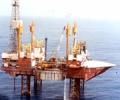
RIL produced a total of 22.04 mmscmd of gas from Dhirubhai-1 and 3 gas fields and MA oil and gas field in the KG-DWN-98/3 or KG-D6 block in Bay of Bengal in the week ended December 30, 2012, the Directorate General of Hydrocarbons said in a production status report to the Oil Ministry.

Among the Sensex firms, Asian Paints, Tata Steel, HCL Technologies, Nestle, Maruti, JSW Steel, NTPC and Larsen & Toubro were the major laggards. Sun Pharma, Bajaj Finserv, Reliance Industries, State Bank of India and Bharti Airtel were the gainers.
A surge in manufacturing pushed up the country's industrial growth to 12.9 per cent in March 2007, taking the expansion during 2006-07 to 11.3 per cent.
India's industrial output rose 5.8 per cent in the year to March 2003 boosted by a robust manufacturing sector despite fears the country's worst drought in 15 years would hurt demand in Asia's third-largest economy.
