
The growth of these core sectors -- coal, crude oil, natural gas, refinery products, fertiliser, steel, cement and electricity -- was 4.6 per cent in April 2023.

India's industrial production growth accelerated to 16-month high of 11.7 per cent in October, mainly due to double-digit growth in manufacturing, power and mining sectors' output, according to the official data released on Tuesday. The factory output growth measured in terms of the Index of Industrial Production (IIP) had contracted by 4.1 per cent in October 2022. The previous high of IIP growth was recorded at 12.6 per cent in June 2022.

The Reserve Bank of India's (RBI's) caution on inflation, highlighted during the recent monetary policy meeting, may put investors' faith in fast moving consumer goods (FMCG) stocks to test, analysts said. They, however, believe FMCG stocks may ride through this near-term investor anxiety as related companies are, typically, well-equipped to handle inflation due to their pricing power and steady demand for essential goods.

The services sector growth in India rose to a six-month high in January as new business expanded at a faster pace amid buoyant demand from domestic and external clients, a monthly survey said on Monday. The seasonally adjusted HSBC India Services PMI Business Activity Index rose to 61.8 in January, up from 59 in December, pointing to the sharpest rate of expansion in six months.

Against the Reserve Bank of India's (RBI's) projection of 7.1 per cent, India's first quarter (Q1) 2024-25 (FY25) gross domestic product (GDP) growth came in at 6.7 per cent. This is in line with market expectations and significantly lower than the 7.8 per cent recorded in the fourth quarter (Q4) 2023-24 (FY24) and 8.2 per cent in Q1FY24. The quarter witnessed decreased government consumption and investment spending due to the parliamentary election.

India's industrial production growth decelerated to 5.8 per cent in September from 10.3 per cent in August, though on an annual basis, the output of manufacturing and mining sectors showed an improvement, according to the official data released on Friday. The factory output growth measured in terms of the Index of Industrial Production (IIP) had grown by 3.3 per cent in September 2022. During April-September 2023-24, the IIP growth works out to be 6 per cent, down from 7.1 per cent in the corresponding period a year ago.

Infrastructure accounts for nearly 38 per cent of India's industrial output

Release of key macroeconomic numbers, monthly derivatives expiry, and global cues are likely to drive stock market movement this week, according to analysts. Markets will also be reacting to remarks made by the US Federal Reserve Chair Jerome Powell, they said. "This week, we expect the market to witness a gradual up-move with stock-specific action.

This growth seen by the consumer goods was led mainly by the durables market, which rose 17.6%, the highest in 11 months

Flour millers want import duty exemption.

'We are going to need more technical people in government.' 'You can't expect a generalist to understand the complicated world of financial engineering.' 'I regret to say that most of our politicians have no competence to deal with these things. Nor is there a willingness to learn.'
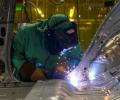
The manufacturing sector, which constitutes 77.63 per cent of the IIP, contracted by 0.4 per cent in March as compared to 5.7 per cent expansion in the year-ago month.

Infra segment, refinery product impacted the most, even as contraction narrows in latest month.

The US Fed interest rate decision, ongoing quarterly earnings, macroeconomic data and FII trading activity are the major triggers that will drive stock markets this week, analysts said. Investors would also track global market trends and the movement in global oil prices for further cues. "This week, the focus will shift to global cues, particularly the US markets," Santosh Meena, Head of Research, Swastika Investmart Ltd said.

India's manufacturing sector growth fell to 18-month low in December amid softer increase in factory orders and output, despite minimal inflation, a monthly survey said on Wednesday. The HSBC India Manufacturing PMI survey, conducted by S&P Global, showed that there were softer, albeit sharp, increase in factory orders and output, while business confidence towards the year-ahead outlook strengthened. The seasonally adjusted HSBC India Manufacturing Purchasing Managers' Index (PMI) fell from 56 in November to an 18-month low of 54.9 in December.

Tomato prices have been on the boil for more than a month. Data from major cities show that the spike has been between 125 and 150 per cent at the wholesale level. Soaring vegetable prices, including tomatoes, pushed the retail inflation rate to a nine-month high of 5.49 per cent in September, according to government data. Though reports say prices are expected to come down in the next few weeks after supplies improve from Madhya Pradesh and Himachal Pradesh, how long will the respite last is anybody's guess.

Trade and market players have already started factoring in at least 10 million tonnes drop in production in rice in the kharif season as compared to last year due to delayed sowing.

The Reserve Bank of India, which mainly factors in retail inflation to decide its monetary policy, has been tasked by the government to ensure the rate of price rise remains around 4 per cent.

India's industrial output unexpectedly rose 1.2 per cent in May from a year earlier, led by a pick up in manufacturing, government data showed on Tuesday.

The government clarified that the majority of industrial establishments had reported nil production, and cautioned that the numbers should not be compared with those of previous months. "It is not appropriate to compare the IIP of April 2020 with that of earlier months, and users may like to observe the changes in the IIP in the following months," said the ministry of statistics & programme implementation.

Haryana has done well in terms of economic growth over the last couple of decades. For it to continue to lead the growth ladder, the new government has to work hard on multiple dimensions, recommend Shishir Gupta and Rishita Sachdeva.

The internals of the food inflation are worrying, given a broad-based uptick across categories that tend to be sticky, such as proteins, and a narrower-than-expected reduction in inflation for vegetables.

'Investment creates capacity and reduces inflation. Income, employment, and savings rise.'

Salaar Actor Sriya Reddy will be seen in the political thriller Thalaimai Seyalagam.

As per use-based classification, primary good registered a growth of 7.4 per cent, intermediate goods 22.4 per cent, and infrastructure/construction goods 0.1 per cent in February 2020 as against the same period a year ago.

India's foodgrain production is estimated to decline by 7.51 per cent to 216.85 million tonnes in the 2009-10 season mainly due to a fall in summer output owing to the worst drought in 30 years.

From the Sensex basket, Kotak Mahindra Bank, HCL Technologies, ICICI Bank, Infosys, Tata Consultancy Services, Wipro, Tech Mahindra and Larsen & Toubro were the major laggards. Mahindra & Mahindra, Nestle, Tata Motors and IndusInd Bank were among the gainers.

A resurgence in Saudi Arabian supplies of crude oil to India coupled with an attack on an Iraqi tanker in August carrying crude to Europe may result in improved bargaining power for India with West Asian and Russian suppliers for winter supplies. Shipments of Saudi oil rebounded in September from August, surging to the highest since March while Russian oil shipments rose marginally as Saudi Arabia tried to claw back market share in Asia, according to industry sources and ship tracking data.

The oil industry experienced three upheavals between 1973 and 1991, which seem to be etched in the memory of the industry's decision makers. Naturally, at the sign of a new crisis, the decision makers like to dip into those tumultuous decades to find ways to deal with the new shock, in addition, of course, to expert reports and forecasts. So, the industry bigwigs turned the pages of history to get a peek into the future of oil price movements after Russia invaded Ukraine in 2022, Israel attacked Gaza in 2023, Iran-linked Houthi rebels pounded tankers crossing the Red Sea in support of Palestine the same year, and Iran rained missiles on Israel in 2024.

The output of eight key infrastructure sectors jumped by 12.1 per cent in October 2023 against 0.7 per cent expansion in the year-ago period on account of a sharp uptick in production of coal, steel, cement and electricity, according to the official data released on Thursday. These numbers assume significance as the eight core sectors -- coal, crude oil, natural gas, refinery products, fertiliser, steel, cement and electricity -- contribute 40.27 per cent to the Index of Industrial Production (IIP). Growth was primarily driven by a low base effect and double-digit growth in four sectors -- coal, steel, cement and electricity.
The IIP data showed a significant slowdown in the manufacturing sector, which grew at 4.2 per cent in July 2019 as compared to 7 per cent a year ago.
India's industrial production growth rose to a 14-month high of 10.3 per cent in August, mainly due to good show by the manufacturing, mining and power sectors, according to the official data released on Thursday. The factory output growth measured in terms of the Index of Industrial Production (IIP) had contracted by 0.7 per cent in August 2022. The previous high was recorded at 12.6 per cent growth in June 2022.

Annual growth in electricity production last month slowed to 4.6 per cent from 14.7 per cent in April.

Analysts polled by Reuters had expected output to grow 0.7 per cent annually.

Jobs requiring AI skills carry a significant wage premium, with some roles offering up to a 25 per cent increase in wages, notes Manoj Nagpal, vice president, professional services, OpenText, an information management company.

The services sector growth in India moderated in February amid softer expansions in business activity, sales and jobs, a monthly survey said on Tuesday. The seasonally adjusted HSBC India Services Business Activity Index registered 60.6 in February, down from 61.8 in January. In Purchasing Managers' Index (PMI) parlance, a print above 50 means expansion, while a score below 50 denotes contraction.

Riding high on the hopes of a normal monsoon, the agriculture ministry aims to increase foodgrain production by 6.35 million tonnes to a record 298.3 million tonnes in the 2020-21 crop year. The foodgrain output in the 2019-20 crop year (July-June) is estimated at an all-time high 291.95 million tonnes, as per the second advance estimates released by the ministry in February.

'Ekta has evolved to the extent that she understands the fight to keep the cinemas alive, to keep collective viewing alive.'

Manufacturing sector, which constitutes over 77 per cent of the index, showed a decline of 0.4 per cent in June as compared to a growth of 7.5 per cent in the same month last year.
Reserve Bank on Thursday retained the growth and inflation projection at 7.2 per cent and 4.5 per cent respectively for the current fiscal amid expectations of a normal monsoon. In its last bi-monthly monetary policy review in June, RBI had projected real GDP growth and retail inflation at the same.
