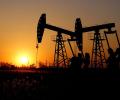
India possesses approximately 100 million barrels of commercial crude oil stocks, capable of covering 40-45 days of its requirements if flows through the Strait of Hormuz are disrupted, according to Kpler.

What we are watching is something different: A fog manufactured and maintained by the people who started the war, so that the question of why it was started never has to be answered, observes Prem Panicker in his must read blog on the war in the Middle East.

'The entire US ecosystem built over decades at the bases in the Gulf region, especially the UAE, costing trillions of dollars have been decimated, dealing a mortal blow to the US Central Command's war capability,' points out Ambassador M K Bhadrakumar.

Israel and the United States had a plan. Iran punched back. And now the Gulf is reeling, the world is beginning to feel the pain and, as on date, no one in Washington or Tel Aviv appears willing to admit that the punch has landed, notes Prem Panicker, continuing his must-read blog on the war in the Middle East.
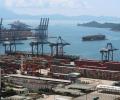
With the Iran war escalating sharply and crisis deepening in the global energy market, India on Monday unveiled a coordinated plan to support exporters and shippers caught in the fallout.

When missiles fly in this region, they are never just aimed at military targets.

'Without ground troops the US will not be able to oust the Iranian Islamic regime. Political change does not happen just by using bombs or planes.'

Finance Minister Nirmala Sitharaman's biggest challenge will be to find a new growth driver, particularly against the backdrop of a global economy ravaged by heightened uncertainty and fragmentation, financial markets on a precipice, and global commodity prices on a continued uptrend.

The rupee appreciated 13 paise to close at 90.34 against the US dollar on Thursday, on trade deal optimism and overnight decline in commodity prices, even as the upside remained capped as investors look for more clarity on the India-US trade deal.

When everyone has footage and no one can verify it, the loudest voice wins, notes Prem Panicker who begins a daily blog on the War in the Middle East.

Market sentiment is likely to remain cautious as investors position themselves for the upcoming Union Budget and the US Fed's interest rate decision, where expectations are muted.

In an event-heavy week ahead, stock markets are expected to track Q3 corporate earnings from several blue-chip firms, including TCS and Infosys, while inflation data and global trends would also dictate investors' sentiment, analysts said.

The rupee breached 90-levels against the greenback for the first time on Wednesday, falling 6 paise to 90.02 in early trade, as banks kept buying US dollars at higher levels and FII outflows continued.

'We believe the truth is in the middle, and that India is at an important crossroads.'

India could save $1 billion in crude oil imports annually if the country switches 10 per cent of its diesel usage in the transport sector to liquefied natural gas.

The fiscal tilt towards capex benefits companies in investment-related sectors like capital goods, defence equipment, engineering & construction and metal & mining. The planned cut in revenue expenditure will weigh on companies in consumption sectors like FMCG, consumer durables and retail.

The US government, under President Trump, justifies the intervention as a security necessity rather than a resource grab. The primary official reasons include: narco-terrorism charges, national security and migration crisis.
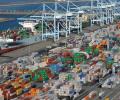
'The immediate impact for India will be very minimal as the share of Venezuela in our total overseas production is very low.'

Analysts at Morgan Stanley have updated their outlook for the Indian markets, and they now expect the Sensex to hit the 107,000 mark by December 2026 in a bull-case scenario, translating into an upside of 26 per cent from current levels.

From the 30-share blue-chip pack, Zomato cracked nearly 7 per cent. Power Grid, Adani Ports, Tata Steel, NTPC, Tata Motors, Tech Mahindra, Mahindra & Mahindra, Asian Paints, Sun Pharma and UltraTech Cement were the other major laggards. In contrast, Axis Bank, Hindustan Unilever, Tata Consultancy Services and IndusInd Bank were the gainers.

Shares of tyre manufacturers have outperformed broader equity benchmarks, buoyed by multiple tailwinds. Softer raw material prices, an uptick in demand from automakers following the reduction of the goods and services tax (GST) rates, and steady replacement demand have lifted sentiment toward the sector.

The Indian economy is likely to grow at 7.4 per cent in 2025-26, up from 6.5 per cent in the previous fiscal, mainly on account of better performance of manufacturing and services sectors, as per the government data released on Wednesday.

Stock markets are likely to trade in a range-bound manner in a holiday-shortened week where trading activity of foreign investors, currency movement and global macroeconomic data announcements are expected to drive sentiments, analysts said. Several global markets may see subdued activity on account of Christmas and New Year holidays, an expert said.

Baghaei also alleged that recent unrest in Iran was fuelled by foreign interference, claiming riots were triggered by "very evident" interventionist remarks by US and Israeli officials.

The rupee fell 23 paise against the greenback to settle at a new all-time low of 91.01 (provisional) on Tuesday, weighed down by relentless foreign fund outflows, no breakthrough in India-US trade deal, and persistent US dollar buying.

The rupee recovered 55 paise from its all-time low level to close at 90.38 against the US dollar after a volatile trade on Wednesday, amid suspected aggressive central bank intervention.
The Indian rupee, swaying through multiple headwinds, tiding over global trade disruptions and massive foreign fund outlfows, is unlikely to arrest its descent until tariff impact overhangs, notwithstanding robust domestic macroeconomic tailwinds. The Reserve Bank of India (RBI), which sees the rupee's depreciation as a silver bullet to offset the tariff shock, expects the currency to find its stable course once India reaches a trade deal with its largest trading partner, the US.

Asian Paints reported a good performance for the second quarter (July-September) of 2025-26 (Q2FY26), with some help from base effects, despite strong competition and extended monsoon. Volume grew in low double digits in the key domestic decorative paints, and value in that segment grew by 6 per cent. Ebitda (earnings before interest, taxes, depreciation, and amortisation) grew 21 per cent year-on-year (Y-o-Y), and PAT (profit after tax) grew 14 per cent. Asian Paints also defended market share better after several quarters where it had lost ground to Birla Opus.

The recent surge in crude oil prices could shave off the gains made by India Inc in profit margins in the past few quarters. Worse, it comes at a time when consumer demand in the country is slipping and major global economies are witnessing a slowdown. A back-of-the-envelope calculation suggests that the margin expansion accounted for three-fourths of the rise in the listed firms' operating profit between the April-June quarter (Q1) of FY23 and Q1FY24, and only a quarter of profits gains came from revenue growth.
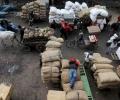
Notwithstanding global headwinds, the Indian economy saw further momentum in October on the back of goods and services tax (GST) rate rationalisation and festival spending, as indicated by high-frequency indicators, the Reserve Bank of India's (RBI's) monthly State of the Economy report said.

Among Sensex firms, Bajaj Finserv, Bajaj Finance, Tata Steel, Reliance Industries, Sun Pharma, Tata Motors Passenger Vehicles, Axis Bank and Infosys were among the major gainers. Bharti Airtel and Asian Paints emerged as the laggards from the pack.

Whether Trump will actually press ahead with the oil sanctions remains unclear, since keeping Russian oil out of the world market risks high oil prices which could boomerang on the US economy and be damaging politically for Trump, points out Ambassador M K Bhadrakumar.

India's decision to import LPG from the US helps it to diversify sources as it reduces almost full reliance on West Asian countries for supply of the country's primary cooking fuel.

Sanctioning Russian oil would have led to a sharp surge in oil prices to above $80 per barrel levels, which would impact pump prices in the US ahead of midterm elections next year.

The ministry of finance is likely to assume crude oil price to remain within $85 per barrel while estimating subsidies for the Interim Budget 2024-25 (FY25), to be presented on February 1. Brent crude prices moved up on Thursday, ending at $78.9 per barrel. Crude oil and cooking gas prices, which move in tandem, impact fertiliser and cooking gas subsidies, constituting 53 per cent of the government's total subsidies.

Stock market sentiment is likely to remain optimistic going ahead, though some consolidation cannot be ruled out after the recent sharp rally in the benchmarks, analysts said. According to experts, the Nifty and Sensex could indeed move towards new record highs before the end of the year, if global cues stay supportive, crude oil prices remain benign and there is continued domestic earnings momentum.

The best way for India to prepare is by preserving and strengthening the RBI's hard-won credibility, point out Rajeswari Sengupta and Vaishali Garga.

Equity market investors would track global trends, foreign fund movement and quarterly earnings in a holiday-shortened week ahead, analysts said. Stock exchanges BSE and NSE will conduct a special Muhurat trading session on Tuesday, October 21.

'An asset must generate income. Equities yield dividends, bonds pay coupons, deposits give interest, and real estate earns rent.' 'Gold, silver, and even Bitcoin produce no income, they merely store value. So, they should not be compared to productive assets.'
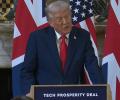
During a visit to the UK, former US President Donald Trump reiterated his claim of intervening to resolve a conflict between India and Pakistan, linking it to trade negotiations. He also discussed tariffs on India for buying Russian oil and the Russia-Ukraine conflict.
