
The Indian American community and US business that had lobbied feverishly for the Indo-US civilian nuclear deal, are euphoric over the recent developments where Prime Minister Manmohan Singh has decided to go ahead with the accord come what may and even in the wake of the Left coalition partners withdrawing their support and leaving the country in a state of political uncertainty.
Advani met RSS chief K Sudarshan and VHP leaders Ashok Singhal and Parveen Togadia to discuss current political situation in the country. At least 15 top leaders of the RSS and the VHP were also present.
A large number of AIADMK cadre, led by former Minister D Jayakumar, had gathered in the area and resisted the entry of Congressmen resulting in a scuffle between the two groups.
The Left parties on Thursday launched a scathing attack on the government for approaching the International Atomic Energy Agency for the safeguards agreement in the nuclear deal before a trust vote in Parliament, terming the move as a "shocking betrayal of a moral commitment" made to the country.
The PMO issued a press release virtually repeating its earlier assurances that the deal did not undermine India's nuclear sovereignty or did any harm to the country's interest. At a press conference later, Singh said the prime minister should come out with a public statement either in Parliament or outside assuaging their concerns as they were not in a position to support the deal as of now.
Samajwadi Party general secretary Amar Singh, who was once hounded out of 10 Janpath soon after the United Progressive Alliance government took over four years ago, triumphantly announced on Tuesday that the National Security Advisor M K Narayanan would call on him at his residence on July 2 to explain the government's position on the Indo-US civil nuclear deal.
During the meeting, held at the residence of Pranab Mukherjee, the government's pointsman for the deal, Samajwadi Party leader Amar Singh was understood to have been briefed about the deal and the steps India would have to take in the coming weeks to push it through.
Prime Minister Manmohan Singh on Monday played down the Left parties' threat to withdraw support from the United Progressive Alliance government over the nuclear deal. Once negotiations are over on the nuclear deal the government will come to Parliament before operationalising the deal, Dr Singh said.
The Telugu Desam Party (TDP), a key partner of the United National Progressive Alliance (UNPA), on Friday dismissed as "speculative" media reports suggesting that Samajwadi Party may come out in support of the Indo-US nuclear deal and bail out the Congress-led UPA government.
Wednesday's critical United Progressive Alliance-Left meeting on the Indo-US nuclear deal ended with both sides agreeing to meet again soon. The date for the same is yet to be finalised
China has apparently decided to adopt a flexible stand on the Indo-US nuclear deal by expressing willingness to do some "creative thinking" along with the international community in the Nuclear Suppliers Group.
Everybody would like the Sri Lankan Tamils to live in peace first and with equal right to the Sinhalese. Even I, a vehement critic of the LTTE and also very much against the Centre intervening the military action against the LTTE, have been saying that the Indo-Sri Lankan accord must be implemented in full by Sri Lanka, says political analyst Cho Ramaswamy.
Former chairman of Atomic Energy Commission Dr. P K Iyengar, former chairman of Atomic Energy Regulatory Board Dr A Gopalakrishnan and former director of Bhabha Atomic Research Center Dr.A.N. Prasad say that there is a great deal of disquiet among the scientific community at large about the deal. They also said they met the Prime Minister Manmohan Singh and discussed about the after-effects of the deal, besides writing to the MPS.
Sonia held discussions with Nationalist Congress Party president Sharad Pawar, Rashtriya Janata Dal leader Lalu Prasad and Lok Janshakti Party chief Ram Vilas Paswan in an effort to break the logjam over the issue that has created a face-off between the Congress and the Left parties. The leaders of the UPA constituents conveyed to Sonia that they back the nuclear deal, but do not favour early polls, particularly because of high inflation.
Defence Minister A K Antony has deferred his visit to Japan, scheduled from June 28, apparently in view of the political developments surrounding the Indo-US nuclear deal. Antony was to undertake a five-day visit aimed at enhancing defence cooperation between the two countries.
Prime Minister Manmohan Singh continues to be unwell, External Affairs Minister Pranab Mukherjee has postponed his visit to Australia by a day and Communist Party of India-Marxist General Secretary Prakash Karat has warned that the Left will withdraw support to the United Progressive Alliance government by Wednesday if the UPA continues to pursue the India-US nuclear deal.
"The increasing strategic connections between the US and India should progress to closer military coordination and cooperation," Cohen said.
The Left parties have steadfastly opposed the 123 agreement for civilian nuclear cooperation with the United States. The United Progressive Alliance-Left Committee on Indo-US civil nuclear cooperation was constituted to discuss the problems arising out of the provisions of the Hyde Act and its impact on the 123 agreement.
External Affairs Minister Pranab Mukherjee rejected suggestions that the United Progressive Alliance government's capacity to operationalise the deal has weakened after the Congress' debacle in Gujarat and Himachal Pradesh assembly elections. "We would not like to proceed with the deal if the Left parties withdraw support from the government," he told Karan Thapar's India Tonight programme on CNBC.
The NSA noted that India has offered to put in a dedicated national facility all the fuel that the US will supply as also the fuel New Delhi will get from other countries.
Even as the Indo-US nuclear deal is gathering dust on the backburner because of stiff opposition from the Left parties, Congress president and chairperson of United Progressive Alliance Sonia Gandhi on Friday underlined the importance of nuclear energy for the country at this juncture.
Srinivasan said instead of relying on nuclear energy, the country should look at available renewable sources of energy to meet the energy requirement.
US President-elect Barack Obama is a solid supporter of the growing Indo-US strategic partnership and backs the landmark bilateral nuclear deal, but has strong views about outsourcing of American jobs overseas, a cause of concern for Indian businesses.

Oil prices dipped on Wednesday as the market prepared for a gradual increase of Iranian exports into an already oversupplied market from 2016.
Ahmed filed an application seeking details about the controversial and much talked about Indo-US nuclear deal as there were apprehensions regarding the sovereignty of the country.
With the Indo-US nuclear deal already turning into a major headache for the government, the BJP on Monday asked the Congress to take a clear stand on the issue instead of blaming others.
The powerful Left members from states like Kerala and West Bengal have told the top brass that if the issue of price rise and terrorism is not handled in a politically savvy manner, then the countdown to withdraw support to the UPA government should start. Within both the Congress and the CPM, a debate is on over the future course of action. The Congress Working Committee is meeting on May 31 to discuss the Karnataka results, price rise and other hot issues.
A range of regional and international issues were discussed during the 30-minute meeting Senators Russel D Feingold and Robert P Casey Jr held with Mukherjee. Asked whether the nuclear agreement came up during the deliberations, Feingold said the two sides discussed a wide range of issues including the deal.
The White House announced on Wednesday that President George W Bush will invite Prime Minister Manmohan Singh and the other leaders of the G-20 countries for a major White House Summit to discuss the Wall Street meltdown.
Power and influence are not given. They are taken. China knows how to take it, India does not, says strategic expert B Raman.
Pakistan will build two more nuclear reactors with Chinese assistance as part of its efforts to improve civil nuclear cooperation between two close allies, a top official said today.
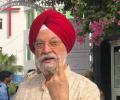
In his book Arun Bhatnagar, a retired IAS officer, makes a dig at Hardeep Singh Puri, former diplomat, Union minister and BJP nominee from Amritsar Lok Sabha seat, for Rajiv's faulty Sri Lankan policy, writes Rasheed Kidwai.

US President George W Bush on Thursday signed into law the legislation to implement the historic Indo-US civil nuclear deal paving the way for the two countries to formally ink the 123 agreement on Friday.
In the 1980s, there were about 400 nuclear suppliers and 900 nuclear-certified companies in the US. These have shrunk to fewer than 80 suppliers and 200 certifications.
Opposing the killer amendments to the legislation on the Indo-US nuclear deal, Democratic and Republican floor managers in the Senate today said that these were "unnecessary" and asked Senators to fall in line by passing the legislation without any change.
The UPA-Left Committee on the Indo-US nuclear deal would meet in New Delhi on Tuesday with the Left parties sticking to their guns and the government saying it would seek the sense of Parliament on the matter. The Government has said it would seek 'sense of the House' on the stalled deal before it goes to the US Congress for ratification.
JWT, Crayons in race for Congress account, BJP calls for a pitch.
Contradicting Bharatiya Janata Party's views on the nuclear deal with the United States, former National Security Adviser Brajesh Mishra has said India should go ahead with the agreement, failing which the country will have a 'severe loss of face' and suffer a setback to its atomic programme. Mishra said the deal should be concluded during the tenure of Bush administration as change of government in the US would make things difficult.
"The people of India deeply love you." This was how Prime Minister Manmohan Singh spoke of President George W Bush while praising him effusively after their 40-minute meeting at the Oval office in White House, flagging his 'important and historic' role in forging several bilateral initiatives including the civil nuclear deal.
 © 2026 Rediff.com - Investor Information - Advertise with us - Disclaimer - Privacy Policy - Sitemap - Feedback - About us - Terms of use - Grievances