
The ministry of external affairs said the artificial enlargement of territorial claims by Nepal is not based on historical facts or evidence.

The diplomat has been also charged with siding with the Nepali Congress opposition in supporting a threat by the Maoist party to topple Prime Minister K P Sharma Oli's government, according to reports.

A five-member Constitutional Bench of the Supreme Court led by Chief Justice Cholendra Shumsher Rana issued the verdict stating that President Bhandari's decision to dissolve the lower house upon a recommendation of Prime Minister K P Sharma Oli was an unconstitutional act, delivering a major blow to the veteran Communist leader who was preparing for snap polls.

Three Madhesi leaders have supported Prachanda's candidacy.

"The Prime Minister's unilateral move to conduct fresh election by allowing to dissolve the most representative Constituent Assembly was aimed at capturing power and this has created frustration in the minds of the general public," said a joint statement issued by five parties.
Hundreds of opposition-backed protesters demanding the resignation of Nepal's Prime Minister Baburam Bhattarai on Monday attacked his motorcade and clashed with riot police at the airport in Khatmandu.
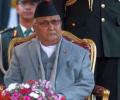
Deuba was elected as the 40th prime minister on June 6 with the support from Communist Party of Nepal-Maoist Centre, which is now a part of Left alliance and opting for merger with Communist Party of Nepal-Unified Marxist-Leninist.
Amid mounting pressure from the main opposition Nepali Congress and detractors within the ruling Communist party, Nepal's embattled Prime Minister Jhala Nath Khanal has said he would quit by next week if there was no "concrete" progress in the 2006 peace process.
Prime Minister Manmohan Singh's special envoy Shyam Saran started hectic parleys with Nepalese leaders on Thursday to help form a consensus government amidst deepening political crisis in Katmandu.

Nepal's former Prime Minister Krishna Prasad Bhattarai, the last of the country's veteran leaders who founded Nepali Congress, died at the age of 87 late on Friday night.

President Bidya Devi Bhandari administered the oath of office and secrecy to Oli, 69, at a ceremony at Shital Niwas, after he was reappointed to the post on Thursday night as the Opposition parties failed to secure majority seats in Parliament to form a new government.

Now, the bill will undergo a similar process in the National Assembly, wherein the ruling Nepal Communist Party commands two-thirds majority.
In a major breakthrough, Nepal's ruling coalition partners on Saturday sorted out the vexed issue of portfolio distribution and power sharing after they 'tentatively agreed to a deal' to give the 20-day-old Communist Party of Nepal-Unified Marxist Leninist government a "full shape" by Sunday.
A day before the declaration of abolition of monarchy, the Maoists in Nepal agreed to the provision of a ceremonial president with executive powers to prime minister. Initially, the Maoists wanted a presidential system and a ceremonial prime minister. However, other major political parties--Nepali Congress and UML-- wanted the prime minister with executive powers and a ceremonial president.
The opposition Nepali Congress had sought Prachanda's resignation after the Maoist government was reduced to a minority in the wake of CPN(UML) pulling out in protest against the decision to sack the Army Chief.
Nepalese Prime Minister Girija Prasad Koirala on Thursday resigned from his post, ending a two-month long deadlock to pave the way for the country's first ever Maoist-led government. Koirala, 83, announced his resignation while addressing the Constituent Assembly, which was elected in April to rewrite the constitution and govern the Himalayan nation, Nepali Congress Assembly member Tirtha Ram Dangol said.

While there is no change in the strength of the Modi-led CCPA over its two tenures, what has changed is its profile.
The Communist Party of Nepal-Maoist, Nepali Congress, CPN-UML and Madhesi People's Rights Forum (MPRF) at a meeting held Monday night agreed in principle to form a coalition government under the leadership of former rebels, NC spokesman Arjun Narsingh Khatri Chhetri said.
The Seven Party Alliance, which has been at the centrestage of the democratic movement in Nepal and was instrumental in the transition of the nation from a monarchy to a republic, is virtually defunct. The Himalayan nation is witnessing a new round of political alignments and re-alignments with the CPN-UML joining hands with the CPN-Maoists, leaving behind the Nepali Congress.The UML and Maoists have reached an agreement to seek consensus with other parties on amendments.
Nepal's major parties on Wednesday failed to break an impasse over the formation of a new government as efforts to strike a deal on sharing of power proved futile. During crucial talks in Prime Minister Girija Prasad Koirala's residence here, the Maoists rejected a proposal from Nepali Congress and the CPN-UML to amend the interim constitution to remove a provision requiring two-thirds majority for forming or unseating the government.
Ending a political deadlock, Nepalese Prime Minister Girija Prasad Koirala on Saturday invited the Maoists to form a government, more than a month after they emerged as the biggest party in the Constituent Assembly polls.
Nepal's Maoist leaders have suggested a referendum to decide the fate of the monarchy if the country is not declared a republic through parliament. Maoist chairman Prachanda and his deputy Dr Babu Ram Bhattarai, recommended a referendum to Prime Minister Girija Prasad Koirala during their meeting on Sunday.
The Maoists in Nepal spearheaded by Prachanda today surged ahead in the landmark constituent assembly polls, winning 14 seats and leading in 65 of the remaining 240 constituencies. Prachanda, 53, chairman of the Communist Party of Nepal-Maoist who led a decade-long insurgency in the country to overthrow the monarchy, defeated his closest rival Rajendra Kumar K.C of the Nepali Congress in Kathmandu.
The elections, which are set to usher in democracy ending the 40-year monarchy, saw the first seat going to Prime Minister Girija Prasad Koirala's Nepali Congress party, whose candidate Prkash Man Singh won one of the constituencies in Kathmandu. Maoist chairman Prachanda, Maoist war time strategist Ram Bahadur Thpa (Badal), its spokesman Krishna Bahadur Mahara and two female Maoist leaders Pampha Bhushal and Hisila Yami are leading in their respective constituencies.
King Gyanendra Monday held talks with former prime ministers of Nepal.
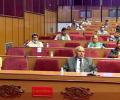
Nepal last month released the revised political and administrative map of the country laying claim over the strategically key areas, more than six months after India published a new map in November 2019.
Heading towards a landslide victory in the historic Nepal polls and poised to form the next government, the Maoists have crossed the 100-mark by winning 110 seats out of the 200 results declared (according to reports that last came in). Poll analysts say it will be difficult for the Maoists to get clear cut majority in the 601-seat assembly in which 575 are elected and 26 are nominated by the new Councils of Ministers.
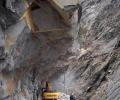
The government had registered the amendment proposal in Parliament on May 22 after releasing the new political map of Nepal depicting Kalapani, Lipulekh and Limipiyadhura as its territories on May 18.
The peace talks between the government and the Maoists, which were postponed about a month ago, will resume in Kathmandu on Monday.
The formation of the new government, which was expected on Friday, was delayed due to last-minute wrangling over the distribution of portfolios.
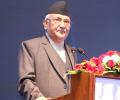
The move comes as the intra-party feud reached climax in the ruling NCP which has been witnessing months long tussle between two factions, one led by 68-year-old Oli and Party's chairman and another led by 66-year-old 'Prachanda', also the executive chair of the party and former premier.
Bollywood actress Manisha Koirala's father Prakash Koirala, who was \nexpelled from the Nepali Congress party for openly supporting the royal takeover, has been made a minister after his induction into the cabinet by King Gyanendra.
Expressing concern over the recent Maoist activities, Indian Prime Minister Manmohan Singh during a recent meeting with a UML team in Delhi had said that the unity between the Nepali Congress and UML be strengthened.
But that is unlikely to deter NGOs planning their first protest march in Kathmandu on Thursday.
A Royal Commission to probe corruption cases against politicians.
Communist Party of Nepal (United Marxist Leninist) leader K P Sharma Oli has been made deputy premier and foreign minister.
 © 2026 Rediff.com - Investor Information - Advertise with us - Disclaimer - Privacy Policy - Sitemap - Feedback - About us - Terms of use - Grievances