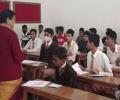
The CBSE has mandated the study of three languages, including at least two native Indian languages, for Class 9 students starting July 1, aligning with the National Education Policy (NEP) 2020 and the National Curriculum Framework for School Education (NCF-SE) 2023.

Art education, physical education and wellbeing, vocational education and interdisciplinary studies will be compulsory.

Describing the assessment for preparatory stage (class 3 to 5), the draft recommends that "written tests should be introduced at this stage".

The Indian government has scrapped the 'no-detention policy' for classes 5 and 8 in schools it governs. This means that students in these classes who do not pass the year-end exams will be allowed to fail. The decision comes after the amendment to the Right to Education Act (RTE) in 2019, which has already led to 18 states and union territories doing away with the 'no-detention policy' for the two classes. The new policy will be implemented in over 3,000 schools run by the central government, including Kendriya Vidyalayas, Navaodyala Vidyalayas, and Sainik Schools.

The textbooks themselves have not been finalised by the National Syllabus and Teaching Learning Material Committee (NSTC), he said.

a former Kenya pacer tried to contact a Ugandan team member multiple times from different numbers during the T20 World Cup.

The 19-member National Syllabus and Teaching Learning Material Committee (NSTC) will be headed by National Institute of Educational Planning and Administration (NIEPA) chancellor MC Pant and develop textbooks for classes 3 to 12.
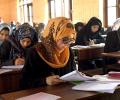
Students can then appear for a board exam in subjects they have completed and feel ready for.

The National Council for Educational Research and Training (NCERT), however, said the withdrawal of anyone's association is out of question as textbooks at the school level are developed on the basis of knowledge and understanding on a given subject and at no stage, individual authorship is claimed.

Dropping references to the demolition of Babri Masjid in Ayodhya, the killing of Muslims in Gujarat riots and Hindutva, and tweaking the reference to Manipur's merger with India are among the latest set of revisions made public by the National Council of Educational Research and Training (NCERT) in its textbooks.

The signatories to a letter sent to NCERT Director Dinesh Saklani include Kanti Prasad Bajpai, a former Jawaharlal Nehru University professor who currently serves as the vice dean at the National University, Singapore, Pratap Bhanu Mehta, a former vice-chancellor of the Ashoka University, Rajeev Bhargava, a former director of CSDS, Niraja Gopal Jayal, a former JNU professor, Nivedita Menon, a JNU professor, Vipul Mudgal, the head of civil society watchdog Common Cause, K C Suri, a former professor at the University of Hyderabad who is now associated with the Gitam University, and Peter Ronald deSouza, a former director of the Indian Institute of Advanced Studies.

The Left leader said the NCERT, which was set up on the basis of the 2005 National Curriculum Framework, has been demolishing the very goals of the NCF through the removal of such passages from textbooks.

A number of academicians as well as political scientists Yogendra Yadav and Suhas Palshikar, who were part of the textbook development committee of the NCERT, had asked the council to drop their names from textbooks over 'several substantive revisions of the original texts'.

Pradhan, who is also the skill development minister, said he has received positive feedback from students on the plan to conduct board exams twice a year.

A division bench of Justices Amjad Sayyed and Anuja Prabhudessai passed the judgment on a bunch of petitions filed by several broadcasters, like the Indian Broadcasting Foundation, a representative body of TV broadcasters, the Film and Television Producers Guild of India, Zee Entertainment Ltd and Sony Pictures Network India.

The government should set up a dedicated fund to rescue Indian agriculture.
Professor M S Swaminathan, the country's most renowned agricultural scientist, may be appointed chairman of the National Commission on Farmers.
The macro-level successes like increase in agriculture production conceal many harsh ground realities with regards to agriculture development, NDA government's background 'paper' on setting up a national commission on farmers has said.

Incidents like these are a wake-up call, says School Education Secretary Anil Swarup. 'Today, if a particular problem has been found, technology allows solutions to address it,' he says, suggesting alternatives such as printing and distribution of encrypted question papers on the day of the exam. Swarup wants electronic tracking to keep tab on who has access to and can, therefore, leak papers.
 © 2026 Rediff.com - Advertise with us - Disclaimer - Privacy Policy - Sitemap - Feedback - About us - Terms of use - Grievances