
Let all the stakeholders, especially the government, remember that if the Make in India lion needs to roar and rise again, it won't happen unless India Inc rises too, points out Shekaar Subramanian.

The Reserve Bank of India (RBI) on Monday issued new norms to regulate the fast-growing pre-paid cards industry and asked all the entities to comply with the guidelines within three months.

India has a unique window of opportunity to effectuate long-lasting structural change in its banking sector, says Riju Agrawal.

'It may sound like sacrilege, but does it really matter if the global raters downgrade India for fiscal slippage?' asks Tamal Bandyopadhyay.
The Reserve Bank of India (RBI) has decided "in principle" to bring under its regulatory ambit holding companies floated by business groups and companies that also own non-banking finance companies (NBFC).

RBI Governor D Subbarao explains the rationale for the moves announced in the second quarter review of the monetary policy in an interview with Sidhartha. Excerpts:
Booking amount financing available from Rs 2850; retail auto loan available at interest rates starting from 9%; insurance premium starts at Rs 3,468 (ex New Delhi).

'Equities are likely to be range-bound with a downward bias for the remaining part of the year.'
In an effort to soothe nerves of the country's mutual funds and the non-banking finance companies, the bankers today assured that they would come forward to support these financial institutions' funding needs including liquidity to meet redemptions.

While demonetisation will benefit the organised sector, the government has to find a way to channel the upcoming revenue buoyancy towards job creation to balance out job losses in the informal sector, says Akash Prakash.

'It's hard to call whether the Indian markets will go through a time or price correction.' 'There could be a swift 5 to 10 per cent fall in the market in the next two months or there could be a gradual fall and six months sideway movement.' 'Eventually, I think there will be a bit of both.'

A senior official with Muthoot Finance said the group would also want to apply for a universal licence.
The Reserve Bank of India (RBI) has permitted housing finance companies (HFCs) to raise up to $10 million through short-term foreign currency loans, like non-bank finance companies (NBFCs).
State Bank of India Chairman O P Bhatt on Sunday said the country's largest lender will take a call on revising interest rates in the second half of the week.

The government also proposed promoting 'one product one district' for better marketing and export of horticulture crops. It also called on states for early implementation of three key central model laws on land leasing, agriculture produce and livestock marketing and contract farming.
The RBI had raised the issue with thegovernment, stating that foreign banks buying majority stakes in non-deposit-taking NBFCs (NBFC-ND) would provide room for regulatory arbitrage.
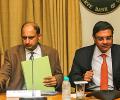
'Those who come from outside are surprised at the relatively small strength of the RBI supervisory cadre, relative to the needs of the country and the needs of the financial sector.'

NBFCs which have not met Sebi criteria will face tough action.

Move to improve transparency but make liquidity more difficult to come by
High interest rates and lack of funds has hit non-banking finance companies. Though banks had extended loans to NBFCs at fixed rates, there is a reset clause which is now being exercised. Besides, the increase in interest rates is impacting companies that were borrowing directly from the market. What is also making life tough is the demand for longer-tenure loans by borrowers as they want to keep the equated monthly instalments under control despite a rise in interest rates.
In order to help the cash-strapped mutual funds and NBFCs, RBI allowed banks to avail funds up to 1.5 per cent of their deposits by relaxing their SLR. In addition, banks have been tapping the repo window to raise resources as and when the need arises. The latest data released by RBI also said that, on a year-on-year basis, credit flow from the scheduled commercial banks, including regional rural banks, grew 27.7 per cent to (Rs 26,348.93 billion) as on November 7.

Earlier this month, RBI had raised loan to value ratio to 75 per cent from 60 per cent earlier.

Based on a feedback, the exchange could cap a sector's weight at 25 per cent, or align with the broader market.
In the last couple of years, reverse mortgage (RM) has been touted aggressively as a product that will allow the elderly to unlock the value of their house. In fact, in the last two Union Budgets, the finance minister has made a special mention about it.

The two entities' combined distribution network would comprise 4,182 banking outlets and 476 ATMs across 34 states and Union territories of India, with more than 31,000 employees serving about 15 million customers across the country.

In this year's budget, Finance Minister Nirmala Sitharaman hiked tax on petrol and diesel, raised import duty on gold, levied additional surcharge on super rich and brought a tax on high value cash withdrawals as she sought to spur growth with reduction in corporate tax and sops to housing sector, startups and electric vehicles.

Amid slowdown blues, the government has unveiled a raft of measures over the past few months aimed at improving liquidity in the system, moderating interest rates as well as credit growth apart from addressing stress in the NBFC sector.

Prof Ananth Narayan, well known financial expert who works as a faculty member at the SP Jain Institute of Management and Research and the RBI's nominee director on the board of Yes Bank, expects a double-digit contraction in India's GDP this fiscal year. In the first of a two-part interview to Shobha Warrier/Rediff.com, Prof Narayan, below, says, "Giving liquidity and loan to cover the cash flow problem is not sufficient because you are essentially increasing the debt of many of these companies. And they might not be able to bear the burden."

'Without bold action to deal with our banking crisis, count on the economy's doldrums to continue for much longer than most of us anticipate,' says Rahul Jacob.

Fitch reaffirmed India's rating at 'BBB-' with a Stable Outlook saying the rating balances a still strong medium-term growth outlook compared with similar category peers and relative external resilience stemming from solid foreign-reserve buffers against high public debt, a weak financial sector and some lagging structural factors, including governance indicators and GDP per capita.

FDI is a major driver of economic growth and a source of non-debt finance for the economic development of the country. The government has put in place an investor-friendly policy on FDI, under which investment up to 100 per cent is permitted on the automatic route in most sectors/ activities. At $ 64.37 billion, FDI in 2018-19 is the highest ever investment received for any financial year.

Focus on large-caps and ensure that the portfolio is balanced.

13 eminent economists, including former RBI governor Raghuram Rajan and current International Monetary Fund Chief Economist Gita Gopinath, in a report have asked the political establishment not to resort to populist tricks.
The government has cleared 12 foreign direct investment (FDI) proposals that will bring in Rs 212 crore (Rs 2.12 billion), of which the largest chunk will be by US-based Millennium India Acquisition Company. Meanwhile, 13 proposals, including two from B A G Films, were deferred by the government, according to an official statement. The US-based company will bring in Rs 159.92 crore (Rs 1.59 billion) of FDI to acquire stakes in two non-banking finance companies.

Physical KYC takes anywhere between two to five working days to get done, V-KYC, only a few minutes.

In case of any grievance, file a complaint with Sebi on its SCORES (Sebi Complaints Redress System) web site, suggests Sanjay Kumar Singh.

The niche banks - small finance and payments banks -have been set up to further the regulator's objective of deepening financial inclusion.

Also says PSU banks divestment to be considered after improvement in governance

'Defence funding is channelled to State-owned research organisations where scientists are merely bureaucrats holding meetings and sending out minutes of meetings and press releases, but have long ago stopped any innovative work.' 'Unless this tragedy is fixed, India's chances to create world-conquering and job-creating new industries are slim,' says Ajit Balakrishnan.
'We do not know when we will get to the business-as-usual mode.' 'Many borrowers may not be able to pay up.' 'The incidence of cheque bouncing has doubled or even trebled, some lenders say,' says Tamal Bandyopadhyay.
