
Sustaining 8 per cent-plus growth rates is necessary if we are to reach high-income status by 2047, points out Amitabh Kant.

India is growing fast, but to keep growing strong, the government must make more things at home, create jobs, and spend money wisely, suggests Rajiv Memani, regional managing partner, Africa-India Region, EY.

Prime Minister Narendra Modi has lauded the Union Budget as a "people's budget" that fulfills the dreams of every Indian and said that it is a "force-multiplier" that will boost consumption, investment and growth. He highlighted a host of measures for different sectors, including welfare initiatives for gig workers, tax relief for the middle class, and support for the manufacturing sector.

The most striking features of this Budget was its focus on simplification and improving the ease of doing business in India, asserts Kaku Nakhate.

Budget 2025 lays down a transformational roadmap for India's digital and economic future, focusing on AI-driven enterprise modernisation, workforce skilling, and sustainable innovation. With bold investments in AI, digital infrastructure, and ease of doing business, the government has set the stage for businesses to scale, innovate and compete on a global level.
These are the highlights of the Union Budget 2025-26 presented by Finance Minister Nirmala Sitharaman in Parliament on Saturday.
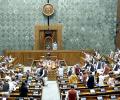
India's opposition parties have sharply criticized the Union Budget, calling it inadequate to address the country's economic woes and accusing the BJP-led government of using it to woo voters in Bihar and Delhi ahead of upcoming elections. Leaders from the Congress, TMC, DMK, SP, and CPI(M) voiced their disapproval, highlighting concerns over inflation, unemployment, and the lack of substantial measures to support the agricultural sector and the poor. They also criticized the tax cuts for the middle class as insufficient and coming too late after years of high taxes and rising prices.

Manufacturing activities in India gained momentum in August as new orders and output increased at the quickest rates in nearly three years, according to a survey released on Friday. The seasonally adjusted S&P Global India Manufacturing Purchasing Managers' Index (PMI) rose to 58.6 in August from 57.7 in July. Pollyanna De Lima, Economics Associate Director at S&P Global Market Intelligence, said the PMI results for India painted a vibrant picture of the nation's manufacturing landscape in August.

Tata Steel was the top gainer in the Sensex pack, zooming 7.57 per cent, followed by Sun Pharma, IndusInd Bank, L&T, ITC and HCL Tech.

While the special economic zones have seen several labour laws being by-passed within their geographical confines, that is not the case with the NMP.

'Rather than cutting and pasting from advanced economies, we should use basic economic principles to think about what is right for India at the stage of development at which we are,' says Chief Economic Advisor Krishnamurthy Subramanian.

'India's future: To manufacture so efficiently that we do not need protection,' says Naushad Forbes.

Domestic supply of electronics is already less than half of domestic dem#8743 and although it is growing at 16 per cent already, demand is growing much faster.

Manufacturers said they expect the growth of manufacturing sector to be less than 7 per cent.
Services cannot create enough jobs that will match the skill sets of the bulk of the work force, says Nirvikar Singh.

NIMZ is conceptualised as integrated industrial townships with all-important elements to help the growth of infrastructure, clean and energy efficient technology, simplified business regulations and the necessary social and institutional infrastructure.

Efforts should be made to nurture the talent and make sure that the skill development programme matches the growth requirement of the industry, the former Finance Minister said.

The manufacturing sector, which constitutes over 75 per cent of the index, declined by 2 per cent in October as against a growth of 9.9 per cent a year ago.

"It will be ensured that such agreements (free trade agreements) do not have a detrimental effect on domestic manufacturing in India," according to the National Manufacturing Policy (NMP), cleared by the Union Cabinet on October 25.
India needs to create 220 million jobs in the next 15 years and this is only possible by implementing the National Manufacturing Policy, launched recently by the government, says Arindam Bhattacharya, managing director, The Boston Consulting Group (BCG) India Pvt Ltd.
A group of ministers, headed by Agriculture Minister Sharad Pawar, has been formed to resolve inter-ministerial differences stalling the national manufacturing policy which aims at giving a boost to the sector.
India needs manufacturing sector growth for a variety of reasons.

Size seems stuck at a low when compared with other developing economies, with various issues dogging growth.

India aims at increasing the share of manufacturing sector, which contributes over 80 per cent in the country's overall industrial production, from 16-17 per cent to 25-26 per cent of the gross domestic product by 2020.

The government expects these special areas -- National Manufacturing and Investment Zones -- will help in increasing the share of manufacturing from 15 per cent of the GDP at present to 25 per cent by 2022.

Freedom to downsize workforce, increase work hours and curtail workers' right to join unions are some of the radical steps under the government's consideration for industries in special investment zones.

Quoting a study conducted by the Department of IT in consultation with the National Manufacturing Competitiveness Council, it said that 'an estimated 2.25 million persons would be directly employed in the industry (IT) by 2015 as against 0.77 million in 2007'. Minister of state for labour and employment Harish Rawat told the Lok Sabha that incremental human resource requirement has been estimated to be around 1.5 million persons.
Ficci has suggested formulation of a 'manufacturing policy'. Such a policy will spell out guidelines for attaining a 12% growth of the sector annually. Guidelines will help in terms of incentives and subsidies; technology development; development of sustainable raw material base; regulatory and procedural reforms to the manufacturing sector. The manufacturing sector's profitability has been badly affected in the last few months & the government needs to intervene immediately.
"The report of the committee will form basis for the country's manufacturing policy," National Manufacturing Competitiveness Council Chairman V Krishnamurthy, who is also member of the panel, told reporters. Prime Minister Manmohan Singh had announced setting up of the high-level committee in 2006. Its mandate included looking into macro-economic issues stifling the growth and competitiveness of the manufacturing sector.

Union Commerce and Industry Minister Anand Sharma takes on Narendra Modi, says: Gujrat cannot be sold as a model state as it has many flaws.

'Modi has given India its 'lost half-decade'. Elect him again and by 2024 it will be a lost decade'

Debroy worked as a consultant in the Department of Economic Affairs in Finance Ministry.
Finance ministry opposed to exemptions in principle: Official.
Increase in the value of Rupee combined with rising interest rates has resulted in erosion of profitability and competitiveness of Indian exports by up to 12 per cent, according to a report by Ficci.
Apprehending a slowdown in the growth of the economy due to the hardening of interest rates, the appreciating rupee and falling tariffs, the government has decided to set up a group to discuss the impact of these changes.
A high-powered panel set up by Prime Minister Manmohan Singh to go into the problems of manufacturing has come out with far-reaching draft strategy including labour reforms to achieve 12 per cent growth in the sector to sustain 9 per cent GDP growth.
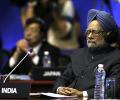
Industry is displeased over the failure of the National Manufacturing Policy, which has failed to invite any sizeable investment since it was launched more than two years ago.
 © 2026 Rediff.com - Investor Information - Advertise with us - Disclaimer - Privacy Policy - Sitemap - Feedback - About us - Terms of use - Grievances