
Magsaysay award-winner ' Rajendra Singh and two others on Saturday quit the National Ganga River Basin Authority, chaired by Prime Minister Manmohan Singh, protesting the government's "negligence" of the river. Besides Singh, two other NGRBA members -- Ravi Chopra and R H Siddiqi -- also submitted their resignation letters to Dr Singh, expressing solidarity with noted environmentalist G D Agrawal, who is on a fast-unto-death to press for the cleansing of Ganga.
Speaking at the third meeting of the National Ganga River Basin Authority on Tuesday, Prime Minister Manmohan Singh voiced concern over the discharge of 2,900 million litres of sewage in the Ganga every day.
Environment scientist-activist G D Agrawal on Friday broke his fast after the government promised to convene a meeting of the Prime Minister Manmohan Singh-led National Ganga River Basin Authority in March. Agrawal, who was on a fast-unto-death since March 8 to press for the cleaning of Ganga, decided to take water and liquid food after he was informed about the government's decision to convene the meeting of NGRBA on April 17 by Union minister Sriprakash Jaiswal.
The time to clean up the Ganga is now and the livehood and future of millions of people depend on it, says geologist Dr Nitish Priyadarshi

Share of central government will be Rs. 5,100 crore and of the state governments of Uttarakhand, Uttar Pradesh, Bihar, Jharkhand and West Bengal will be Rs. 1,900 crore.
Last November, the Ganga was declared as a 'National River' and the NGRBA was set up as an empowered planning, implementing and monitoring authority for the Ganga River for which this year's budget has a special provision of Rs 250 crore. The NGRBA has as its members the chief ministers of four states through which the Ganga flows.

Three expert members -- Rajendra Singh, Ravi Chopra and Rashid Siddiqui -- have resigned from the National Ganga River Basin Authority.

Directions have been issued to about 48 industrial units polluting River Ganga to close down, the Rajya Sabha was informed on Monday.

The green panel ordered a survey to seek views of the common people about what they feel on ground about the pollution in the Ganga.

Congress leader Jairam Ramesh today accused the National Democratic Alliance government of turning the programme to clean Ganga as a "Hindutva project" by attempting to polarise politics through the initiative on the holy river.

With the Government actively looking for ways to check pollution in river Ganga, Union Water Resource Minister Uma Bharti on Monday said immersion of mortal remains would not be allowed on the banks of the holy river.
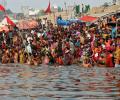
'Though the river is cleaner than what it was five years ago, a lot more needs to be done.'
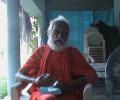
The Ganga agitation and the question of preserving the Himalayan ecology has become a deadly cocktail of politics and religion. Behind the scene, of course, at play are powerful business interests. What is needed is an independent scientific assessment of the problem and preparation of a blueprint for preservation of the Himalayan rivers and associated ecology, says Dinesh C Sharma.

A report submitted by the consortium of seven Indian Institutes of Technology on way to rejuvenate the Ganga river is at heart of Prime Minister Narendra Modi's ambitious plan to restore the glory of the river.
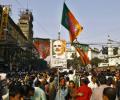
It has been said that by 2025, India could become among the top five economies in the world. If India does become a $5 trillion economy but gets all its rivers polluted, food chain poisoned and genetic pool depleted and biometric database of Indians sold or stolen at the behest of commercial czars, will it not be a pyrrhic economic victory, asks Gopal Krishna.

'Those who have seen the functioning of the Modi government in Gujarat know that the issues related to Hindutva and issues of economy and growth function simultaneously.' 'Modi's politics are based on the understanding of the middle-class consumer society which is in pursuit of material aspirations.' Sheela Bhatt/Rediff.com reveals the Modi government's economic and political plans for the year ahead.
 © 2026 Rediff.com - Advertise with us - Disclaimer - Privacy Policy - Sitemap - Feedback - About us - Terms of use - Grievances