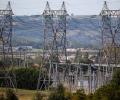
The government on Wednesday put out the draft of a new policy that projects the country's power sector will need Rs 50 trillion in investments by 2032 and Rs 200 trillion by 2047, proposing ambitious reforms in generation, transmission and distribution.

Opening up the corner office is fine, but will the government be able to attract talent without giving a market-rate salary?, asks Tamal Bandyopadhyay.

As many as 2.17 lakh pieces of fake notes of various denominations were detected during 2024-25 compared to 2.23 lakh such notes in the previous year, Parliament was informed on Monday. Of this, highest -- 117,722 pieces -- counterfeit notes of 500 [MG (New) Series] were detected in FY25, Minister of State for Finance Pankaj Chaudhary said in a written reply in the Lok Sabha.

Infrastructure bonds, which were relied upon the most in 2024-25 (FY25) by commercial banks to raise funds through the domestic debt capital market amid lagging deposit growth, seem to have lost their sheen in FY26. So far in FY26, no bank has tapped the domestic debt capital market to raise funds via infra bonds, and the expectation is that the amount raised through this route will be significantly lower than that last year, unless credit demand picks up.

The fiscal deficit for FY25 has been pegged at 4.8 per cent of GDP and at 4.4 per cent for FY26, Finance Minister Nirmala Sitharaman said on Saturday. Presenting the Budget 2025-26, she said net market borrowings are estimated at Rs 11.54 lakh crore for next fiscal year.

State-owned Life Insurance Corporation (LIC) on Thursday entirely subscribed to the Rs 5,000 crore bond issue of Adani Ports and Special Economic Zone (APSEZ) at a coupon rate of 7.75 per cent, said sources privy to the development.

A gradual approach to privatise public sector banks (PSBs) is more ideal than taking a big-bang approach, a study by Reserve Bank of India (RBI) staff has concluded. It has backed the government's idea to privatise two PSBs initially. Such a gradual approach would ensure that large-scale privatisation does not create a void in fulfilling important social objectives of financial inclusion and monetary transmission, the study has argued.

The government on Wednesday announced the appointment of veteran banker K V Kamath as chairperson of the newly set up Rs 20,000 crore development finance institution NaBFID to catalyse investment in the funds-starved infrastructure sector. Parliament had in March cleared the National Bank for Financing Infrastructure and Development (NaBFID) Bill 2021 to support the development of long-term non-recourse infrastructure financing in India, including the development of the bonds and derivatives markets necessary for infrastructure financing.

'I don't think we have ever seen such alignment of everything that we need in the banking sector.'

Highly-rated finance firms and housing finance companies are expected to benefit from the absence of Housing Development Finance Corp (HDFC) from the bond market once it merges with the HDFC Bank in early FY24. Post merger, the bond market is expected to become less crowded, which will ease fund raising conditions for other players in the field. It may perhaps also compress the spread for debt instruments floated by housing finance companies (HFCs) over 10-year government bonds, subject to demand and supply conditions.

Exuding confidence in sustaining the tempo of credit growth, public sector bankers said on Wednesday that consolidation in the public sector bank (PSB) space has given them a robust base to scale. The privatisation of PSBs can be done through divestment of government stake to a wider base of investors without haste. There is nothing to worry about at this point (high credit offtake) as underwriting standards and risk management are much better.

According to the third batch of supplementary demands for grants tabled in the Lok Sabha, approval is being sought for gross additional expenditure of over Rs 1.58 lakh crore.
7 key areas that the Budget must address to re-energise the infrastructure sector, suggests Vinayak Chatterjee.

Only NIIF has stayed the course as a viable infrastructure financing institution.

Amendments would be required in the Banking Companies (Acquisition and Transfer of Undertakings) Act, 1970 and the Banking Companies (Acquisition and Transfer of Undertakings) Act, 1980 for privatisation, sources said.

This month, advertisements for managing directors and the senior management team for the National Bank for Financing Infrastructure and Development or NaBFID, should be out, signalling the start of a financial institution (FI) like no other the country has ever had. For this and other reasons government managers associated with the NaBFID project are convinced it should remain a 100 per cent government-owned entity. This is somewhat different from what former economic affairs secretary Tarun Bajaj said when the NaBFID Bill was being tabled in Parliament earlier this year: "To begin with, it will be 100 per cent government owned.

The session started on January 29 and was originally slated to end on April 8 but several members had urged Speaker Om Birla to end the session earlier as they focus on electioneering for the five assemblies.

Flush with liquidity, banks are eager to lend. And, therein lies the problem, warns Tamal Bandyopadhyay.
For development finance institution to succeed now, the government must stand like a rock behind it and be patient.
 © 2026 Rediff.com - Investor Information - Advertise with us - Disclaimer - Privacy Policy - Sitemap - Feedback - About us - Terms of use - Grievances