
The new figures released by the United Nations Food and Agriculture Organisation on Thursday ahead of next week's General Assembly meeting on global anti-poverty targets known as the Millennium Development Goals, show that the number of people suffering from hunger is now roughly 925 million.
With Pakistan's possible suspension from the grouping expected to dominate the Commonwealth Heads of Government meet, Prime Minister Manmohan Singh left Delhi on Thursday for Kampala where hot issues like climate change, human rights and terrorism will also be on the agenda.
Top United Nations experts on Latin America and the Caribbean have warned that global economic shocks could throw some 16 million people of the Americas into extreme poverty, threatening important gains toward achieving the Millennium Development Goals in the region.
"Unfortunately, the trend is in the opposite direction," Ambassador Ajai Malhotra said and demanded increased voice for the developing nations in the decision making process of international financial institutions.
A new World Bank-IMF Report says India has achieved significant levels of poverty reduction as a result of high GDP growth of about nine per cent, but regretted serious shortfalls in achieving other Millennium Development Goals (MDGs) like child nutrition and health. Entitled 'Global Monitoring Report 2008,' the report's theme was 'MDGs and the Environment: Agenda for inclusive and sustainable development.' South Asia nations may fall short of the MDGs, says the report.
India has asked rich nations to end protectionism, which costs developing countries $ 700 billion a year in export income, if the world is to meet the Millennium Development Goals (MDGs), aimed at eliminating or sharply reducing several social and economic ills by 2015. India's UN Ambassador Nirupam Sen asserted that the problem is not lack of resources, but little stomach for structural changes. A separate action is required to attack poverty and hunger and promote progress.
The Millennium Development Goals (MDGs) aim to halve world poverty by 2015. South Asian countries should include disaster-risk management in national strategic plans, the study 'Rethinking Disasters' released on Thursday by Oxfam said. Two to six per cent of South Asias gross domestic product is lost to disasters every year, the study said.
The Asian Development Bank said on Wednesday India, despite making significant improvement in access to primary education, will not meet the millennium development goal targets as in the case of other countries in the Asia Pacific region.
Halving global poverty and hunger is one of the key Millennium Development Goals.
The report gives India a pat on the back for bringing a large number of children to schools. However, it scores poorly in the matter of getting girls to school.
Yet in many areas in South Asia, including India, naturally occurring arsenic and fluoride contamination are threatening to reverse the gains made in providing improved drinking water.
Buoyed by rapid economic growth, Asia has made dramatic progress in the eradication of extreme poverty and hunger, halving the number of people living on the equivalent of a dollar a day, a just released United Nations report has said.

India's external affairs minister takes a stroll in Manhattan.
He expressed hope for positive changes in a world that faced a myriad of daunting challenges, ranging from poverty to global warming and terrorism.
A World Bank report said India bas been slow in progressing towards Millennium Development Goals.
India has still a long way to go to meet the Millennium Development Goals such as elimination of poverty by 2015, Finance Minister P Chidambaram said.
Women hold the key to eradicating poverty worldwide, but must be supported in their efforts to lead families, societies and nations towards prosperity, senior United Nations officials told an inter-governmental meeting on Tuesday.\n\n\n\n
In an effort to allow 19 poor countries to promote growth and make progress towards achieving the Millennium Development Goals, the International Monetary Fund will grant 100 per cent debt relief to them amounting to $3.3 billion

Bihar, Jharkhand and Uttar Pradesh have emerged as the poorest states in India, according to Niti Aayog's first Multidimensional Poverty Index (MPI) report. As per the index, 51.91 per cent population of Bihar is poor, followed 42.16 per cent in Jharkhand, 37.79 per cent in Uttar Pradesh. While Madhya Pradesh (36.65 per cent) has been placed fourth in the index, Meghalaya (32.67 per cent) is at the fifth spot. Kerala (0.71 per cent), Goa (3.76 per cent), Sikkim (3.82 per cent), Tamil Nadu (4.89 per cent) and Punjab (5.59 per cent) have registered the lowest poverty across India and are at the bottom of the index.
The World Bank has warned India that its growth prospects are weakened by high fiscal deficits and slow reforms, and the country needs to accelerate poverty reduction efforts.
"There's no doubt that this has been a particularly difficult year and I am relieved that this annus horribilis is coming to an end," the UN secretary general said.
The UN Special Rapporteur on the right to food Jean Ziegler said it is indefensible that so many small children are still dying because they do not have enough food to eat. 'How can we continue to live with this shame?' he asked.
44% citizens of the world agree that the eradication of poverty and hunger is the most important priority for the world, says the Voice of the People survey, carried out for the WEF, by Gallup.
The World Bank has lauded India for the 'remarkable progress' it made in alleviating poverty as well as educating children through the Universal Elementary Education programme.
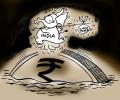
India's public debt ratio, which remarkably remained stable at around 70 per cent of the GDP since 1991, is projected to jump by 17 percentage points to nearly 90 per cent because of increase in public spending due to COVID-19, the IMF said.

Move the slider on the map above to see the change in percentage of population using an improved drinking water source over 1990 to 2015.
 © 2026 Rediff.com - Investor Information - Advertise with us - Disclaimer - Privacy Policy - Sitemap - Feedback - About us - Terms of use - Grievances