
'It is advisable to stay away from the markets for now and buy only on a dip.'

Equity mutual fund (MF) schemes have raked in Rs 46,200 crore in net lump-sum inflows in the past six months (ended February 2024), almost thrice the inflow in the previous six-month period.

Two midcap banking stocks have been on a roll; Centurion BoP on the news of its merger with Lord Krishna Bank merger, and IndusInd Bank, which might be looking at a foreign buyer.

The number of dematerialised (demat) accounts - required to hold shares and other securities in electronics format - crossed the 150-million mark for the first time in March. In March, 3.12 million new demat accounts were added despite a spike in market volatility, taking the total count to 151.4 million. The milestone has come 19 months after the total number of demat accounts hit the 100-million mark, a sign that more domestic households are taking to direct equity investing.

The S&P BSE Midcap and the S&P BSE Smallcap indices have managed to stay afloat in a volatile January that saw the frontline indices hit their respective 52-week high levels and then slip. While the S&P BSE Sensex has lost over 2 per cent thus far in January, the S&P BSE Midcap and the S&P BSE Smallcap indices have gained nearly 2.5 per cent and 4 per cent, respectively during this period.

Prominent exits by promoters included a Rs 15,300 crore share sale in Indus Tower by Vodafone Plc, a Rs 9,300 crore share sale by the Tata group in Tata Consultancy Services.

rediffGURU Dev Ashish answers your personal finance and mutual fund queries.

As milk prices rise, analysts have an optimistic view on dairy stocks such as Heritage Foods and Dodla Dairy, hoping the companies' margins will grow in the near to medium term. From a long-term perspective, they believe that a growing population, increasing disposable income and health consciousness will strengthen dairy consumption in India.

Do you have financial planning or income tax queries? Ask rediffGURU Anil Rego.

'The long-term impact of elections is minimal.'

The sharp surge in investment accounts (folios) in midcap and smallcap mutual funds (MF) in recent months is likely driven by the do-it-yourself (DIY) investors. In the first five months of the present financial year (FY 2024), net folio additions in direct MF plans (4.5 million) has outpaced that in regular plans (3.9 million), contrary to the trend seen in the previous three six-month periods. The net folio additions in direct plans in the five-month period (April-August 2023) is 40 per cent higher than the total additions made in the previous six month period.

The BSE Midcap index has declined 5.7% thus far in May 2018. In comparison, the S&P BSE Small-cap index has lost 5.6%
Unperturbed by election uncertainty, investors poured record sums into equity mutual fund (MF) schemes in May, driving India closer to a $5 trillion market capitalisation. The Rs 34,697 crore net inflows into actively managed equity funds last month surpassed the previous high of Rs 28,463 crore recorded in March 2022. In April 2024, equity schemes had garnered nearly Rs 19,000 crore.

Investors' wealth jumped Rs 13.78 lakh crore on Monday as the benchmark equity index Sensex hit its lifetime high after exit polls predicted a massive win for the BJP-led NDA in the Lok Sabha polls. The 30-share BSE Sensex jumped 2,777.58 points or 3.75 per cent to hit a record peak of 76,738.89 in early trade. The benchmark finally ended at 76,468.78, registering a sharp rally of 2,507.47 points or 3.39 per cent.

'An equity-based index fund should be held for more than five years to average out market volatility and achieve financial goals.'

This year's tally is the second best ever after 2022 when 16 firms raised Rs 40,311 crore, led by LIC's biggest-ever IPO.
The June quarter is usually considered as a seasonally strong period for the IT sector.

It has mostly been a one-way street for smallcap stocks that have taken it on their chin thus far in February. The Nifty Smallcap 250 index has shed 3.2 per cent in the current month as compared to the 1.8 per cent decline in the Nifty Midcap 100 and the 0.5 per cent drop in the Nifty 50 index, data showed. Technically, the index has slipped below its 20-day moving average (DMA) placed at 14,800 levels on Monday, and is currently testing the 50-DMA, and is placed at 14,278 levels.

Analysts remain bullish on the road ahead for the equity markets, but warn against volatility on account of domestic and global cues. The upcoming Lok Sabha elections back home and the interest rate trajectory of the US Federal Reserve, they said, will be the two most important factors that the markets will keep a tab on. That apart, the valuation of the Indian markets, they feel, will also be eyed in context of how global peers are performing.

Five firms, including ACC Ltd, HDFC Asset Management Company and FSN E-Commerce Ventures that runs Nykaa, will be dropped from Nifty Next 50 index from September 29. NSE Indices Ltd, an arm of the National Stock Exchange, on Thursday said that Indus Towers and Page Industries will also be dropped from the index. Punjab National Bank, Trent, Sriram Finance, TVS Motor Company, and Zydus Lifesciences will be included in the Nifty Next 50 index, NSE Indices said in a statement.

Draft Red Herring Prospectus (DRHP) filing continued to be robust in October, signifying the optimism in the initial public offer (IPO) market despite the recent turbulence in equities. In October, 17 companies filed their offer documents for IPOs. The rush in filings has made August-October 2023 the best three-month period for DRHP filings since July-September 2021.

The mutual fund (MF) industry had an action-packed 2023 as it tackled the scrapping of tax benefits for debt fund investors and surging flows into equity funds.

The country's six largest smallcap schemes would require more than 20 days to liquidate half of their holdings, despite most of them maintaining high cash levels and having considerable exposure to more liquid largecap stocks, stress tests conducted by fund houses reveal. For midcap funds, the time required to sell half of the assets of the top six schemes varies between seven and 34 days, according to disclosures made by asset management companies. The Securities and Exchange Board of India (Sebi) had called for such tests in the face of strong inflows into smallcap and midcap funds, despite concerns over high valuations, to keep investors better informed.

From the Sensex basket, Mahindra & Mahindra, Tata Motors, NTPC, HCL Technologies, Larsen & Toubro, Infosys, Tech Mahindra and State Bank of India were the major laggards. Bharti Airtel, Bajaj Finance, Bajaj Finserv, Tata Consultancy Services and IndusInd Bank were among the gainers.

The spike in volatility, amid election uncertainty, has done little to dent the confidence of retail investors, shows demat account addition and equity mutual fund (MF) investment data. In May, investors opened a net 3.6 million demat accounts, taking the total to 158 million. MF data released on Monday pegged the net inflows into equity schemes and SIP investments at new record highs of Rs 34,697 crore and Rs 20,904 crore, respectively.

A buoyant equity market, coupled with an improved performance of mutual funds (MFs) on the returns chart, has heightened retail investors' appetite for equities. In the past few months, equity MF schemes have seen a surge in fresh investments through both lump sum (one-time investments) and systematic investment plan (SIP) routes. During the August-September 2023 period, equity MF schemes recorded net lump sum investments of Rs 35,270 crore, compared to just Rs 5,550 crore in the previous three months, according to data from the Association of Mutual Funds in India (Amfi).

Ulhas Joshi, Head -- Sales, Rank MF, a mutual fund investment platform, answers your queries.
Retail investors now own a bigger slice of smallcap companies than at the start of 2023-24 (FY24), underscoring their growing conviction about investing in this red-hot space. Data from Capitaline shows mutual funds' (MFs') average holding in the National Stock Exchange Nifty Smallcap 250 rising to 9.26 per cent from 8.67 per cent during the first six months of FY24, with the number of companies with over 20 per cent MF holdings increasing from 24 to 28. In comparison, MF holdings in Nifty50 companies have gone up only marginally, from 9.67 per cent to 9.75 per cent.
The ongoing weakness in the broader equity market is likely to weigh on primary market investor participation ahead, which has already begun showing signs of fatigue, analysts said. The spillover effect, they say, will continue as long as the midcap and smallcap segments remain volatile. "The effect will be felt in the IPO market. The subscription levels have come down in the last few days and recent 4-5 IPOs have not done well.

Equity investors suffered a massive loss of Rs 31 lakh crore on Tuesday as markets went into a tailspin with the BSE Sensex tumbling nearly 6 per cent as vote counting trends showed the BJP may not have a clear majority in the Lok Sabha polls. Erasing the record-rally of the previous trade, the 30-share BSE Sensex cracked 4,389.73 points or 5.74 per cent to settle at 72,079.05. During the day, the benchmark tanked 6,234.35 points or 8.15 per cent to hit a nearly five-month low of 70,234.43.

The market capitalisation of BSE-listed companies jumped to a lifetime peak of Rs 404.18 lakh crore on Thursday helped by a five-day rally in benchmark indices, making investors richer by Rs 11.29 lakh crore. Recovering after a sell-off in early trade, the 30-share BSE Sensex climbed 486.50 points or 0.66 per cent to settle at 74,339.44 on Thursday. During the day, it surged 718.31 points or 0.97 per cent to 74,571.25.

'The Nifty index looks to be 20 per cent overvalued as per our model after moving up more than 10 per cent in the last two months.'

In the Sensex pack, NTPC, Tata Steel, SBI and IndusInd Bank were among the major laggards. In contrast, Wipro, HCL Tech, Mahindra & Mahindra and Nestle were among the nine stocks that defied the trend.
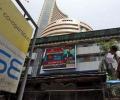
Among the Sensex constituents, as many as 16 stocks closed with losses with Nestle India, Kotak Mahindra Bank, IndusInd Bank, Bajaj Finserve, Titan and JSW Steel being the major laggards. Index major Reliance, Hindustan Unilever, Maruti and Tata Steel also declined due to selling pressure. In contrast, NTPC, TCS, Tech Mahindra, Bajaj Finance bucked the trend and ended the day in green. Axis Bank, Bharti Airtel, Mahindra & Mahindra and Tata Motors also defied the trend.

From the Sensex basket, Asian Paints, Sun Pharma, HDFC Bank, Tata Consultancy Services, Axis Bank, Tata Steel, JSW Steel, Larsen & Toubro, ICICI Bank and Power Grid were the major gainers. Tata Motors dropped over 8 per cent despite reporting over three-fold jump in consolidated net profit at Rs 17,528.59 crore for the fourth quarter ended March 31, 2024. NTPC, Bharti Airtel, Titan, State Bank of India and Nestle were the other major laggards.

The post-Covid pandemic boom in corporate revenues appeared to have faded away in 2023-24. Yet, companies have reported a sharp recovery in their profits in FY24, driven by high margins. Their combined net sales, including gross interest income for lenders, rose by a modest 4.8 per cent year-on-year (Y-o-Y) in FY24.

With the last quarter of 2023-24 (FY24) expected to have been soft owing to lower discretionary spend and macro uncertainty, many are hoping FY25 will be a year of recovery for the information-technology (IT) industry. The fourth quarter, January-March, is considered soft, and will continue to see the headwinds the sector has been facing. And the sector has entered the new financial year on a weak footing. Analysts are expecting Tier-I firms to report sequential growth of -1 per cent to 1.5 per cent and midcap players' growth may range between 0.7 per cent and 4 per cent.

Investors are reluctant to take long-term positions this year after the spectacular gains in 2023. The delivery-based trades on the National Stock Exchange (NSE) have declined to below 36 per cent this year from an average of 38.1 per cent in 2023. Investors tend to seek delivery for stocks where they see a long-term investment opportunity or tactical positional trade.

From the Sensex basket, Maruti, Mahindra & Mahindra, NTPC, JSW Steel, Larsen & Toubro, Reliance Industries, Axis Bank, and Power Grid were the major gainers. Nestle, Wipro, Tata Consultancy Services, HDFC Bank, Titan, HCL Technologies and Infosys were the laggards.
 © 2026 Rediff.com - Investor Information - Advertise with us - Disclaimer - Privacy Policy - Sitemap - Feedback - About us - Terms of use - Grievances