
The number of hungry people in India has fallen to by 9.5 per cent to 190.7 million now from 210.8 million two decades ago, but in neigbouring Pakistan the number has risen by over 38 per cent in the same period.
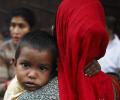
India continues to battle poverty, child and maternal deaths, according to a United Nations report on the Millennium Development Goals that said while several key global targets have been met, more sustained effort is needed to cover disparities by the 2015 deadline.

Bihar, Jharkhand and Uttar Pradesh have emerged as the poorest states in India, according to Niti Aayog's first Multidimensional Poverty Index (MPI) report. As per the index, 51.91 per cent population of Bihar is poor, followed 42.16 per cent in Jharkhand, 37.79 per cent in Uttar Pradesh. While Madhya Pradesh (36.65 per cent) has been placed fourth in the index, Meghalaya (32.67 per cent) is at the fifth spot. Kerala (0.71 per cent), Goa (3.76 per cent), Sikkim (3.82 per cent), Tamil Nadu (4.89 per cent) and Punjab (5.59 per cent) have registered the lowest poverty across India and are at the bottom of the index.

Between 1997 and 2008, aid commitments for sanitation and water fell from eight per cent of total development aid to five cent per cent, according to the latest UN-Water Global Annual Assessment of Sanitation and Drinking-Water (GLAAS) report.

The global financial crisis has hit the realisation of Millennium Development Goals hard with loss of employment and food inflation slowing down the progress and an additional 64 million people expected to be thrown into extreme poverty by 2010-end relative to a no-crisis scenario.
The Asian Development Bank said on Wednesday India, despite making significant improvement in access to primary education, will not meet the millennium development goal targets as in the case of other countries in the Asia Pacific region.
About 32,000 petrol pump dealers across the country will go on a day-long strike on April 13 to press for their demands and have threatened to launch an indefinite shutdown from April 28 if their demands are not met by then.
The UN Special Rapporteur on the right to food Jean Ziegler said it is indefensible that so many small children are still dying because they do not have enough food to eat. 'How can we continue to live with this shame?' he asked.
At the current rate of decline in the under-5 Infant Mortality Rate, India is not likely to achieve the Millennium Development Goal of bringing down the IMR to 40 per 1,000 live births for the year 2015, according to a UNICEF report.

Move the slider on the map above to see the change in percentage of population using an improved drinking water source over 1990 to 2015.

India is also set to achieve the goal of reducing hunger by half and reduce maternal mortality by three quarters.

While the DMK fears that the Congress with its poor strike rate will pull it down in the 2021 state elections, like it did five years ago, the ruling AIADMK is worried that the BJP may ultimately do a Bihar on it, relegating it to second place in Tamil Nadu, says N Sathiya Moorthy.

Pneumonia and diarrhoea have collectively claimed the lives of over three lakh children in India in 2013, posing a major challenge to public health in the country, a report said.
 © 2026 Rediff.com - Investor Information - Advertise with us - Disclaimer - Privacy Policy - Sitemap - Feedback - About us - Terms of use - Grievances