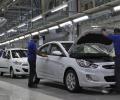
Domestic passenger vehicle (PV) sales saw a significant growth in October due to increased availability of semiconductor chips and rising consumer confidence. The sales figures during the month - which coincided with the first post-Covid festival season - released by the top ten carmakers saw a jump of 30.7 per cent to 322,885 units in October. Auto companies count wholesales - units dispatched to dealers - as sales.
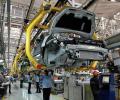
The K-shaped economic recovery in India from the pandemic slowdown shows in corporate results as well. The automobile sector, which represents big-ticket consumption, continues to do well and has increased its share in corporate revenues and profits while fast-moving consumer goods (FMCG) companies that sell low-ticket consumer goods are struggling with poor sales and earnings growth. The share of the automobile sector, including makers of auto ancillaries, in corporate net sales rose to a 10-quarter high of 10.05 per cent during July-September 2023 (Q2FY24) from 8.94 per cent a year earlier and 9.75 per cent in Q1FY24.

Only five of India's top 20 car models have seen a reduction in wait times over the past year.

Maruti Suzuki India and Hyundai reported single-digit sales growth in July with the sports utility segment continuing to drive overall demand in the market. Mahindra & Mahindra witnessed a 29 per cent increase in passenger vehicle dispatches while Tata Motors saw a marginal increase in the wholesales last month. Maruti Suzuki on Tuesday said its total domestic passenger vehicle sales stood at 152,126 units last month as compared to 142,850 units in the year-ago month, a growth of 6 per cent.
Automobile manufacturers are likely to report strong numbers for the September quarter of Financial Year 2023-24 (Q2 FY24), riding on growth across segments and offset by a marginal drop in overall two-wheeler (2W) volumes. Higher average selling price (ASP) year-on-year (YoY), which was necessitated by price hikes taken by original equipment manufacturers (OEMs), and an improved product mix will also aid revenues and margins. Moreover, commodity prices are down on a YoY basis, leading to higher margins in earnings before interest, taxes, depreciation and amortisation (Ebitda).

Amid better semiconductor chip supplies, the Indian automotive industry posted an 8 percent growth in production of vehicles across categories for the month of May, with three-wheelers (20 per cent) and passenger vehicles (16 per cent) leading the pack. Exports, however, dipped 21 per cent at an industry level. The industry also recorded its highest-ever May wholesales of domestic passenger vehicles (334,802 units), riding on high demand for sport utility vehicles (SUVs) and better supplies of semiconductor chips.

Mumbai's Museum of Living History is truly a delight.

The country saw a massive year-on-year surge in the demand for electric vehicles, with retail sales of electric two-wheelers rising by 58 per cent, passenger vehicles by 130 per cent, three-wheelers by 82 per cent, and commercial vehicles by 171 per cent in March 2023, according to the data shared by the Federation of Automobile Dealers Associations (Fada). According to a report by JMK Research, the EV segment as a whole grew by 157 per cent during FY23, to 1,180,597 units, from 458,746 units a year ago. Overall, EV sales in March 2023 rose by 82 per cent from the March 2022 figure, the JMK report added.

Tech Mahindra was the top loser in the Sensex pack, shedding 2.51 per cent, followed by Bajaj Auto, RIL, Hero MotoCorp, IndusInd Bank, Mahindra and Mahindra, HDFC and TCS.

On the Sensex chart, index heavyweight HDFC rallied over 8 per cent. Other prominent gainers were IndusInd Bank, Mahindra and Mahindra, Asian Paints, Bajaj Finance, HDFC Bank and Ultratech Cement.

HUL was the top gainer in the Sensex pack, rallying 5 per cent, followed by Kotak Bank, Nestle India, ICICI Bank, Mahindra and Mahindra, Asian Paints and RIL.

In the Sensex pack, HDFC, ONGC, Bharti Airtel, Titan, Asian Paints, Mahindra and Mahindra and TCS were the prominent gainers. On the other hand, ICICI Bank, IndusInd Bank, NTPC, UltraTech Cement, Tech Mahindra and SBI were among the major laggards. On the other hand, HCL Tech, Tech Mahindra, HUL, Bharti Airtel and ICICI Bank were trading in the red.

The Warren Buffet-backed Chinese electric vehicle manufacturer BYD will be unveiling a Born Electric SUV for the Indian market by the fourth quarter of the current calendar year. The deliveries of the same would begin in January, the company's top official said. This will be the first Born Electric SUV in the mass market. The Born Electric models from Tata Motors and Mahindra and Mahindra would be launched from 2024. BYD has been selling the E6 MPV in the Indian market since 2021.

Tech Mahindra was the top laggard in the Sensex pack, followed by Tata Steel, Mahindra and Mahindra, HCL Tech, Infosys, SBI and Bajaj Finance.

The EV industry is at an inflection point and batteries will play a critical role ahead -- batteries and related components typically constitute 35-45 per cent of an EV's costs.

According to Siam data, Indian auto companies sold 982,456 units of utility vehicles in the first half of FY23, a 50.29 per cent growth over the corresponding period last year.

Mahindra and Mahindra was the top gainer in the Sensex pack, advancing over 7 per cent, followed by Bajaj Finance, Reliance Industries, Maruti, TCS, HDFC Bank and Tata Steel. On the other hand, Bajaj Auto, HDFC, Bharti Airtel and HUL were among the laggards.

India is sceptical that Tesla might import into the country cars made in China. Tesla executives were in India last month and appear to have proposed a factory in the country. But do not be surprised if that does not happen in a hurry.

The bid amount will go towards three charities -- Naandi Foundation, Swades Foundation and PM-CARES -- with Mahindra contributing a matching amount, reports Rajesh Karkera.

All Sensex components ended on a positive note with IndusInd Bank surging over 22 per cent, followed by Axis Bank, Mahindra and Mahindra, ICICI Bank, HUL, Maruti, HCL Tech and Hero MotoCorp.

Buying a car, particularly a diesel-powered one, is set to pinch the customers' pockets even more from the next financial year, as the second phase of Bharat Stage VI (BSVI) emission norms kicks in. The rules require cars to be compliant with real driving emission (RDE) norms, which measure pollutants emitted by cars while they are being driven on the road, unlike in a laboratory test. The norms may increase the cost of producing diesel vehicles by nearly Rs 75,000 to Rs 80,000, and petrol-powered ones by Rs 25,000 to Rs 30,000, analysts said.

Yes Bank led the laggard's list on the Sensex with a nearly 10 per cent drop after Moody's Investors Service downgraded the private sector lender's ratings. Other top losers were SBI, IndusInd Bank, Tata Motors, Mahindra and Mahindra and HDFC.
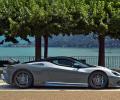
The Battista hyper GT delivers a unique dynamic experience that can be tailored to suit every journey and the pure-electric model will accelerate from 0-100 km/h in less than two seconds - faster than a current Formula 1 car.

Top gainers in the Sensex pack included ONGC, HDFC, Bharti Airtel, Infosys, Maruti, HCL Tech, Mahindra and Mahindra, HUL, TechM and SBI -- rising up to 2.89 per cent.

Cumulative sales of India's top passenger vehicle makers -- Maruti Suzuki, Mahindra and Mahindra, Tata Motors, Honda Cars, and Toyota Kirloskar -- increased to 206,418 units in February over 200,322 units in the same month last year, an increase of 3 per cent.

Mahindra and Mahindra was the top gainer in the Sensex pack, surging over 16 per cent, followed by Maruti, Titan, Bajaj Finance, HDFC, Bajaj Auto and Hero MotoCorp. On the other hand, HUL, Tech Mahindra, IndusInd Bank and Nestle were the laggards.

The keenly-awaited Mahindra Thar 2020 was finally unveiled on August 15, 2020. Here are the first images of one of the finest off-roaders!

In other countries, Street View's content comes from two sources -- Google and individual contributors. However, in India, these will be collected by the tech giant's new local partners.

Home-grown auto major Mahindra and Mahindra on Monday unveiled a new visual identity, including a brand-new logo, exclusively for its SUV portfolio, ahead of the launch of its much awaited SUV, XUV700. The new brand identity is in tune with the company's focus to be makers of sophisticated and authentic SUVs. It heralds the strategic shift across Mahindra's SUV portfolio, where we are putting the building blocks in place for a new world with a range of authentic SUVs, the company said in a release.

Its portfolio comprises of some amazing models like Mahindra Scorpio, Mahindra XUV 500, Mahindra Verito sedan and Mahindra Xylo.

Supply chain constraints will keep plaguing automobile companies even though demand significantly improved resulting in a 13 per cent year-on-year (YoY) increase in sales in financial year 2021-22 (FY22). Executives at auto firms fear that the Russia-Ukraine war will further dent the sector's prospects of recovery as supply chains face more disruptions. "The visibility in the supply side is so hazy that it is difficult to give even one quarter projection. But all the parameters of demand like pending bookings and enquiries are increasing.

Both are finding it difficult to sell one each of their plants -- Chennai Maraimalai Nagar (Ford) and Talegaon near Pune (GM) -- and are finding the road blocked by employee severance snarl-ups, report Sohini Das and Shine Jacob.

Recently, TPEM's first born electric concept, Avinya broke cover. The model promises a minimum range of 500 kilometres and advanced technology features, aimed at buyers in India and outside. TPEM, the newly formed entity may also consider a separate dedicated sales channel for the EVs with a distinctive corporate identity once the volumes reach a critical mass and throughput is large enough for the dealers to be profitable, said Chandra. Elaborating further on the hiring strategy he said, "We will hire from everywhere-wherever the talent of the required competency is available."
M&M was the top gainer in the Sensex pack, rallying around 6 per cent, followed by PowerGrid, Tata Steel, IndusInd Bank, Reliance Industries, HCL Tech, ONGC and Infosys. On the other hand, Bajaj Auto, Asian Paints, Sun Pharma, HDFC and Nestle India were among the laggards.
NTPC, Maruti, SBI, PowerGrid, Bajaj Auto, UltraTech Cement and Axis Bank rose up to 2.95 per cent.

But it is less adventurous. It seems, at last, that in its eighth decade, Pakistan has settled into being a parliamentary democracy just like Bangladesh has and like we have always been, observes Aakar Patel.

As Mahindra readies to unveil its latest version of the Jeep that is so beloved of adventure enthusiasts, the urban crowd as well as the countryside, Rajesh Karkera/Rediff.com traces the vehicle's journey through the decades.
The financing arm of the $4.5 billion Mahindra Group, Mahindra and Mahindra Financial Services Limited, is now looking to tap overseas markets with possible ventures in the US and South Africa.

M&M was the top laggard in the Sensex pack, cracking over 7 per cent, after the home-grown auto major on Saturday reported 73 per cent decline in consolidated quarterly net profit.
Nissan, which has entered into a tripartite joint venture with Renault and Mahindra and Mahindra for setting up a plant in Chennai, is almost certain to have 25 per cent stake in the venture, while it plans to launch premium sedan Teana in India.
 © 2026 Rediff.com - Investor Information - Advertise with us - Disclaimer - Privacy Policy - Sitemap - Feedback - About us - Terms of use - Grievances