
The government has utilised 'escape clause' under the FRBM Act which provides it leeway for relaxation of fiscal deficit roadmap during time of stress.

Foreign portfolio investors (FPI) have pumped in a net sum of Rs 49,553 crore in Indian markets this month so far on back of high liquidity coupled with improving global indicators and clarity after the US presidential elections. FPIs invested Rs 44,378 crore in equities and Rs 5,175 crore in the debt segment, taking the total net investment to Rs 49,553 crore between November 3-20. In October, FPIs invested a net sum of Rs 22,033 crore.

India attracted an estimated $49 billion FDI in 2019, a 16 per cent increase from the $42 billion recorded in 2018.

Axis Bank was the top loser in the Sensex pack, shedding over 4 per cent, followed by Asian Paints, SBI, IndusInd Bank, ICICI Bank, Bajaj Finance, HDFC and Reliance. On the other hand, Bajaj Auto, Hindustan Unilever, UltraTech Cement, TCS, Bajaj Finserv and Infosys were the gainers.

The ongoing key reforms such as sops for manufacturing, easier labour laws, wooing FDI inflows and privatisation will help improve productivity and support long-term growth at 7.5-8 per cent levels, which if played out well, can help India contribute 15 per cent of global GDP growth by FY2026, says a report. According to a report pencilled by the India economist at UBS Securities, Tanvee Gupta Jain, the country has the lowest manufacturing costs among peers, even though China retains significant ecosystem advantages and despite that India and Vietnam appear most likely to benefit from a shift out of China.

Something seems to be working for Indian consumers. Yet, the Indian consumer expresses some caution this festive season, reveals Mahesh Vyas.

The Tata group firm has enhanced its product portfolio through "targeted acquisitions" as it aspires to be a formidable player in the FMCG category, said Chandrasekaran, who is also the chairman of Tata Sons. Besides, it has stepped up the pace of innovation across markets in line with consumer trends such as health and wellness and convenience, he said in his message to shareholders in the latest annual report of TCPL.

The Reserve Bank's rate-setting panel, Monetary Policy Committee (MPC), began its three-day deliberations on Wednesday amid expectations of a status quo on benchmark rate mainly on account of uncertainty over the impact of the second wave of COVID-19 pandemic. Moreover, the fears of firming inflation may also refrain the MPC from tinkering with the interest rate in its bi-monthly monetary policy outcome to be announced on Friday. The RBI had kept key interest rates unchanged at the last MPC meeting held in April.

'Q1 is going to bear the brunt of the second wave, exposing full-year GDP forecasts to downward revisions, unless phase-3 of vaccination is executed quickly.'

ITC was the top loser in the Sensex pack, shedding 1.97 per cent, followed by Tata Steel 1.80 per cent, HUL 1.57 per cent, Vedanta 1.44 per cent, Bharti Airtel 1.37 per cent and M&M 1.35 per cent.

Amid uncertainties arising out of the second wave of COVID-19, the Reserve Bank on Thursday said that a durable revival of private consumption and investment would be critical for sustaining economic growth post-pandemic. Observing that 2020-21 has left a scar on the economy, RBI in its annual report said, "in the midst of the second wave as 2021-22 commences, pervasive despair is being lifted by cautious optimism built up by vaccination drives." The second wave of the pandemic has prompted revision of growth projections for the current fiscal and the consensus appears to be gravitating towards RBI's forecast of 10.5 per cent, the report added.

'When you plot the growth, -- 7.5 per cent for Q2, 0.4 per cent for Q3, 1.6 per cent for Q4 and 20.1 per cent for Q1 now -- all you see is a 'V'.' 'You don't see any other alphabet in the shape there.'

Expressing the government's commitment to continue with reforms, Finance Minister Nirmala Sitharaman on Thursday assured India Inc that it is ready to do everything required to revive and support economic growth hit by the COVID-19 pandemic. Stressing that there is a need to promote growth as it helps bring down poverty, she however said it would not be at the cost of inflation. RBI has been mandated to keep inflation at 4 per cent, with tolerance level of 2 per cent on either side.

The future of cryptocurrencies in India appears uncertain but that has not deterred young Indians from embracing the so-called 'fourth industrial revolution' world, where interconnectivity and smart automation, much of it relying on blockchain technology, drive human civilisation. Reserve Bank of India (RBI) Governor Shaktikanta Das has repeatedly warned of macroeconomic instability and even "serious consequences" if cryptocurrencies turn mainstream. The country's monetary authority wants a China-like total ban on crypto, not even allowing these currencies to be treated as investments. Though Parliament's website had listed the Cryptocurrency and Regulation of Official Digital Currency Bill as one seeking a total ban of cryptocurrencies in the country, it was not presented in the Winter Session. India now has the highest number of cryptocurrency investors in the world.

Jaitley said he would stick to the government's existing fiscal deficit target.

From Covid to climate change, Shankar Acharya's look at some of the trends and events that might shape 2022.

India's GDP is within the striking distance of attaining positive growth, the Reserve Bank said observing that the letter "V" in the V-shaped recovery stands for vaccine. The Indian government launched the world's biggest vaccination drive on January 16 to protect people from COVID-19. "What will 2021 look like? The shape of the recovery will be V-shaped after all and the 'V' stands for vaccine," said an article on the 'state of economy' in the RBI's January Bulletin. India has launched the biggest vaccination drive in the world, backed by its comparative advantage of having the largest vaccine manufacturing capacity in the world and a rich experience of mass inoculation drives against polio and measles.

The Three-Pointed Star also unveiled its 2021 motto coined as 'Reimagining Excellence', which aims at making the brand more desirable and drawing customers closer.

Other gainers included SBI, Kotak Bank, Sun Pharma, Tata Motors, M&M and Tata Steel, rising up to 5.19 per cent.
While efforts are being mounted on a war footing to arrest its spread, COVID-19 will impact economic activity in India directly through domestic lockdown. The second-round effects, it said, would operate through a severe slowdown in global trade and growth.

Encouraged by improvement in corporate earnings and decent monsoon forecasts, Citigroup has raised its BSE Sensex target to 28,800 for the fiscal year ending March 2017.

Top other laggards in the Sensex pack included Tata Motors, Maruti, Axis Bank, Bharti Airtel, RIL, NTPC, Bajaj Auto, Asian Paints, ITC, Kotak Bank, Bajaj Finance and TCS, falling up to 5.10 per cent.

Patel urges government to rein in borrowings, inflation

At a combined level, the fiscal deficit of the Centre and states together will come at 12.1 per cent, with the states contributing 4.5 per cent.

Is the worst over for Indian banks? The past two years saw them ride on treasury trades as deposits soared and credit growth dipped sharply. Gross and net non-performing assets (NPAs) moved south, and the provision coverage ratio (PCR), capital buffers, and profitability indicators are back at pre-pandemic levels. So, what's the plot ahead?
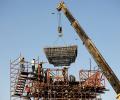
India's economy is unlikely to see double-digit growth and may grow between 8 per cent and 9 per cent this fiscal year (2021-22, or FY22), against the estimated 11.5 per cent, according to leading economists and rating agencies. The downward revision of growth projections to as low as 10 per cent is mostly on account of stringency in restrictions by states, relatively slow vaccination pace, and the possibility of a third wave of the pandemic. However, they say the impact will not be as severe as the first wave, and expect the first quarter to see positive growth.

Many in the US establishment must hope that the crisis would put the brakes on China's growing military might. Well, it ain't gonna happen, says T T Ram Mohan, who was appointed a member of the prime minister's economic advisory council on Wednesday, October 28, 2021.

Fitch's rival S&P had threatened to downgrade the rating to junk status, calling for immediate course-correction.
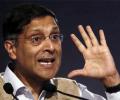
"It's a welcome development, but we also feel it was long overdue... It's a recognition of the actions that the government has undertaken like GST, bankruptcy. We also need to keep all these things in perspective," Chief Economic Adviser Arvind Subramanian said.

Tata Steel was the top gainer in the Sensex pack, rallying 3.23 per cent, followed by SBI, Yes Bank, Hero MotoCorp, ICICI Bank and Bharti Airtel.

Business Standard tracks pollution levels, goods ferried by the Indian Railways and consumer visits to various categories of places, in addition to power generation and traffic numbers to understand the fast-changing situation on the ground.
