
Analysts expect Nifty to rise up by to 6 per cent in six months, with intermittent corrections likely due to global factors.

'Keeping a bench increases cost. If you keep a bench, the skills may not remain relevant.' 'In the future, bench strength will literally be zero.'

Investors would track a host of macroeconomic data announcements scheduled this week, including inflation numbers, and also monitor global market trends, and trading activity of foreign institutional investors, analysts said. The ongoing quarterly earnings announcements and the rupee-dollar trend would also influence the markets.

India has decided to submit a dossier at the upcoming Financial Action Task Force (FATF) meeting, calling for Pakistan to be placed back on the grey list of the global money laundering and terrorist financing watchdog.
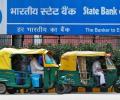
State Bank of India (SBI), the largest lender in the country, has launched a share sale to institutional investors to raise upto Rs 25,000 crore, the biggest qualified institutional placement (QIP) so far by an Indian firm, and has set a floor price of Rs 811.05, which is at a 2.5 per cent discount on Wednesday's closing price.

While TCS cited evolving business needs and future readiness as reasons, industry experts say the action is a cost-cutting measure aimed at improving operating margins that have remained below the firm's aspirational range despite multiple efforts.

Domestic gold jewellery consumption is likely to decline by 9-10 per cent in 2025-26, mainly due to a 33 per cent surge in gold prices, a report said on Thursday. The consumption of bars and coins increased 17 per cent and 25 per cent, respectively, in FY24 and FY25, reflecting investor preference for safe-haven assets amid global macroeconomic uncertainty and heightened geopolitical and trade tensions, Icra said in the report.

India's top listed real estate developers reported steady growth in Q4FY25, supported by healthy pre-sales, even as earnings reflected signs of moderation amid elevated housing prices and subdued launches.

The heightened global uncertainty due to the US "reciprocal tariffs" on India may cause near-term corrections and market turbulence, but the long-term outlook remains constructive, market experts said on Thursday. The US has announced 27 per cent reciprocal tariffs on India, citing high import duties imposed by New Delhi on American goods.

Over 60 companies are ready to launch IPOs in the coming months.

'Many global investors have been overweight on dollar assets, so some diversification or hedging is naturally expected.'

Since February 2025, the RBI has reduced the policy rate by 100 basis points. In its previous policy review in April, it had also trimmed the repo rate by 25 basis points to 6 per cent.

Hero MotoCorp on Tuesday posted 24 per cent increase in consolidated profit after tax at Rs 1,169 crore for the fourth quarter ended March 31, 2025 riding on higher margins backed by better product mix, parts revenue and cost effectiveness. The company had reported a consolidated profit after tax (PAT) of Rs 943 crore in January-March FY24.

Global trends, macroeconomic announcements and US tariff developments are expected to drive stock markets in a holiday-shortened week, analysts said. Market participants will also closely track foreign investor activity, geopolitical tensions, and their impact on the US dollar and crude oil prices, they added.

India registered its protest at the board of IMF, which met on Friday to review the EFF lending programme for Pakistan.

Passenger vehicle dispatches in India from factories to dealers rose to record levels at over 43 lakh units in FY25, with utility vehicles accounting for 65 per cent of the total sales in the segment, industry body SIAM said on Tuesday. Passenger vehicle (PV) dispatches rose to 43,01,848 units in the last fiscal year, marking a 2 per cent increase compared to 42,18,750 units in FY 2023-24.

Hyundai aims to raise exports to 30% of output by FY30 as domestic sales slow; six EVs among 26 product launches planned as part of long-term growth strategy.

Indian stock markets have experienced some ups and downs in the first half of 2025. However, both the Nifty 50 and Sensex saw steady gains, supported by a healthy economy and better corporate earnings. In this article, we will look at the detailed performance of these key indices and explore the sectors that drove the market rally.
Reserve Bank on Tuesday launched mobile application 'RBIDATA' which will provide access to more than 11,000 different series of economic data related to the Indian economy. The mobile app offers macroeconomic and financial statistics relating to the Indian economy in a user-friendly and visually engaging format, Reserve Bank of India (RBI) said in a release.

With rising credit demand, cleaner balance sheets, and renewed investor confidence, banks are positioned at the forefront of the market rally. From major players like ICICI and HDFC to broader policy shifts, there's much driving this momentum.
With rising credit demand, cleaner balance sheets, and renewed investor confidence, banks are positioned at the forefront of the market rally. From major players like ICICI and HDFC to broader policy shifts, there's much driving this momentum.
With rising credit demand, cleaner balance sheets, and renewed investor confidence, banks are positioned at the forefront of the market rally. From major players like ICICI and HDFC to broader policy shifts, there's much driving this momentum.

Foreign investors have infused nearly Rs 8,500 crore in the country's equity markets last week, after a phase of heavy outflows earlier in the month, supported by renewed investor confidence, resilient domestic economy and relative insulation from global trade disruptions. During the holiday-truncated week ended April 18, Foreign Portfolio Investors (FPIs) made a net investment of Rs 8,472 crore in equities.

Gold prices rose by Rs 70 to hit yet another record high of Rs 98,170 per 10 grams in the national capital on Thursday amid firm global demand, according to the All India Sarafa Association. On Wednesday, the precious metal of 99.9 per cent purity soared by Rs 1,650 to hit an all-time high of Rs 98,100 per 10 grams.

Investors' sentiments will be guided by a host of domestic and global macroeconomic data announcements this week, along with the trading activity of foreign investors and trends in world stocks, analysts said. Besides, the rupee-dollar trend and movement of global oil benchmark Brent crude will also be crucial in dictating terms in the market, experts added.

Wipro on Wednesday reported a 25.9 per cent year-on-year rise in consolidated net profit for the March quarter to Rs 3,569.6 crore, but warned of a weak quarter ahead with up to 3.5 per cent expected drop in IT services revenue for Q1FY26, amid global uncertainties. CEO and Managing Director Srini Pallia said clients remain cautious in the face of macroeconomic uncertainty.

Nepal's macroeconomic performance has been held back by the earthquakes and the recent unrest and disruptions to transportation and trade routes following the promulgation of a new constitution, the IMF said has said.

Moody's Ratings on Wednesday said US tariffs will weaken credit conditions and raise defaults risks especially for low-rated and speculative grade corporates. It said that an unpredictable US trade policy will lead to a deterioration in global credit conditions and macroeconomic impact will slow growth with a growing possibility of recession.

India's industrial production growth remains almost flat at 3 per cent in March sequentially, though, on a year-on-year basis, it slipped from 5.5 per cent, mainly due to poor performance of the manufacturing, mining and power sectors.

Sun Pharma, Tata Steel, State Bank of India, Axis Bank, Tata Motors, Larsen & Toubro and ICICI Bank were also among the Sensex gainers. HCL Tech, UltraTech Cement, Nestle and Hindustan Unilever were among the laggards.

Geopolitical developments between India and Pakistan, quarterly earnings and macro data will be the key drivers of stock markets in the holiday-shortened week, say analysts.

Investor confidence in value mutual funds remains robust, with the category witnessing an inflow of Rs 1,556 crore in January, indicating a shift in their focus towards fundamentally strong yet undervalued stocks.

Inflows into sector and thematic (S&T) funds fell sharply from around 5,711.6 crore in February 2025 to about 170.1 crore in March 2025 - a decline of 97 per cent. With many such funds underperforming, investors need to assess whether to remain invested or exit.
The Reserve Bank on Thursday said the macroeconomic risks to the Indian economy have increased over the last six months due to the fall in growth, external sector developments and subdued performance of the corporate sector.
Stock markets will be driven by further developments on the US-China tariff war front along with quarterly earnings announcements from IT majors Wipro and Infosys in a holiday-shortened week, analysts said. Global market trends and trading activity of foreign investors would also dictate market movement this week, experts noted.

India's Foreign Secretary Vikram Misri has underscored the importance of not equating the victims and perpetrators of terror attacks, highlighting the need for global unity in combating terrorism. Speaking at Raisina Tokyo 2025, Misri expressed appreciation for Japan's support following the recent terror attack in Pahalgam, India. He also cautioned against the trend of some Western countries hyphenating India and Pakistan in the context of their recent military confrontation. Misri further outlined India's economic aspirations and its commitment to becoming a factor of stability in a turbulent world.

'Increasingly, they treat gold as a financial asset in their portfolio rather than just as jewellery.'
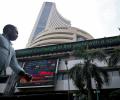
Like with all great crashes, some had noticed the cracks. "... cash balances (of banks) seem, from the available indications, to be hopelessly inadequate; and it is hard to doubt that in the next bad times they will go down like ninepins. If such a catastrophe occurs, the damage inflicted on India will be far greater than the direct loss falling on the depositors," said John Maynard Keynes in his May 1913 work "Indian Currency and Finance", written before his path-breaking work in macroeconomics laid the foundation of dealing with global crises.

The implication of April 2 reciprocal tariffs on global trade, trends in overseas markets and trading activity of foreign investors would dictate equity investors' sentiment in a holiday-shortened week ahead, according to analysts. Stock markets would remain closed on Monday for Eid-Ul-Fitr.
The US Fed interest rate decision, global trends, tariff-related developments and trading activity of foreign investors will drive the equity market movement this week, analysts said. Among macroeconomic data announcement, WPI inflation for February is scheduled to be announced on Monday.
