
India's JSW Steel has been awarded more than 5.4 million carbon credits, including four million carbon credits in the single largest issuance of emissions permits to a Kyoto Protocol project, by the United Nations.
Rajendra Pachauri, head of the Intergovernmental Panel on Climate Change of the United Nations said the developing countries, including India and China, are unwilling to sign up a new global climate change pact to replace the Kyoto protocol in 2012 as the rich world has failed to set a clear example on cutting carbon emissions. He said rich countrieslike the US, had failed to take the action needed to convince developing nations to sign a deal to help stabilise emissions.

The Conference of Parties must come up with a successor to the Kyoto Protocol which expires in 2012.
When it comes to growing the economy the most with the least energy, 10 nations lead the way.
Even as developing nations gear up for a big boom in carbon market, several projects registered with the UN carbon market regulator have drawn flak from various quarters.
Carbon credits are a tradable permit scheme. They provide a way to reduce greenhouse gas emissions by giving them a monetary value.
The United States has said post-Kyoto protocols to tackle climate change will not make any sense if India and China are 'given a pass' and that Washington will not be a signatory to any such framework if the two Asian giants are not on board."The international community has got to come up with a new plan. And if we give a pass, again, to India and China,whatever measures we take are going to be totally cancelled and overshadowed,"Deputy Secretary of State John Negroponte said

Trump's diatribe against India in his speech on the Paris Agreement is hard to explain, especially when a Modi-Trump meeting is supposedly on the cards, says Ambassador T P Sreenivasan.

India reaffirmed its commitment to the landmark Paris climate change agreement.

We lost the gains of Rio and Kyoto in Copenhagen and Paris, but it would have been worse, if any mandatory restraints were imposed on our green house gas emissions, says Ambassador T P Sreenivasan.
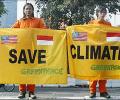
India working towards devising strategies to reduce global warming.

The two-day G20 Summit saw the Indian side making "significant contributions" on resolve to counter terrorism and boost global trade and investment.

COP 21 is about how much carbon space is left and who gets how much of that space

Obama has made combating global climate change a top priority of his presidency
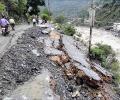
About 190 nations agreed on Sunday the building blocks of a new-style global deal due in 2015 to combat climate change amid warnings that far tougher action will be needed to limit rising world temperatures.

Worse still, the cities ranked second, third and fourth for their poor air quality are also in India.
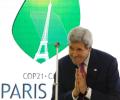
If Paris really meant to serve as a landmark in recognising equity in climate negotiations, it should have heralded the second phase of the Kyoto protocol. Instead we have all countries, India and China included, all signing up with voluntary commitments in what can only be seen as a race to the bottom, reports Darryl D'Monte.

EU operates as one block at the climate change negotiations and takes a single greenhouse gas emission reduction target under the Paris Agreement

New text is "ambitious and balanced"
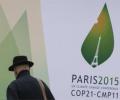
The new agreement, will be negotiated and once it is sealed it will also be judged

The conference has to agree on a draft agreement which would form the cornerstone of a historic deal to be signed in Paris in December 2015 and take effect by 2020.
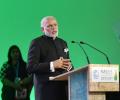
PM Modi cautioned against any unilateral steps that will lead to an economic barrier in the battle against climate change as he hoped that the developed countries would mobilise aid.

Senior journalist Darryl D'Monte reports exclusively for Rediff.com from Paris.

That does not change with the much-expected new US announcement, it only reiterates the imbalance.

With the weaker-than-expected agreement at the recent Climate Change Conference at Lima, there is an urgent need to highlight endeavours in civil society and business for a sustainable global economy with grassroots empowerment, say Rajni Bakshi.
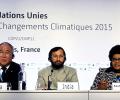
The omission of historical responsibilities, implying the build-up in the atmosphere of 165 years of greenhouse gas emissions from industrialised countries, is a body blow to the notion of climate justice, sums up Darryl D'Monte, reporting exclusively for Rediff.com from COP21.

Arvind Panagariya speaks about climate change, globalisation and India's economy.
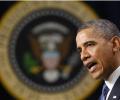
'By his very presence in Delhi on Republic Day, Obama is revisiting the most defining relationship of the 20th century after a period of stagnation,' says Ambassador T P Sreenivasan.
 © 2026 Rediff.com - Advertise with us - Disclaimer - Privacy Policy - Sitemap - Feedback - About us - Terms of use - Grievances