
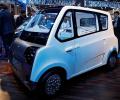
It is a perfect city car for both your daily office commute and fun weekend drives.
The EV industry is at an inflection point and batteries will play a critical role ahead -- batteries and related components typically constitute 35-45 per cent of an EV's costs.

Vader is the first electric bike in India to offer 7-inch Android display.
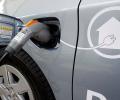
At a time when consumers increasingly embrace green mobility solutions, it is not electric cars but hybrids that are taking the lead, as automotive sales data indicate. Since January, 64,097 electric cars have been sold compared to 266,465 hybrids, according to data from the ministry of road transport and highways' Vahan dashboard. Hybrid car sales have surged from 4.42 per cent of the 4.1 million cars sold in calendar year 2022 to 7.2 per cent this year.
At a time when consumers increasingly embrace green mobility solutions, it is not electric cars but hybrids that are taking the lead, as automotive sales data indicate. Since January, 64,097 electric cars have been sold compared to 266,465 hybrids, according to data from the Ministry of Road Transport and Highways' Vahan dashboard. Hybrid car sales have surged from 4.42 per cent of the 4.1 million cars sold in calendar year 2022 to 7.2 per cent this year.

The BSA Gold Star is launched....Ola Enters e-motorbikes Biz... Bajaj, TVS To Enter e2Ws Market...

As the government plans no further extension of the scheme beyond FY24, the task is to achieve the unfinished target of subsidising 914,707 EVs.

Tata Motors on Monday said it has bagged an order for supply of 10,000 XPRES-T EV units from BluSmart Electric Mobility. The deployment of 10,000 units makes this the biggest ever EV fleet order in India, the auto major said in a statement. With deliveries starting soon, these vehicles are an addition to the 3,500 XPRES-T EV order, which was signed by both the companies in October last year, and will be used across the country for commuters, in turn helping minimise the carbon footprint.

The new Duster will go head-to-head with popular models like Hyundai Creta, Kia Seltos, Volkswagen Taigun, Skoda Kushaq, Maruti Suzuki Grand Vitara, Toyota Urban Cruiser Hyryder, MG Astor, etc in the highly competitive mid-size SUV segment.
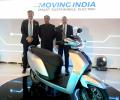
With its new premium Primus and Ampere NXG, it is targeting buyers seeking a faster and more stylish ride

With two drive options, three battery options and a design selection option, the Enyaq promises to tick all the boxes.

Adani group-AAI operated Mumbai airport on Monday said it has switched to green energy sources, fulfilling 95 per cent of its requirement from hydro and wind and the rest 5 per cent from solar power. The facility witnessed a rise in natural energy procurement with 57 per cent green consumption in April to a whopping 98 per cent between May to July, and finally attained 100 per cent utilisation of renewable sources of energy in August, the private airport operator said in a statement. Mumbai Airport was the first in India to launch hybrid technology which has been solely running on green energy since April, thus enabling an efficient and low carbon future for aviation, as part of efforts to reduce carbon footprint, it said.

The automobile sector has started seeing volume growth, the crucial economy segment included. Maruti Suzuki India (MSIL) could be a big beneficiary as the country's largest passenger vehicle (PV) maker has seen several favourable developments including volume recovery. Demand for its new sports utility vehicles (SUVs) appears to be good, and the company has 4 lakh outstanding orders by April 2023, (up from 3.6 lakhs in January 2023). Siam (Society of Indian Automobile Manufacturers) estimates that passenger vehicle demand would grow by 5-7 per cent in the 2023-24 financial year (FY24) and MSIL is likely to beat the market growth.

Maruti will launch its first electric vehicle (EV) in the next financial year (FY24), and will roll out six EVs in the country by FY30, the automaker's parent firm Suzuki said on Thursday.

SoftBank-backed Ola Electric took the wraps off its maiden e-scooter offerings -- Ola S1 and S1 Pro -- for a commercial launch on Sunday. With prices starting from Rs 99,999 (excluding state government incentives, registration fee, and insurance cost), the Bhavesh Aggarwal-founded firm said the e-scooters are designed and engineered in India for the world and will deliver the best scooter experience to the consumer. He suggested that after 2025, sale of petrol-powered two-wheelers should not be allowed.

You increase the production, only then it is possible to reduce cost, Gadkari said.
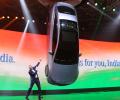
The first all electric Mercedes AMG launched in India

Auto Expo 2023 may not trigger a fresh rally in automobile stocks, say analysts, as this year's edition lacks participation from major listed players. It is also owing to the focus on electric vehicles (EVs), a segment where four-wheelers have minuscule market share. "In the passenger vehicles (PV) segment, Maruti Suzuki India and Tata Motors are the only listed players.

German luxury car maker Audi on Thursday launched three all-electric SUVs under its e-tron range with prices starting from Rs 99.99 lakh kicking off its electrification journey in the country. The three all-electric SUVs -- e-tron 50, e-tron 55 and e-tron Sportback 55 -- are priced at Rs 99.99 lakh, Rs 1.16 crore and Rs 1.18 crore respectively (all prices ex-showroom), Audi India said in a statement. Commenting on the launch of the e-tron brand in India, Audi India Head Balbir Singh Dhillon said, "we are launching not one, but three electric SUVs that begin our electrification journey." The three electric SUVs are "the perfect confluence of luxury, zero emissions, performance and everyday usability", he added.

Given India's reliance on coal, electric vehicles could at best be 10% more efficient than petrol in terms of CO2 savings.

The all-new ZS EV will be available in two variants -- Excite and Exclusive, priced at Rs 21.99 lakh and Rs 25.88 lakh, respectively. The company said it has initiated bookings for the Exclusive variant, while bookings for the Excite trim will commence from July 2022. The model comes with the largest in-segment 50.3-kWh (kilowatt-hour) battery with advanced technology, offering a 461-km certified range in a single charge.

The over 3,800-km-long Brahmaputra, one of the longest rivers in the world passes through China, India and Bangladesh and has several tributaries and sub-tributaries.
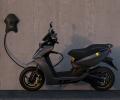
The soaring prices of metals like lithium, nickel and cobalt, which are the primary constituents of the cell, as well as supply chain bottlenecks, are also pushing up the cost of batteries
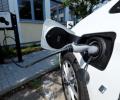
While traditional automakers in India are reeling under a global shortage of semiconductors, the country's electric vehicle (EV) makers, too, are now facing a shortage of lithium-ion batteries, a key raw material. The soaring prices of metals like lithium, nickel and cobalt, which are the primary constituents of the cell, as well as supply chain bottlenecks, are also pushing up the cost of batteries. Battery manufacturers say that prices have been increasing every quarter since the beginning of 2021.
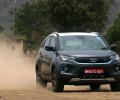
If you thought the Tata Nexon EV was it, wait till you drive the new Tata Nexon EV Max with more battery power, says Rajesh Karkera. Photographs and video: Hitesh Harisinghani/Rediff.com.

Ola Electric on Monday said it will foray into the electric car segment with plans to launch its first model by 2024. The company, which struggled with deliveries for its electric scooters after it announced entry into the segment exactly a year ago, has set an ambitious target of selling 10 lakh electric cars by 2026-2027. In a press conference, Ola founder and CEO Bhavish Aggarwal said Ola Electric aims to provide a range of electric two-wheelers to electric cars which are priced in the range of Rs 1 lakh to Rs 50 lakh.

India's flagship motor show Auto Expo 2023 kicked off on Wednesday with the global unveiling of Suzuki Motor Corporation's concept electric SUV 'eVX' which is slated to hit the market by 2025. The company's Indian arm Maruti Suzuki India is among the major manufacturers participating in the show that has returned after three years. The Concept eVX is a mid-size electric SUV concept designed and developed by Suzuki Motor Corporation (SMC), Japan. It will be powered by a 60 kWh battery pack offering up to 550 km of driving range on single charge.
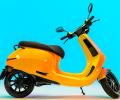
The entry of SoftBank-backed Ola into the electric scooter (e-scooter) segment is set to power up the overall market and perhaps fast-track the adoption of battery-operated vehicles. But for manufacturers of internal combustion engine (ICE)-powered two-wheelers, such as Bajaj Auto, Hero MotoCorp, and TVS Motor, it will be a double whammy. Not only will they have to contend with the aggressive pricing of Ola's scooter and incur a loss at each unit of the e-scooter sold, the volumes of their regular (ICE) models, too, could feel the squeeze, observed analysts. Ola is expected to price its e-scooter in the range of Rs 85,000-1.1 lakh.

This is essential to promote investment in essential infrastructure such as Power. Any additional burden will only pass on to the end consumer.
India has a history of jugaad, and retrofitting vehicles is one such manifestation of the legendary Indian skill. Not so long ago autorickshaws and small Marutis used to strap on subsidised LPG cylinders and power themselves to a cheap ride. There were the odd explosions, lives were lost, but the jugaad continued. Then compressed natural gas (CNG) was introduced in Delhi following a court order. Initially, customised CNG kits were fitted to conventional (internal combustion engine or ICE) autos cheaply, enabling commuting at less than half of what you would cough up for diesel. The industry is better organised now with Suzuki and Hyundai designing CNG-fired vehicles, and Mahindra and TVS manufacturing liquefied petroleum gas (LPG)-powered three wheelers.

'I have personally been very keen on investing in lithium ion battery technology for some time.'

Bhavish Aggarwal, the founder of ride-hailing firm Ola who disrupted the electric scooters market in the country, is planning to launch an electric sports car in 2024. The plan will put it in competition with Indian players, such as the Tata group and Mahindra & Mahindra, and global giants like Tesla and Hyundai. Aggarwal, recently, took a group of reporters to the firm's design studio at the Ola campus in Bengaluru where his teams are working on several EVs, including scooters, motorcycles, sedans, and SUVs - and even robotaxis.

Rajesh Karkera/Rediff.com takes the XUV 400, the first electric SUV from the Mahindra stable, for a spin and comes away impressed.

Tata Motors on Wednesday expanded its electric vehicle range in the country with the launch of Nexon EV MAX, priced between Rs 17.74-19.24 lakh (ex-showroom). Equipped with a 40.5 kWh lithium-ion battery pack, the Nexon EV Max offers 33 per cent higher battery capacity than the Nexon EV, delivering ARAI certified range of 437 km (under standard testing conditions), ensuring uninterrupted inter-city travel. ARAI refers to Automotive Research Association of India. The model produces 105 kW (143 PS) of power and delivers a torque of 250 Nm, resulting in 0 to 100 sprint times in under 9 seconds.
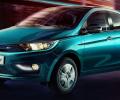
Tata Motors on Wednesday unveiled Tigor EV, its second electric model in the personal mobility space after Nexon EV. The auto major has tasted success with Nexon EV, which currently commands about 70 per cent market share in the domestic electric vehicle segment. The Tigor EV comes powered by the company's high voltage electric architecture - Ziptron - and has been developed based on three pillars of technology, comfort and safety.

KVA is a measure of demand load while KWH is a measure of usage. India's per-capita consumption is 750 KWH or 750 units, while the world average is 1,000 KWH per annum. A 40W tube can consume one KWH power in 250 hours. Power for illuminating the bridge would be supplied by Brihanmumbai Electric Supply and Transport and Reliance Power.
The exchange, Indian Energy Exchange (IEX), received bids for 13,176 Mwh of power when operation commenced and the transaction took place in the price range between Rs 6.46/kwh and Rs 8.01/kwh. Power will be delivered on Saturday as IEX is trading a day ahead currently.

Even as India goes green, lack of uniform standards for setting up charging stations is holding back companies. Alnoor Peermohamed reports.

Reviving stranded gas-based power plants and substituting diesel usage is a clear near-term opportunity.
In a judgement that will bring relief to power deficit states, the Appellate Tribunal for Electricity has disallowed power surplus states like Orissa from charging a premium on exported power.
