
The Indian Pickleball Association has announced the national team, led by Harsh Mehta, for the upcoming Pickleball World Cup in Da Nang, Vietnam. The squad includes both experienced players and young talent, with corporate backing providing a boost for their preparations.
The Indian Pickleball Association has announced the national team, led by Harsh Mehta, for the upcoming Pickleball World Cup in Da Nang, Vietnam. The squad includes both experienced players and young talent, with corporate backing providing a boost for their preparations.
Arjun Singh and Veer Shah have been selected as captains for India's U-18 and U-14 pickleball teams, respectively, for the upcoming World Cup in Da Nang, Vietnam. The squads were finalised after selection trials in Ahmedabad, with officials expressing confidence in the team's potential to perform well.

Mihika Yadav and Arjun Singh headline the Indian team selected to compete in the US Open pickleball tournament in Naples, Florida. The squad includes players across various age categories, with the Indian Pickleball Association supporting their participation in upcoming international events.
The Indian Pickleball Association has sanctioned the fourth edition of the Indian Open, to be held in Hyderabad, as a PWR 1000 event, marking a significant step for the sport in India.

The Indian Pickleball Association and the Sports Authority of India will conduct trials in Ahmedabad to select the Indian team for the upcoming Pickleball World Cup in Vietnam.

India's pharmaceutical industry is experiencing increased bulk drug prices, particularly for APIs from China, following the escalation of the West Asia crisis in March. While current inventories provide a temporary buffer, concerns are mounting over the availability of key solvents and feedstocks, potentially leading to manufacturing disruptions and shortages in specific drug categories.

Artificial intelligence (AI) is no longer a side conversation for Indian pharma. It is fast becoming central to how drugs will be discovered, made, and supplied. Along with that shift comes a sharper focus on innovation, on the one hand, and quality and trust, on the other.
Indian Pharmaceutical Alliance (IPA) on Friday said US President Donald Trump's move to impose 100 per cent import tariffs on pharmaceutical drugs from October 1 will impact only patented and branded products, not generic medicines.

President Trump announces 100% tariffs on movies made outside the US, potentially impacting the Indian film industry. The move follows similar tariffs on pharmaceutical products.

Trump said California has been particularly "hard hit" because of this, blaming democrat Gavin Newsom, the Governor of California, for this loss, calling him "weak and incompetent."
Ranbaxy Laboratories, the biggest member of the Indian Pharmaceutical Alliance, has come out in the open against the alliance's stand on patent issues.

Indian drugmakers supply 47 per cent of the generic medicine requirements in the US, and tariffs would have increased prices in the US domestic market for patients, who are already dealing with drug shortages.

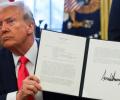
A fresh US executive order (EO) which seeks to bring down prices of prescription drugs in the country by up to 90 per cent -- on par with other developed nations -- will affect innovator companies, while sparing the Indian generic drug makers in the short term. US President Donald Trump signed the EO on Monday, directing the US Trade Representative and the Secretary of Commerce to act against foreign countries that "purposefully and unfairly undercut market prices", driving price hikes in the US.
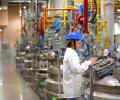
Indian pharmaceutical companies have made major strides in adhering to stringent US Food and Drug Administration (USFDA) norms in 2024, with data suggesting a decline in the number of adverse classification outcomes of inspections across biologics, drugs, and devices. In 2023, the USFDA conducted 225 inspections, which led to 18 cases of Official Action Indicated (OAI) and 117 cases of Voluntary Action Indicated (VAI).
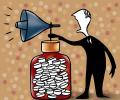
Indian pharmaceutical companies may have units abroad as part of "distributed manufacturing" across various locations, according to industry veterans. This may come about over the next five to 10 years.
Industry insiders in India warn that any such move in the pharmaceutical sector could be counterproductive for the US as it may face increased drug shortages if tariffs are imposed on such imports.

Indian pharmaceutical companies are stepping up their efforts to combat the problem of counterfeit drugs, employing a variety of strategies, from packaging innovations to engaging private investigation agencies. The stakes are high, as counterfeit medicines not only harm consumers but also tarnish the reputation of leading brands.
There is a need to incentivise R&D investments, offer corporate tax concessions and establish an effective intellectual property rights regime in order to push the growth of domestic pharmaceutical industry, as per the industry bodies. Outlining the sector's wish list for the upcoming Union Budget, Organisation of Pharmaceutical Producers of India (OPPI) Director General Anil Matai urged the government to explore methods to incentivise R&D investments, such as deductions on R&D expenses, research-linked incentives for MNCs, and corporate tax concessions.
As the Drugs Controller General of India (DCGI) is set to crack down on companies to ensure compliance with printing QR codes on top-selling brands to curb counterfeiting, top pharma companies say they welcome the regulator's mandate and that they are on track. They also view it as a positive step to ensure patient safety. Sheetal Arora, CEO of Mankind Pharmaceuticals, which has already adopted QR codes in 20 of their products, stated: "We strongly advocate for mandatory implementation of barcodes and QR codes on medicines as this initiative will not only protect patients but also strengthen the integrity of our healthcare system by reducing circulation of counterfeit drugs."

"The 'red bag' belonged to one of the hijackers, it contained explosives, and possibly, real passports, too.

Most of the pharma units are failing in documentation, and validation processes, and many don't have full-fledged quality control laboratories.
The pharmaceutical and the consumer durables sectors, which depend on China for imports, have not been impacted yet due to unrest in China with people protesting against lockdowns. But the lockdown could have an impact on the supply of components used in consumer durables if it continues for the next fortnight. In the pharmaceutical industry, Indian players import 66-70 per cent of their bulk drug requirements from China.
The government should take measures to promote innovation and R&D while simplifying regulations for the sector in the upcoming Union Budget, as per pharmaceutical industry bodies. Outlining the wish list for the sector in the upcoming Union Budget, Indian Pharmaceutical Alliance (IPA) secretary general Sudarshan Jain said the domestic pharma industry is currently around $50 billion in size and aspires to grow to around $130 billion by 2030 and $450 billion by 2047. "To achieve this vision, the Union Budget 2023-2024 should help fuel innovation and R&D, which will set the pace for propelling the pharmaceutical industry forward," he told PTI.
Members of the IMA and IPA had met Mansukh Mandaviya on Monday and expressed their concerns over the regulations.

An NGO claimed that its documentary cast a slur on the reputation of India, its judiciary and Prime Minister Narendra Modi.
Reinvent and innovate will be the key mantra for the Indian pharma industry in the New Year as the 'pharmacy of the world' looks to move from volume to value leadership, amid emerging challenges of inflation and pricing pressures in the global markets. While R&D investment, market competitiveness, regulatory scrutiny, and domestic price regulations are expected to shape the growth of generics and injectable products, concerns such as price control and customs duties on medical equipment will continue to bother the healthcare industry in 2023. The industry believes that in view of India's G20 Presidency, digital health innovation, achieving universal health coverage, improving healthcare infrastructure and delivery will continue to be the key driving factors in 2023.

Currently, the spend on R&D as a percentage of GDP is just 0.9%

The pharmaceutical companies may suffer sales loss of Rs 3,000 crore (Rs 30 billion) if the government's span of control increases, as proposed in the new pricing policy for the medicines, a section of the industry said on Monday.

The API of Paracetamol, a fever and pain medication, has grown 25 per cent from Rs 450-480 per kg in December 2020 to Rs 580-600 per kg in April. When compared to the pre-Covid prices of December 2019, the surge is much steeper -- around 140 per cent, reports Sohini Das.
Pharma firms wants new policies that will boost investment.
Pharma firms wants new policies that will boost investment.

Britain's Prime Minister David Cameron brought Chinese President Xi Jinping to his favourite pub for a pint and a portion of fish and chips on Thursday.
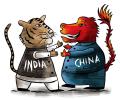
Indian auto and pharma industries import several critical components and raw materials from China.
The 11-member Indian Pharmaceutical Alliance has frozen the prices of all decontrolled medicines until March 31, 2005, in view of high inflation.
Indian drug firms get a shot in the arm in the $12 bn Australian drug market as the Therapeutic Goods Administration (TGA), Australia agrees to accelerate the drug approval process in that country for Indian players who already have an approved plant and product from one of the stringent regulatory authorities like US, EU or Canada. From current sales of $340 mn, the Indian firms can see a significant upside in sales; felt Dinesh Dua, former chairman of the Pharmaceutical Exports Promotion Council of India (Pharmexcil), and the MD of Nectar Lifesciences. He highlighted that only 12 percent of the Australian drug market is generic, as against 80-90 per cent in the US or EU. Of this $1.5 bn generic drug market in India, Indian companies have a small share.

The helpline 'KIRAN' (1800-599-0019) was launched by Union Minister for Social Justice and Empowerment Thaawarchand Gehlot. The helpline will offer mental health rehabilitation services with the objective of early screening, first aid, psychological support, distress management, mental well being, promoting positive behaviour and psychological crisis management, the minister said.
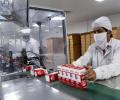
When compared to the domestic sales of April 2019, the growth is around 37 per cent. However, compared to the previous month (March), the growth is 18.4 per cent.

Patients' lobbies cheer ruling on anti-cancer drug Glivec, as affordability and access to life-saving drugs get a leg-up.
Prices of various leading drug brands will come down by up to 80 per cent thanks to the newly-approved National Pharmaceutical Pricing Policy but at the same time it will hurt investment sentiments in the country's pharmaceutical sector, according to industry bodies.
