
India's current account slipped into a deficit of $9.6 billion or 1.3 per cent of GDP in the September quarter, the Reserve Bank said on Friday. The current account, which records the value of exports and imports of both goods and services along with international transfers of capital, was in a surplus mode both in the quarter-ago and year-ago periods. India's current account surplus had stood at $6.6 billion or 0.9 per cent of GDP in the April-June 2021 quarter, while in the year-ago period (Q2FY22), the surplus had stood at $15.3 billion or 2.4 per cent of the GDP, the data said.

Saudi Arabia has agreed to provide US$ 4.2 billion worth of assistance to cash-strapped Pakistan to support its economy, it emerged on Wednesday after Prime Minister Imran Khan held talks with Saudi Prince Mohammad bin Salman in Riyadh this week.

The IMF and World Bank have stopped loans, and the FATF warned its 39 member nations to block Taliban assets.

Gold reserves were down by $580 million in the reporting week to $37.440 billion.

China on Tuesday said the activities of its high-tech research vessel will not affect the security of any country and should not be 'obstructed' by any 'third party', as the ship berthed at Sri Lanka's strategic southern port of Hambantota amid Indian and United States concerns.

Wickremesinghe will resign after an all-party government is established and the majority is secured in Parliament.

Pakistan was "drowning" in debt and it was the new government's job to "sail this ship ashore," Prime Minister Shehbaz Sharif said on Wednesday.

Khan's Pakistan Tehreek-e-Insaf (PTI) won 15 of 20 seats up for grabs in the politically crucial province of Punjab on Sunday, dealing a major blow to Prime Minister Shehbaz Sharif and his 13-party alliance led by the ruling PML-N.

Indian economy is expected to grow by 10 per cent or more in the current fiscal, and 8 per cent plus in the next fiscal year, Niti Aayog Vice-Chairman Rajiv Kumar said on Tuesday. Addressing a book launch event, Kumar further said that seven years of the Modi government has laid a strong economic foundation for businesses to thrive in India. "There was a hiccup (in economic growth) for two years due to COVID-19 pandemic.

Gold reserves were down by $1.441 billion in the reporting week to $35.999 billion.

The President had been moved out of his residence on Friday, in anticipation of Saturday's protests.

From the enactment of the capital control Act to the recognition of the BSE as a stock exchange and the infamous Harshad Mehta scam, here are the 18 biggest events for stock markets from 1947 to 1993.

International Monetary Fund (IMF) chief economist Gita Gopinath has made a strong case for regulating cryptocurrencies, saying it will always be a challenge to ban them as they operate from offshore exchanges. Gopinath also suggested a global policy and co-ordinated action for regulating cryptocurrencies. "I think cryptocurrencies are a particular challenge for emerging markets. "It seems to be more attractive to adopt cryptocurrencies and assets in emerging economies than in advanced economies," she said while addressing an event organised by the National Council of Applied Economic Research (NCAER) on Wednesday.

The International Monetary Fund (IMF), in its latest World Economic Outlook report, has slashed its forecast for India's FY23 gross domestic product growth to 8.2 per cent from 9 per cent, saying that higher commodity prices will weigh on private consumption and investment. This was one of the steepest cuts for emerging economies compared to the IMF's January WEO forecasts. Saying that global economic prospects have worsened significantly due to commodity price volatility and disruption of supply chains caused by the war in Europe, IMF cut its global growth outlook for calendar year 2022 to 3.6 per cent from 4.4 per cent, and said both Russia and Ukraine could experience large GDP contractions.

The country's foreign exchange reserves crossed the $600 billion mark for the first time after increasing by $6.842 billion in the week ended June 4, RBI data showed on Friday. The reserves surged to a record $605.008 billion in the reporting week, helped by a rise in foreign currency assets (FCA), a major component of the overall reserves, as per weekly data by the Reserve Bank of India (RBI). In the previous week ended May 28, 2021, the reserves had swelled by $5.271 billion to $598.165 billion.

Gold reserves were down by $331 million to $37.264 billion.

Gold reserves rose by $320 million to $31 billion.

Pakistan has been on the grey list of the Paris-based Financial Action Task Force since June 2018 for failing to check money laundering, leading to terror financing, and was given a plan of action to complete it by October 2019.

Sri Lanka's Acting President Ranil Wickremesinghe on Monday imposed emergency giving him sweeping powers ahead of the key election on July 20 to pick a new President as he urged the political parties to put aside differences and form an all-party government, with the Opposition dubbing his decision as an 'undemocratic draconian act'.

Gita Gopinath, the IMF's Indian-American chief economist has been promoted as its First Deputy Managing Director recognising her exceptional intellectual leadership in helping the global economy and the Fund to navigate the "twists and turns" of the "worst economic crisis of our lives". Gopinath would replace Geoffrey Okamoto who plans to leave the International Monetary Fund early next year, Kristalina Georgieva, IMF's managing director announced on Thursday. Gopinath, who was scheduled to return to her academic position at Harvard University in January 2022, has decided to stay, she said. Gopinath, 49, has served as the first female chief economist of the Washington-based global lender for three years.

The country's foreign exchange reserves swelled by USD 3.005 billion to a lifetime high of USD 490.044 billion in the week ending May 22, mainly on account of a rise in foreign currency assets, RBI data showed on Friday. In the previous week, the reserves had increased by USD 1.726 billion to USD 487.04 billion.

Chief Economic Adviser K V Subramanian on Wednesday said India is expected to hit a growth rate of 6.5-7 per cent in 2022-23 and accelerate further to 8 per cent in the subsequent years on the back of reforms undertaken by the government. He also said the government is expected to meet the fiscal deficit target of 6.8 per cent in the current fiscal despite pressure on revenue collections.
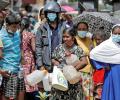
New Delhi has a chance to rid itself of its image as the bully in the subcontinent by helping a neighbour tackle problems that India, for once, has no role in creating. It should grab the opportunity with both hands, suggests Aditi Phadnis.

Gold reserves were up by $712 million to $34.729 billion.
IMF's Chief Economist Gita Gopinath will leave her job in January next year and return to the prestigious Harvard University, according to the global financial institution.

The Indian economy remains on track to regain its position as the world's fastest-growing major economy after official estimates on Friday put the expansion at a tempered 9.2 per cent this fiscal amid concerns over the impact of a resurgent virus on the fragile recovery. The growth in the gross domestic product (GDP) of 9.2 per cent in April 2021 to March 2022 fiscal (FY 2021-22) given by the National Statistical Office (NSO) in its first advance estimate compares with 9.5 per cent expansion forecast by the Reserve Bank of India (RBI) last month. The economy had contracted by 7.3 per cent in the previous financial year.

President Gotabaya Rajapaksa on Monday fired Basil Rajapaksa from his post and invited the Opposition parties to join a unity Cabinet to tackle the raging public anger against the hardships caused by the economic crisis.

Foreign currency assets, a major component of the overall reserves, fell by $490 million to $441.458 billion in the reporting week.

With inflation remaining at elevated levels, central banks around the world, including the Reserve Bank of India (RBI), will kill excess demand in economy over the next six to eight months, sources in the know said. They also indicated that there could be a rate hike in June, when the inflation forecast for the current financial year would be raised. The RBI, the sources said, might announce more steps such as raising the limit on held-to-maturity (HTM) bonds to support government borrowings but might not come out with any further quantitative easing GSAP (Government Securities Acquisition Programme) measures.

Reconstruction efforts after the Russia-Ukraine war will be dominated by the heft of the membership of major nations across international organisations. India is hamstrung because it does not play host to any major global institution nor does it hold positions of significant influence in the ones in which it has membership. As a result, the world's sixth largest economy is obliged to follow the rules set by most of them.

India's exports in April jumped nearly three-fold to USD 30.63 billion from USD 10.36 billion in the same month last year, according to government data released on Friday.

Emerging markets such as India have always run higher inflation rates than developed economies such as the US and countries of Western Europe. But for the first time in the past 30 years, the US reported a higher consumer price inflation (CPI) rate than India in five consecutive months. The US reported a CPI rate of 7.5 per cent in January 2022 against 6.01 per cent in India and analysts expect the trend to continue for at least a few months more

Gold reserves increased $1.54 billion to $32.68 billion in the reporting week.

The foreign exchange kitty had crossed the half-a-trillion mark for the first time in the week ended June 5, 2020, after it had swelled by $8.223 billion to stand at $501.703 billion.
Gold reserve also declined by $340 million to $30.55 billion.

Gold reserves in the reporting week increased by $707 million to $33.52 billion.
Gold reserves were up by $1.525 billion in the reporting week to $37.625 billion.

Should we not stop uncritically celebrating NRIs' elevation without regard to what kind of companies they are getting to run, and the nature of their products or business practices, asks T N Ninan.

The money stashed away in tax havens is estimated at between $5.6 trillion and $32 trillion, numbers to make your eyes pop, asserts T N Ninan.

You will need a sharper eye for stock picking and a greater appetite for risk than most retail investors possess, recommends T N Ninan.
 © 2026 Rediff.com - Advertise with us - Disclaimer - Privacy Policy - Sitemap - Feedback - About us - Terms of use - Grievances