
As if wanting to be an antidote to the coronavirus pandemic, the Indian stock market adorned carnival robes in 2021 with a tsunami of liquidity unleashed by global central banks coupled with supportive domestic policies and the world's largest vaccination drive sparking off a world-beating rally on Dalal Street, despite bouts of uneasiness over fizzy valuations. While the wider economy shuttled between recovery and relapse, dictated by multiple mutations of the virus, equity market benchmarks appeared headed in just one direction -- skywards. The dizzying upward journey has added a whopping Rs 72 lakh crore during 2021 to investors' wealth, measured as the cumulative value of all listed shares in the country, taking it to nearly Rs 260 lakh crore.
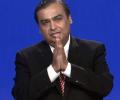
Reliance Retail Ventures Ltd, run by India's richest man Mukesh Ambani, on Tuesday raised Rs 5,512.50 crore from Abu Dhabi Investment Authority (ADIA), taking the total fundraise to Rs 37,710 crore in less than four weeks.
If you are running a sweetmeat shop, will you manage a dairy for milk supply or buy milk from the market? Banks are running a dairy (which has its cost for processing milk), while NBFCs are buying milk from the market, observes Tamal Bandyopadhyay.
Market players said NBFCs and HNIs are recalibrating their plans based on the changing dynamics.
The PE biggie has committed to pumping money into Jio Platforms, Byju's and Reliance Retail so far this year - all marquee names in their respective sectors.


China's e-commerce giant Alibaba, which completed the world's largest initial public offering ever this month, has won approval from authorities in Beijing to establish a private bank as it diversify into financial services.
Let's take a look at world's top stock exchanges by IPO value in 2012.


The government currently holds 87.40 per cent stake in IRCTC. To meet Sebi's public holding norm, it has to lower its stake in the company to 75 per cent.
Firms in rush to raise capital but those putting in money at new valuations might be left holding the can.

Many are now hoping the markets remain in good stead as they look to finalise the dates for IPOs, such as UTI MF, Computer Age Management Services, Happiest Mind, and Angel Broking. Most of the issues are expected to come to the market in the second half of September.
The Reserve Bank of India on Tuesday raised margins on all advances against shares, initial public offerings and issuance of guarantees to 50 per cent from 40 per cent.

After the government sought Parliament's nod for a second batch of supplementary demand for grants that will cause a hit of Rs 2.99 trillion to the exchequer, doubts suddenly arose about the government's ability to meet the Budget projections of reining in its fiscal deficit at 6.8 per cent of gross domestic product (GDP), or Rs 15.06 trillion, for the current financial year. Till now, many were of the opinion that the government would succeed in checking the deficit at a much lower figure than what was given in the Budget Estimates (BE). The government had sought Parliament's approval to spend Rs 3.74 trillion extra, but Rs 74,517.01 crore will be matched by equal savings on other heads.
The financial sector has been deeply troubled since 2013. It is now in a full-blown crisis, warns Devangshu Datta.
Flipkart, the poster boy of Indian e-commerce, hit a new high by raising $1 billion (about Rs 6,000 crore) in the latest funding round, led by existing investors Tiger Global Management and Naspers.
Facebook is seeking to raise $5 billion.

'Banking is a business of trust.'
After unfavourable response to the safety net, Sebi considers instruments with an option of conversion into equity.

Equity investors grew richer by Rs 32.49 lakh crore in 2020 on the back of smart returns in the stock market which had a roller-coaster ride during the year hit by the coronavirus pandemic. The COVID-19 outbreak ravaged lives and livelihoods on a global scale, shuttering businesses and jolting world equities. But amid all the gloom, Indian stock indices gave hope of returning to winning ways towards the latter part of the year.

India is currently home to 52 unicorn startups and one of the fastest-growing startup ecosystems.
Power Trading Corporation's initial public offering of 5.85 crore (58.5 million) shares was oversubscribed by about two times on day one, sources associated with the process said in New Delhi.

Around 70 companies have received IPO clearance from markets regulator Sebi, but are waiting for election results.
Markets regulator Sebi on Tuesday proposed to rationalise the definition of 'promoter group' and move to the concept of 'person in control' as well as reduce the minimum lock-in periods for promoters' and other shareholders post an IPO. In a consultation paper, the watchdog has also suggested streamlining the disclosures requirement of group companies. The Securities and Exchange Board of India (Sebi) has sough comments from public on the proposals till June 10.
Twitter CFO Mike Gupta grilled banks about how to sidestep the problems that beset Facebook's IPO from start to finish.
While Facebook's CEO had shown up in a hooded sweatshirt and sneakers, Twitter's executives were clad in dark suits as they pitched investors over plates of pesto chicken salad and raspberry tart.

This will encompass the sale of Air India, a number of other privatisation initiatives, mergers, initial public offerings, the Centre's two exchange-traded funds, buybacks and offers-for-sale, and even monetisation of land assets.

In the past 10 trading sessions, shares of the state-owned company have shot up more than 50 per cent.
Twitter has filed for an initial public offering with US regulators.

Investing in start-ups can be highly rewarding, but direct investing is not meant for everyone. For the majority of wealthy investors, taking the private-equity route could still be the better option.

A weak economy coupled with rising Covid-19 cases and inflation that is above RBI's comfort zone, geopolitical developments, and upcoming India Inc's second quarter results for FY21 could impact sentiment, analysts say.
The microblogging network priced 70 million shares at $26, above the targeted range of $23 to $25, which had been raised once before.

However, the number of renewals has grown by only 0.4 per cent, which means only high value and ticket size renewals are coming.
Retail investors shunned the Bharti Infratel initial public offering.

The issue will comprise a secondary share sale worth Rs 600 crore by private equity major Everstone Capital and fresh fundraising worth Rs 400 crore.
RailTel Corporation of India, Indigo Paints, Home First Finance Company, Indian Railway Finance Corporation, and Suryoday Small Finance Bank are among the companies looking to tap the market.
Despite a more liberalised business milieu, modern-day entrepreneurs remain prone to unethical behaviour and poor governance.
 © 2026 Rediff.com - Investor Information - Advertise with us - Disclaimer - Privacy Policy - Sitemap - Feedback - About us - Terms of use - Grievances