
The fundamental challenge to United States-India strategic cooperation is China, says Daniel Markey, senior fellow for India, Pakistan, and South Asia at the Council on Foreign Relations, where he specialises in security and governance issues in the subcontinent.
The recent Pentagon report on Indo-United States military-to-military ties signifies America's commitment for strengthening relations with India, top US senators have said.
In the final step to operationalise the India-United States nuclear agreement, American President George W Bush has sent the text of the landmark agreement to the US Congress for final approval.The move by the White House comes five days after the 45-member Nuclear Suppliers Group granted a waiver for India to carry out nuclear commerce.In a statement, the White House said it was transmitting the text of the agreement 'concerning peaceful uses of nuclear energy'.
The two nations have agreed to discuss a science and technology agreement and resolved to expand cooperation in developing and commercialising more efficient energy technologies.
The India-United States relationship has still not reached its full potential, though the two countries have developed steadily closer ties built on a uniquely strong foundation, according to powerful Senator Richard Lugar, a key supporter of the civil nuclear deal between the two sides. "The remarkable deepening of US-India ties over the past decade is only a start, as the relationship has still not reached its full potential," Lugar, ranking Republican.
"I think the principle benefit would be greater visibility to the relationship at the highest level with President Obama and Prime Minister Singh," Karl F 'Rick' Inderfurth, the former Assistant Secretary of State for South Asian Affairs said.
Reflecting an improvement in economic ties with the US, the bilateral trade has increased to $48.71 billion during April-December of this fiscal, Parliament was informed on Friday.
Terming the 'historic transformation of United States' ties with the rising democratic power India' as among its key strategic accomplishments, the Bush administration has said it will enable Washington to advance its 'interests and values' in the region in future.

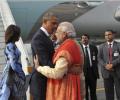
Obama joked that he too wanted to wear a Modi kurta.

The composition of the US delegation led by Secretary of State Hillary Clinton to next week's India-US Strategic Dialogue in New Delhi points to the wide-ranging scope of talks between the two countries.

Terry McAuliffe, chairman of Hillary Clinton's presidential campaign, speaks exclusively to Aziz Haniffa.

In bilateral interfaces relations with China have also to be given due weight, opines Premvir Das
Expressing concern over slowdown of trade with India, United States said bilateral trade between the two countries could go up by a further $38 billion by 2015 if India accelerated its economic reforms to match the US endeavour.

The two governments have already set a target of increasing bilateral trade in goods and services to $500 billion.
With an integrated network of marine, air, road and rail systems, the Atlantic Gateway provides strong connections to global markets, he said, adding that upon entry, goods flow easily through the Gateway's transportation corridors to major markets in Central Canada and the US.
The US-India Business Council has hailed American cooperation in India's first unmanned lunar mission Chandrayaan-I saying it marks the beginning of a new era of trust and partnership between the two countrys in the field of space exploration.
The lawmakers, speaking at a Capitol Hill event hosted by the Confederation of Indian Industry to release its new study about Indian companies investing heavily in the US and both saving and creating jobs, hoped that this message will alleviate the concerns over outsourcing and loss of American jobs among their constituents.
The year 2007 did not turn out to be much different than 2006 in that much of the time was spent on figuring out whether Washington and New Delhi will come to terms with the so-called 123 Agreement that would formalise the Henry J Hyde Peaceful Atomic Energy Cooperation Act that the President George W Bush signed into law in the closing days of 2006.
The Indian public is not naive and indeed demonstrates a streak of hard realism in its judgments about the US.
The Communist Party of India Marxist on Thursday vowed to oppose a strategic alliance between India and US, stating such a move is aimed at countering China. ''We shall not rest in our fight till the strategic ties with the US is snapped out,'' Karat said at a CPI(M)-sponsored programme in Kolkata to celebrate the October Revolution. He said the US was trying to make India its strategic ally in countering China, which is "the most powerful socialist country."
A top Bush Administration official has expressed hope that the civil nuclear deal with India will be done and that the Americans, in about twenty years, would be able to look at India as being one of its two or three most important partners.
Kamal Nath said the meeting identified "some areas of concerns and interest" from both sides impacting two-way trade, like "the issue of setting up titanium plants for the aircraft sector.

United States President Barack Obama was "very pleased" to meet India's new Prime Minister Narendra Modi and values the opportunity to discuss a broad array of topics reflecting the depth of the strong ties between the world's two largest democracies, the White House has said.
Th defence minister said warships of the two countries conducted seven exercises, involving participation of two US nuclear carriers and five nuclear-powered submarines in the Malabar series of war games.
India, US troops will hold anti-terror drill in the N-E state
The heart of the matter is that the Indo-US nuclear deal, unless it is closed now right now and on American terms, will soon need to be harmonised with the new Russian-American format and the international regime emanating out of it
'It is important to realise that the United States looks upon India as the world's largest democracy, as an important and vital ally in a whole host of things -- regional security, global trade, climate change'.
New United States Secretary of State John Kerry has called up External Affairs Minister Salman Khurshid who said India was looking forward to take the bilateral ties to a higher level encompassing diverse sectors.
Pakistan did not oppose the George W Bush administration's move to ink a civil nuclear agreement with India because it expected it would receive a similar deal from the United States, Prime Minister Yousuf Raza Gilani has said.
Asked whether Australia would export uranium to India, the Australian foreign minister said: "Let's have a look at the agreement India and the United States finally come up with before we get into that."
Top law makers led by Chairman of Foreign Affairs Committee of the House of Representatives Tom Lantos have urged the Bush administration to maintain favorable conditions for importing products from India to keep up the pace of its trade with the Uni
He, however, said that India and Pakistan are proceeding with the composite dialogue process, which has led to reduction of tensions and resulted in several Confidence Building Measures.
Ironically, the opponents of the deal in the US are concerned about the narrow aspects of non-proliferation, while its critics in India are fighting the larger issue of US domination.
A 140-strong Indian contingent is participating with troops from the 25th Infantry Division of the US Pacific Command in Yudh Abhyas 06-02, the second training exercise of its type this year.

When President Barack Obama and Dr Manmohan Singh had announced the initiative, Geithner had said that 'India is an emerging global power and a country with which the US has an increasingly important economic and financial relationship.'
The deal will let India draw upon the resources of the Federal Aviation Administration to modernise its infrastructure.
 © 2026 Rediff.com - Investor Information - Advertise with us - Disclaimer - Privacy Policy - Sitemap - Feedback - About us - Terms of use - Grievances