
Ahead of the Non Proliferation Treaty review conference, the United States on Friday said the Indo-US civil nuclear deal has not weakened the Nuclear Non-Proliferation Treaty as the pact comes with a number of 'transparency mechanisms.'
Prime Minister Manmohan Singh has dismissed concerns among leading analysts, both in India and the United States, that Indo-US ties under the aegis of President Barack Obama and his administration cannot compare to the bonhomie and rapport he and New Delhi enjoyed with President George W Bush and his administration."I have a very good relationship with President Obama. So I think there should be no confusion on that point," he stated at a press interaction.
The Advisory Committee on International Economic Policy meets four times a year. It is possibly for the first time that the committee held a discussion on India-US economic relationship.
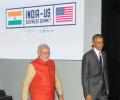
'Some of the learning may be implemented in the Budget'

Budget was big jump forward in revitalising the economy

Makki is a US-designated terrorist and brother-in-law of Lashkar-e-Tayiba chief and 26/11 mastermind Hafiz Saeed.
The talks between S M Krishna and Hillary Clinton covered important bilateral issues like Afghanistan, nuclear waiver, defence purchases, terrorism, cyber security and US demands for market access, particularly in insurance and retail trading. Sheela Bhatt reports.
Signalling the continuity of policy, the new government has ratified the Additional Protocol, a commitment given under Indo-US nuclear deal by the previous dispensation to grant greater ease to International Atomic Energy Agency to monitor India's civilian atomic programme.

India will welcome two trade missions in 2015 focused on meeting its infrastructure needs with US technology and services.
Thinning attendance, 'absconding' speakers and too much 'unused space' in the lecture halls have embarrassed organisers of the much-hyped Indo-US Space Conference underway in Bangalore.
More than 130 experts and non-governmental organisations from 23 countries have criticised the Ind0-US nuclear deal, saying its proposal to exempt India from the long-standing global nuclear trade standards "would damage the already fragile nuclear nonproliferation system and set back efforts to achieve universal nuclear disarmament".
Claiming that the Nuclear Suppliers Group had 'reneged' on its waiver on nuclear fuel supply to India, Bharatiya Janata Party on Tuesday accused Prime Minister Manmohan Singh of betraying the nation on the Indo-US nuke deal and asked him to clarify how it is beneficial to the country.
An anonymous lawmaker in the Senate put a 'hold' on consideration of the Bill in the Senate, which must be lifted before the agreement is brought to its floor or approved by a Unanimous Consent Agreement. It, however, is not clear what provision of the Senate Bill is the lawmaker objecting to.
The 123 agreement commits Washington to ensure uninterrupted supplies to India's safeguarded civilian nuclear reactors through engagement with other Nuclear Supplier Group countries.
Bruce Riedel and Karl F Inderfurth, who were the point persons for South Asia in the Clinton administration and are expected to play key roles if a Democratic administration recaptures the White House, particularly a Hillary Clinton Administration, have bemoaned the unraveling of the Indo-US civilian nuclear agreement.
Observing that Indo-US ties were on an upswing, Commerce Minister Kamal Nath on Saturday mooted five milestones, including technology and trade cooperation for deepening bilateral economic relationship.
In a scathing indictment of the nuclear liability bill passed by Indian Parliament, Nicholas Burns, former under secretary of state in the Bush administration, has warned that if the bill was not amended it could sound the death knell of the historic Indo-US nuclear deal and adversely impact on the envisaged US-India strategic partnership.
India's offer of the reported proposal to put a dedicated facility under safeguards, could be a positive contribution to moving the process forward during the talks led by Narayanan, predicts Dr Ashley J Tellis.
India should not be dictated by any country on its nuclear policy, Advani, who was in Hyderabad as part of his Bharat Suraksha Yatra, said.
Over the past six years, the largest consortium of businesses in India spent more than 1 million dollars on fact-finding trips to India for US members of Congress, their staff, and spouses and lobbying.
The US said the exercise had given it an opportunity to highlight some of the most sophisticated systems of its arsenal.
President Barack Obama has sent the report on the Indo-US civilian nuclear deal to the US Congress, the White House said on Friday.
Significantly, the official spokesman of the Russian foreign ministry said in a statement posted on the ministry's website that the new guidelines adopted by the NSG to ban the sale of ENR technology to NPT non-signatories would not apply to India. This unambiguous statement was made just a few days before the Indo-US Strategic Dialogue
"If the US does not carry out its obligations, we are also free not to carry out our obligations," Dr Singh said

Prosperity was not possible without peace, the minister said.
Retired Commodore Uday Bhaskar, leading strategic analyst, has predicted that the Indo-US relationship 10 years into the future will still remain on track even if the bilateral civilian nuclear deal is not consummated because it is now driven largely by non-government actors.
The US is keen to improve business ties with India.
In its bid to offset the impact of Indo-US nuclear deal, Pakistani President Asif Ali Zardari will take up the acquisition of nuclear fuel technology from China during his forthcoming visit.
The letter seeks to allay the Left's fear that signing the Indo-US nuclear deal would bind India not to conduct tests and put caps on the nuclear arsenal.
Outgoing American Ambassador to India Robert D Blackwill said the Indian government had also spoken about considering sending troops under different circumstances.

Biden, the first US Vice President to visit India in three decades, welcomed relaxation of foreign direct investment norms in certain sectors but said a lot more needed to be done to remove trade barriers.

The last meeting of the 2+2 was held in New Delhi and the next meeting is to be hosted by the US in Washington, DC.
 © 2026 Rediff.com - Investor Information - Advertise with us - Disclaimer - Privacy Policy - Sitemap - Feedback - About us - Terms of use - Grievances