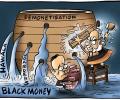
Assuming that demonetisation had not happened, the value of notes in circulation this year could have increased to Rs 19.3 lakh crore. But what we have, instead, by the end of August is a 20 per cent lower figure for currency notes in circulation, says A K Bhattacharya.

IT and interest rate-sensitive bank, realty, and auto stocks ended with sharp gains.

'Efforts are on to make the data readily available so that it proves useful for policymakers.'

India's monstrous public distribution system ensured that the government, and not private players, became a huge hoarder of food grains.

The number of fresh formal jobs generated in a month increased to a seven-month high in April, signalling a recovery in the formal labour market in the country, according to the latest monthly payroll data released by the Employees' Provident Fund Organisation (EPFO) on Thursday. In April, the number of new monthly subscribers under the Employees' Provident Fund (EPF) sequentially increased by 18.77 per cent to 887,438 from 747,146 in March.
BJP is hiding behind a GDP number which is being challenged. People are not dazzled by it, but are asking 'where are the jobs?'

60 per cent of the companies reported improved industry performance at present, compared to the last six months.

'If the period between 1991 and 2014 was about laying the foundations and building the runway, the period from 2014 to 2024 has been about the aircraft taking off.'

'The ceaseless process of privatisation is shrinking the space of reservation.' 'Where will reservation go if you keep privatising?'
"India's economic fundamentals are quite robust and its economy remains the second-fastest growing one in the world," the prime minister's Economic Advisory Council's chairman Suresh Tendulkar told reporters in Mumbai. According to him, the financial meltdown in advanced economies 'has been very serious'.

'Everyone in Dhaka today is aware that that they need good relations, normal relations with India, but the question... but it's premature to think about that now, right now it is a crisis moment'

'The Indian economy is full of potential.'

The market capitalisation of listed companies on the NSE surpassed $5 trillion (Rs 416.57 trillion) on Thursday on a day when the Nifty 50 index touched an all-time high of 22,993.60. The Nifty 500 index also touched an all-time high of 21,505.25 on Thursday indicating that growth in the equity market is not restricted to only the large capitalised stocks, a statement by NSE said.
Global rating agency Moody's Investor Services in its latest report said the strong fundamentals, combined with upturn in savings and investment as well as rising rate of potential growth, supports the Indian government's foreign currency sovereign medium investment grade (Baa3) bond rating and local currency speculative grade (Ba2) bond rating.
Nobel Prize winner in economics in 2001, Stiglitz, who was delivering a lecture in the Indian Statistical Institute in Kolkata, said that a government needed to play an important role 'in any economy correcting pervasive market failures'.

'What happens in the real estate market is that once the prices go up it goes on to stay at that level.' 'It might not increase and at the same time the prices will not come down too.'

Riding on a bull run, equity investors became richer by Rs 128.77 lakh crore in the 2023-24 fiscal, driven by robust fundamentals of the Indian economy, increased investment inflows and promising corporate earnings. After a muted performance in 2022-23, equity markets made a remarkable recovery in FY24, giving handsome returns to investors. The 30-share BSE Sensex climbed 14,659.83 points or 24.85 per cent in 2023-24.

According to BofA-ML, lead indicators still point to six months of pain and it is not until the March quarter that growth is expected to recover to 6.5 per cent levels.

There was no smooth surge in middle class prosperity for foreign businesses to tap into because of the Indian economy was mismanaged, argues Debashis Basu.

The UK voted to leave the European Union after 43 years.

Stating that COVID-19 has not yet been contained in India, the rating agency in a statement said the government stimulus package is low relative to countries with similar economic impacts from the pandemic. "The COVID-19 outbreak in India and two months of lockdown -- longer in some areas -- have led to a sudden stop in the economy. That means growth will contract sharply this fiscal year (April 2020 to March 2021)," it said. "Economic activity will face ongoing disruption over the next year as the country transitions to a post-COVID-19 world."
Of course, we would still grow at 7-8 percent. We would still be smug in our achievement and say it is still better than most of the economies in the world. As for double-digit growth, let that remain only in paper.
'I think some of us, like Mukesh Ambani, myself and those of us who head industrial units, ought to really focus on what we can really do to make the world a safer place, maybe 50 or 100 years from now.' 'For instance, how can we deal with climate change and global warming, right now?' 'The effects of it may not be felt now; in fact, we may pay a price for it today, but it will help the generations to follow.'
It will take a period of time to recover back to the higher levels that India enjoyed in previous years, IMF director said.

India's economic growth is gaining momentum, Paris-based think tank OECD said on Monday amid the new government initiating various measures to bolster the economy.

Indian National Developmental Inclusive Alliance (INDIA) MPs, including Congress president Mallikarjun Kharge, Congress Parliamentary Party chief Sonia Gandhi and Leader of Opposition in the Lok Sabha Rahul Gandhi, staged a protest in Parliament premises on Wednesday over the alleged discrimination against opposition-ruled states in the Union Budget.

India Inc on Thursday pitched for lowering income tax burden on common man, increase in capital expenditure, and firm steps to contain food inflation in their nearly two-hour long interaction with finance minister Nirmala Shitharaman ahead of the Union Budget. During pre-Budget consultation with Sitharaman, the industry leaders and associations also urged the government to focus more on infrastructure development with a view to maintaining the economic growth momentum. The industry leaders also laid stress on boosting the MSME (micro, small, and medium enterprises) sector, considered a backbone of the Indian economy and main employment generator.

'What's sad today is that there are so many people who cannot find work, not because the country is devoid of that opportunity, but because we are not doing enough in the country.'
RBI has reiterated its faith in the Indian economy but it has also put forth some key concerns that have the potential to derail the growth engine.

By taking the mutual fund route, investors can take exposure to gilts with small amounts. Over a decade or more, returns from these funds tend to be sound.

After adding 11.7 million workers in the October 2022-September 2023 period from the pandemic lows in April 2021-March 2022, total workers employed in the vast informal sector in India - at 109.6 million - still remains below the pre-pandemic period.
Consumer durables shrank year on year, which could suggest to observers that spending confidence is yet to return to the economy.

'In the new coalition government, India's reform agenda may prioritise job creation and factor market reforms.'
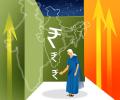
Citing various macroeconomic parameters that are doing pretty well, India's G20 Sherpa and former CEO of Niti Aayog Amitabh Kant projected that the country is all set to overtake Japan as 4th largest economy in the world by 2025. The size of India's GDP is currently ranked 5th, after the US, China, Germany, and Japan. It overtook the UK in 2022.
India could emerge as the world's third largest economy by 2030.
Amid projections of up to over 9 per cent growth in Indian economy this fiscal, ratings firm Moody's has cautioned against overheating that can result in probable asset bubbles.
Moody's Investors Service on Friday said India's economy is expected to contract for the first time in more than four decades saying economic damage owing to the coronavirus-induced lockdown will be significant with lower consumption and sluggish business activity. Even before the coronavirus outbreak, Indian economy already was growing at its slowest pace in six years and with the stimulus measures announced by the government falling short of expectations, the disruptions are likely to be greater. "We now expect India's growth to register a real GDP contraction for the fiscal year ending in March 2021 (fiscal 2020-21), from our earlier projection of zero growth," it said in a research note.

Few finance ministers announce any taxation measure that could upset the stock market. Ms Sitharaman decided to take that risk, observes A K Bhattacharya.
Over the last few months, the Indian economy has been on nothing short of a roller-coaster ride.

'The government should come back as a job creator as it did in the 1960s and the 1970s.'
 © 2026 Rediff.com - Advertise with us - Disclaimer - Privacy Policy - Sitemap - Feedback - About us - Terms of use - Grievances