
ISRO Chairman S Somanath had recently said the most critical part of the landing will be the process of reducing the velocity of the lander from 30 km height to the final landing, and the ability to reorient the spacecraft from horizontal to vertical direction. "This is the trick we have to play here," he said.

In this process, millions and millions of tons of solar materials are thrown into the interplanetary space, he said, adding these CMEs can travel at a speed of approximately 3,000 km per second.

An entire nation waited, praying and hoping fervently, as the countdown to touch down on the moon wound to a slow close on Wednesday with many thousands gathering in schools, places of worship and elsewhere and scientists doing last minute checks to ensure Chandrayaan-3 makes a soft landing on the lunar south pole.

India will become the fourth country to master the technology of soft-landing on the lunar surface after the US, China and the erstwhile Soviet Union.

The entire process being autonomous when the lander has to fire its engines at the right times and altitudes, use the right amount of fuel, and scan of the lunar surface for any obstacles or hills or craters before finally touching down.

Using a comic strip, the ISRO tweeted, showing orbiter telling the lander 'Vikram' that it enjoyed its company before it separated on September 2 afternoon.

A mysterious shooting incident at a ISRO facility in the early hours near Bangalore threw up conflicting versions with a CISF guard claiming that two unidentified persons shot at him while the police raised serious doubts.

The Vikram Moon Lander, named after the father of India's space mission Vikram Sarabhai on his birth centenary year, is scheduled to touch the lunar surface near its south pole on September 7 about 1.55 am.

All spacecraft parameters are normal, the Bengaluru headquartered space agency said after the maneuver on the spacecraft.
There will be two more orbit manoeuvres to make the spacecraft enter into its final orbit passing over the lunar poles at a distance of about 100 km from the Moon's surface.

All spacecraft parameters are normal, the Bengaluru headquartered space agency said after the maneuver.

Indian Space and Research Organisation's Mars Orbiter Mission and American National Aeronautics and Space Administration's orbiter mission Mars Atmosphere and Volatile Evolution or MAVEN will share data concerning the upper atmosphere of Mars.
.jpg)
India's maiden mission to Mars has traversed beyond the sphere of influence of Earth extending about 9,25,000 km in its 10-month long voyage to the red planet.

Vikram (with rover 'Pragyan' housed inside) is expected to touch down on the lunar surface on September 7, between 1.30 am and 2.30 am.

Indian Space Research Organisation's Mars Orbiter, which was placed in inter-Mars trajectory in the early hours on Sunday, has crossed Moon's orbit and is travelling beyond Earth's natural satellite.

Utilising his visit to Fiji, Prime Minister Narendra Modi on Wednesday acknowledged the role played by this tiny South Pacific Island nation in the success of India's Mars mission in the very first attempt and offered to make it the hub for regional collaboration in space.

Hours before Chandrayaan-2's 'Vikram' module's proposed soft landing on the Lunar surface, Indian Space Research Organisation chairman K Sivan said on Friday things are progressing as per plan for the much-awaited event.

Two de-orbit manoeuvres of Vikram Lander, to bring it further down, have been planned to prepare for its landing in the south polar region of the moon.
The Chandrayaan-2 spacecraft is expected to reach the moon's orbit on August 20 and land on lunar surface on September 7.

Crossing a major milestone in the country's space history, ISRO's Mars Orbiter mission ventured out of Earth's sphere of influence for the first time in an attempt to reach the red planet's orbit
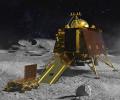
ISRO chairman K Sivan said the proposed soft-landing was going to be a 'terrifying' moment.

Ahead of India's Mars orbiter's scheduled rendezvous with the red planet on September 24, ISRO is all set for the crucial fourth trajectory correction manoeuvre and test fire of the main liquid engine on the spacecraft on Monday.

On Monday, ISRO scientists will run a test of the Mars orbiter satellite's main engine and make a small course correction. This is crucial because the engine has been idle for nearly 10 months. T E Narasimhan reports
 © 2026 Rediff.com - Investor Information - Advertise with us - Disclaimer - Privacy Policy - Sitemap - Feedback - About us - Terms of use - Grievances