
Home Minister P Chidambaram on Friday arrived to attend the South Asian Association for Regional Cooperation Home Ministers' Conference and was personally received by his Pakistani counterpart Rehman Malik at the Chaklala airbase. Chidambaram arrived at the Chaklala airbase in the garrison city of Rawalpindi by a special aircraft. Malik, who will host his Indian counterpart later on Friday, went to the airbase to personally receive Chidambaram.

In the first ministerial visit from India to Pakistan since the terror strike on Mumbai, Home Minister P Chidambaram will travel to Islamabad on Friday on a two-day trip, during which he is expected to press for a probe against Lashkar-e-Tayiba founder Hafiz Saeed and seek voice samples of the handlers of the 26/11 terrorists.Chidambaram is visiting Pakistan to attend the South Asian Association for Regional Cooperation Interior Minister's Conference on Saturday.
Bringing the perpetrators of the Mumbai attacks to justice is an important task to finish for Pakistan, which also needs to look into the issue of Hafiz Saeed, accused by India of masterminding the terror strike, besides preventing cross-border infiltration, the United States has said.
The key to the conspiracy hatched by David Headley and Tahawwur Rana may lie in Bangladesh and Pakistan.
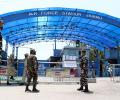
'The fact that this happened and the fact that we were not able to bring it down, we were not even able to trace from where it came from and where it went, certainly raises questions on our level of preparedness.'
Pakistan's Supreme Court, which is hearing petitions against the release from house arrest of Jamat-ud-Dawa chief Hafiz Saeed, on Thursday imposed a fine of Rs 10,000 each on the federal and Punjab governments, for delaying the case with their 'non-cooperative attitude'. Saeed, the founder of terror outfit Lashkar-e-Tayiba, has been accused by India of masterminding the terror attack on Mumbai.
India has said that it is disappointed with the verdict passed by the Pakistan Supreme Court on 26/11 mastermind Hafiz Saeed.
Nirupama Rao, who took over as the foreign secretary on August 1, has had a variety of issues on her platter -- the reported incursions by China along the border, the attack near the Indian embassy in Kabul, Pakistan dilly-dallying on prosecuting Mumbai terror attack mastermind Hafiz Saeed and the mounting political pressure over the rehabilitation of displaced Tamils in Sri Lanka.

The US on Wednesday shared India's concern about the terrorist threat that could emanate from Pakistan and sought prosecution of seven suspects of the Mumbai attacks, including its mastermind and Lashkar-e-Tayiba founder Hafiz Saeed.
Pakistan on Tuesday expressed disappointment over India's reaction to the Lahore high court quashing cases registered under the anti-terror law against 26/11 mastermind and Lashkar-e-Tayiba founder Hafiz Saeed, saying that questioning decisions made by the country's independent judiciary was "not a wise step".

Disappointed at the Lahore high court's decision to scrap terror cases against Jamaat-ud Dawa chief Hafiz Saeed, India on Monday said it would take up the issue with Pakistan, as it had earlier made to understand that formal investigation would be conducted against him.
The Pakistani police on Wednesday said they were awaiting instructions from the government for taking further action against founder of Lashkar-e-Tayiba and Jamaat-ud-Dawa chief Hafiz Saeed, who was placed under house arrest after two cases were registered against him under an anti-terror law.

"We have submitted all information available to us, but we want more information to make our case solid," Pakistan's Interior Minister Rehman Malik said, adding that in the absence of enough evidence, the court would exonerate Saeed for lack of authentic proof.

Ribbing Modi, Gandhi on his Twitter handle said "more hugs were urgently needed" between PM Modi and Trump.
The US also said Pakistan-based Lashkar-e-Tayiba posed a "regional and global" threat for it and India. "There are five, probably six, suspects currently being held in Islamabad in connection with the 26/11 Mumbai terror attacks," US Ambassador Timothy J Roemer said.

No militant belonging to the Lashkar-e-Tayiba or its parent organisation, the Jamaat-ud-Daawa, has been included in Pakistan's top 10 most wanted terrorists list.JuD chief Hafiz Saeed, along with other top LeT commanders, has been accused of masterminding the deadly Mumbai terror attacks on November 26, 2008, in which 179 people were killed.Pakistan's top ten most wanted terrorists belong to six militant and sectarian organisations linked to the al-Qaeda and the Taliban.

With Interpol issuing Red Corner Notice against Jamaat-ud Dawa chief Hafiz Saeed, India on Wednesday said the development vindicates its stand on his involvement in Mumbai terror attacks, and urged Pakistan to act on the basis of evidence collected 'painstakingly'.External Affairs Minister S M Krishna said the world should take note of the Interpol notice.
India handed over "additional information" on Mumbai attacks to Pakistan High Commissioner Shahid Malik, who met Foreign Secretary Nirupama Rao in New Delhi on Friday. During the meeting held following a request by Malik, additional information on the 26/11 terror attacks including inputs on some of the key aspects and accused involved was given by Rao.

Stating that prosecution of "some individuals" of the Lashkar-e-Tayiba by Pakistan was "not enough," India on Wednesday demanded "severe action" against Hafiz Saeed, mastermind of Mumbai attacks, so that he does not remain a free man to incite more violence against the country.
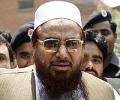
India on Thursday rubbished Pakistan's contention that it was not provided sufficient evidence about involvement of Jamaat-ud Dawa chief Hafiz Saeed in Mumbai attacks, even as it is seeking details about Islamabad's claim about banning outfits like JuD and Jaish-e-Mohammad.
India on Saturday said there was "enough evidence" to continue investigation against Jamaat-ud Dawah chief Hafiz Saeed in connection with the Mumbai attacks even as it finalised response to the latest set of questions sent by Pakistan.
Unhappy over Pakistan's repeated claim about lack of evidence to prosecute Jamaat-ud Dawa chief Hafiz Saeed, India on Wednesday said it should not ask any more questions as enough proof has been provided in the dossiers on Mumbai attacks. "They should not ask any more questions. Everything is contained in the dossier," Home Minister P Chidambaram told reporters in New Delhi when asked to comment on Pakistan's claim that it does not have evidence to prosecute Saeed.

Faisal said Pakistan respected all religions and would continue the Kartarpur project to help Sikh pilgrims.
India on Monday termed as "internal matter" the Pakistan Supreme Court rejecting petitions challenging the release of Jamaat-ud-Dawah chief Hafiz Saeed, a key accused in the Mumbai terror attack, but said it will closely monitor the case.
Union Home Minister P Chidambaram, while reacting to Pakistan's claim that India had not provided any evidence against Saeed, said "Zaki-ur-Rehman Lakhvi is one of the masterminds. There are others. We know their names and Pakistan also knows their names. If they do not bring the others to trial, then I would have to conclude, reluctantly and regretfully that they are dragging their feet," Chidambaram told media-persons in New Delhi.
Mohammed Omar Madni, a suspected aide of Lashkar-e-Tayiba founder Hafiz Saeed, is likely to be questioned by the Mumbai police in connection with the July 11, 2006 serial train blasts case. "We are in touch with Delhi police authorities and after getting more information from them, we will send a team to interrogate him," Additional Director General (Anti-Terrorism Squad) K P Raghuvanshi said.
The most wanted man in connection with the serial blasts, which had claimed 187 lives on July 11, 2006, is Lashkar-e-Tayiba operative Azam Cheema.Cheema, 57, is based at the Bahawalpur camp of the LeT in Pakistan. He has been given the charge of fomenting terror-related activities in Delhi and Mumbai, say sources in the Intelligence Bureau.

Demanding cancellation of the paper, MP Congress spokesperson Neelabh Shukla in a statement said, "It is highly objectionable that DAVV coloured the examination of important faculty like journalism in BJP's hues. The students of this subject should be taught party neutrality in a higher education institute."

The two leaders reaffirmed that the United States and India 'will take concerted action against all terrorist groups, including groups proscribed by the UNSCR 1267 Sanctions Committee'.
India on Monday reacted strongly to the Lahore High Court's order to dispose of the anti-terror case against Jamaat-ud-Dawa chief Hafiz Saeed, the alleged mastermind behind the November 26, 2008 Mumbai terror attacks.

"If 5,000 of these folk (some have estimated the strength of the LeT upwards of 150,000) decide to come out tomorrow in defense, there would be no police -- nowhere in sight. They could take over the city."

Pakistan President Asif Ali Zardari does not believe that India's demand to take action against Jamaat-ud-Dawa chief Hafiz Mohammad Saeed, the mastermind of the terror attacks on Mumbai, is a 'major hurdle' and was hopeful that relations would be normalised soon between the two neighbours."I don't think the issue of Hafiz Saeed is a major hurdle in the normalisation of our relations. I am hopeful that ties between the two countries will be restored very soon," Zardari said.

Mahmood Ali Durrani, who was sacked as the Pakistan's National Security Advisor after he acknowledged Ajmal Kasab's Pakistani nationality, has insisted that Jamaat-ud-Dawa chief Hafiz Saeed had no role in the 26/11 terror strike and has asked New Delhi not to "push" Islamabad.
Even as Pakistan continues to claim that India has not provided enough evidence in the Mumbai terror attack case, Interpol has suggested otherwise by issuing an arrest warrant against Jamaat-ud-Dawa chief Hafiz Saeed.
External affairs Minister SM Krishna has taken on Lashkar-e-Tayiba founder and Jama'at-Ud-Dawa chief Hafiz Saeed saying India believes Saeed is the "brain" behind the Mumbai attacks of November 2008, telling Pakistan's government that if it wants to prove its seriousness on tackling terror, it must tackle Saeed.
Asserting that Pakistan should be given a 'categorical response', Samajwadi Party chief Mulayam Singh said Saeed's release posed a 'grave threat to India's security'.

Pakistan plans to ban 10 terror outfits, including 26/11 mastermind Hafiz Saeed-led Jamaat-ud-Dawa and the dreaded Afghan-based Haqqani Network, a move seen by experts as a "paradigm shift" in the country's security policy in the wake of Peshawar school massacre.
Pakistan has said it cannot arrest outlawed Jamaat-ud-Dawah chief Hafiz Mohammad Saeed, linked by India to the Mumbai terror attacks, since there is no proof of his involvement in the 26/11 assault.
India on Thursday asked Pakistan to demonstrate the same 'force' to deal with terror groups like Laskar-e-Tayiba and Jaish-e-Mohammed like it has done against the Taliban in Swat Valley.
On the eve of the Indo-Pak foreign secretary-level talks, Pakistan on Wednesday said that India's demand for handing over of Jamaat-ud-Dawa chief Hafiz Saeed, the mastermind of the 26/11 Mumbai attacks, should not be bracketed with the parleys as it would be 'counter-productive.'
