The CAG has found that the Union government in the very first two years of the GST implementation wrongly retained Rs 47,272 crore of GST compensation cess that was meant to be used specifically to compensate states for loss of revenue.
Industry body CII has pitched for a reduction in personal income tax rates, decriminalisation of the goods and services tax and a relook at the capital gains tax rates as part of its agenda presented to the government for the forthcoming Budget. Arguing that the GST law already contains adequate penal provisions for deterrence against evasion of taxes, CII has suggested decriminalisation of GST law. Also, the applicability of prosecution provisions should not be based on the absolute amount of tax evasion but should be based on real intent to evade the taxes and a certain percentage of the tax payable, it stated.

Amid record-high fuel prices, Finance Minister Nirmala Sitharaman on Monday said there is no proposal as of now to bring crude oil, petrol, diesel, jet fuel (ATF) and natural gas under the Goods and Services Tax (GST). When the GST was introduced on July 1, 2017, amalgamating over a dozen central and state levies, five commodities - crude oil, natural gas, petrol, diesel, and aviation turbine fuel (ATF) - were kept out of its purview given the revenue dependence of the central and state governments on this sector. This meant that the central government continued to levy excise duty on them while state governments charged VAT. These taxes, with excise duty, in particular, have been raised periodically.

Fresh plans of privatisation or divestment in central public sector enterprises and public sector banks might take a back seat this financial year because these may require a large consensus among coalition partners.
GST taxpayers will be required to reverse by November 30 the input tax credit (ITC) claimed in the last fiscal in case their suppliers fail to deposit the due tax by September 30, the finance ministry has said. The taxpayers, however, can reclaim the ITC later following the deposit of taxes by the supplier. The ministry has inserted Rule 37A in Central Goods and Services Tax rules to give effect to the new provision.

The all-powerful GST Council on Friday decided to charge food delivery platforms such as Swiggy and Zomato a tax even as it extended concessional tax rates on certain COVID-19 drugs by three months till December 31. The Council, which comprises the Union finance minister and her state counterparts, decided to continue keeping petrol and diesel out of the GST purview as subsuming the current excise duty and VAT into one national rate would impact revenues. Briefing reporters on the decisions taken by the Council at a meeting here, Union Finance Minister Nirmala Sitharaman said GST has been exempted on muscular atrophy drugs like Zolgensma and Viltepso, which cost crores of rupees.

Stating that GST council meetings have become "almost toxic" with the erosion of trust between the Centre and states, West Bengal minister Amit Mitra on Wednesday urged Union Finance Minister Nirmala Sitharaman to consider a "course correction" to rebuild faith. In a letter to Sitharaman, the state's finance minister also claimed that the central government comes to GST council meetings with a "predetermined conclusion". Mitra on June 13 alleged that his voice was "muzzled" during the GST Council meeting on that day and his opposition to levy taxes on Covid essentials like vaccines, masks, PPE kits and anti-viral drug Remdesivir, was not heard.

From connectivity woes to infrastructure advancements and the startup boom, there is a gulf between claims and reality in India's economic landscape, points out Devangshu Datta.
India's GST collection remained above Rs 1 lakh crore for the third month in a row at over Rs 1.17 lakh crore in September, raising expectations that second half of the year will post higher revenues. The tax collections in September on goods sold and services rendered was 23 per cent higher than Rs 95,480 crore collected in September 2020, and 27 per cent higher than Rs 91,916 crore collected in September 2019. The collection in September is the highest in five months since April, when revenue was at record high of Rs 1.41 lakh crore.

'Challenge is basically near-term growth as the outlook has turned a bit adverse.'
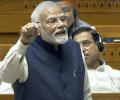
Prime Minister Narendra Modi on Saturday launched a scathing attack on the Congress party, accusing it of repeatedly "wounding" the Indian Constitution. He claimed that the Congress, driven by its "lust for power," has consistently undermined the principles of the Constitution. Modi, however, praised India's democratic journey since its independence, highlighting the country's strong democratic roots and its unwavering commitment to its founding principles. He underscored the importance of unity for India's future development and emphasized that the Constitution is the bedrock of that unity.
Three industry bodies suggested changes in India's tax regime in their pre-Budget discussions with Revenue Secretary Sanjay Malhotra in New Delhi on Tuesday. The bodies - Confederation of Indian Industry (CII), PHD Chamber of Commerce and Industry (PHDCCI), and Federation of Indian Chambers of Commerce & Industry (FICCI) - held separate meetings with Malhotra during the day and put across their suggestions for the upcoming Budget.

The proposed exemption in customs duty on import of lithium, cobalt and other rare minerals in the Union Budget 2024-25 is likely to lower the battery production cost and help in making electric vehicles more affordable for the buyers, auto industry leaders said on Tuesday.

All eyes will be on whether Sitharaman provides the much-expected tax relief for the middle class, leaving more money in their hands, as there is tax buoyancy
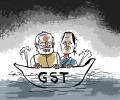
The Centre managed to collect only Rs 990 crore as compensation cess in April 2020-21, almost one-ninth of the figure of Rs 8,874 crore mopped up a year ago. The subdued collection would further increase states' problems unless the GST Council, which meets next week, decides to borrow from the market.

Businesses that have not filed GSTR-3B returns in the preceding two months will not be able to file details of outward supplies in GSTR-1 from September 1, GSTN has said. While businesses file GSTR-1 of a particular month by the 11th day of the subsequent month, GSTR-3B, through which businesses pay taxes, is filed in a staggered manner between 20th-24th day of the succeeding month. In an advisory to taxpayers, GSTN, which manages the technology backbone for Goods and Services Tax, said that Rule-59(6) of Central GST Rules which provides for restriction in filing of GSTR-1, will come into effect from September 1, 2021.
Revenue from Goods and Services Tax (GST) stood at over Rs 1.04 lakh crore in November as against Rs 1.05 lakh crore collected in the previous month, the Finance Ministry said in a statement. This is the second straight month in the current fiscal when GST revenue has topped Rs 1 lakh crore. The collection in November 2020 is 1.4 per cent higher than in November 2019 when the GST mop-up was Rs 103,491 crore.

Higher reliance on GST receipts for revenue reduces states' autonomy as these receipts depend on tax rates decided by the GST Council, a report by Delhi-based non-profit, PRS Legislative Research shows.

Ahead of the first meeting of the top decision-making body in nearly eight months, finance ministers of eight states ruled by non-Bharatiya Janata Party and like-minded parties -- Rajasthan, Punjab, Chhattisgarh, Tamil Nadu, Maharashtra, Jharkhand, Kerala and West Bengal -- have devised a joint strategy to press for a zero tax rate on Covid essentials, sources said.

The controversy over the goods and services tax (GST) rate on food products refuses to die. Now, the Gujarat-based authority of advance rulings (AAR) has ruled that 'parathas' would attract 18 per cent GST. The applicant, Vadilal Industries, sought to know whether various kinds of 'parathas' supplied by them would attract five per cent GST in line with 'khakhra', plain chapati or 'roti'.

Shadow of elections may overshadow political consensus at GST Council meetings.
In the year-long crackdown on tax evasion, the GST authorities have unearthed over Rs 35,000 crore of tax fraud committed by misuse of input tax credit provision under the Goods and Services Tax (GST) regime. During the 2020-21 financial year, the CGST zones and the Directorate General of GST Intelligence (DGGI) booked about 8,000 cases involving fake ITC of over Rs 35,000 crore, a statement from CBIC said. Under the GST regime, at the time of paying tax on output, entities can reduce the tax they have already paid on inputs.

Ironically, West Bengal, which has been seeking a postponement of the GST roll-out, has fared better among most other states.
After the GST Council's meeting in March, the Centre had sought views from Attorney General K K Venugopal -- who is the chief legal officer of the government -- on the legality of market borrowing by the council to make good any shortfall in the compensation fund. The AG in his view said there is no obligation on the central government to pay the GST compensation shortfall, according to the sources.

Does a doctor need to pay GST and other queries...

Sources said GST exemption on such items would lead to blocked input tax credit, thereby increasing the cost of manufacturing and a higher price for consumers.
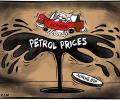
Many states are open to the idea of petrol and diesel being brought under the goods and services tax (GST) regime - contrary to the perception that they are averse to it - but they want a concrete proposal, including a compensation mechanism, from the Centre. West Bengal Finance Minister Amit Mitra says while the issue can be discussed, the Centre may not be keen to bring the change because it earns "much more" from taxes on petrol and diesel. "(The peak rate of) GST is 28 per cent. Under the regime, the Centre would only get 14 per cent. "So, definitely, the Union government does not want GST on fuel. It is all lies. Currently, they are in a very cozy place," Mitra said.

Reserve Bank Governor Shaktikanta Das on Thursday said the fundamental drivers of the Indian economy are gaining momentum and the country is moving on a sustainable growth path. In the inaugural address at FIBAC 2024, the governor said that massive changes are taking shape in various economic sectors and markets, and the country is geared for orbital shifts.

The stalemate over compensating states for the shortfall in GST collections continued on Monday with a meeting of the GST Council ending without reaching any consensus. The panel, which is the highest decision-making body on indirect taxes, for the second time in a week failed to reach a consensus on the Centre's proposal of states borrowing against future GST collections to make up for the shortfall.
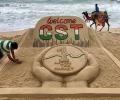
Agencies, whether public sector or private sector, may have to pay goods and services tax on the charges they collect on behalf of the government from clients. The authority for advance rulings (AAR), Telangana, has ruled that e-procurement transaction fee collected by an agency on behalf of the government is chargeable to GST, said Rajat Mohan, senior partner at AMRG & Associates. The AAR also ruled that neither services provided by the agency to the government, nor services provided on behalf of the government to the business entities are exempt from GST, he informed about the case.

The Securities and Exchange Board of India (Sebi) has intervened in the matter concerning alleged irregularities by Trafiksol ITS Technologies, which had come out with a Rs 45 crore initial public offering (IPO) last month. In an ex-parte order, the market regulator has said it will undertake a detailed examination into the disclosures made by the small and medium enterprise (SME) company in its draft offer document. BSE had halted the listing of Trafiksol, a software provider for traffic systems, amid complaints around use of the issue proceeds and wrongful disclosures.
The government has extended the deadline for filing GST annual return and audit report for the 2018-19 fiscal year by a month, till October 31.
The video clip shows Sitharaman purportedly giving a bite to the media and terming Goods and Services Tax as the Gopaniya Suchna Tax. It was shared by one Chirag Patel on his X handle.

Traversing from being just vehicle manufacturers to mobility solutions providers amid a raging debate over which eco-friendly technology must be incentivised, the Indian automobile industry is driving in the new year under the shadow of a slowdown in sales with the post-pandemic pent-up demand in distant memory. The shift in the auto industry -- where advanced technologies like autonomous driving, vehicle intelligence, connected features and electrification are quickly gaining traction -- will be reflected in the upcoming Bharat Mobility Global Expo in which India's flagship Auto Expo has been clubbed to be held from January 17-22, 2025 in Delhi-NCR.
Income tax officials on Monday conducted surveys at offices of engineering major Larsen & Toubro and media firm Zee Group for alleged GST evasion, an official of the tax department said. When contacted, L&T neither confirmed nor denied the development, while the media group has confirmed the tax survey. The tax official said surveys have been carried out at many L&T premises in the city, and in case of Zee, the surveys are underway at all its offices across the country since morning.

With 7 per cent economic growth, India is not creating enough jobs as reflected by the number of applicants for vacant posts in some states, Reserve Bank's former governor Raghuram Rajan said and suggested the government needs to focus on promoting labour-intensive industries to generate employment. Rajan further said some Indians, especially those at upper level, are comfortable and have high incomes, but consumption growth from the lower half of the country has still not recovered to pre-pandemic level.
The 41st meeting of the GST Council, to be held via video conferencing, has just one agenda for discussion -- making up for shortfall in states' revenues, sources said.

One reason the fee can't be lower than 3 per cent is that it is difficult for an RIA to do a good job and remain viable even at 3 per cent.
The Centre is looking to convene a meeting of the all-powerful Goods and Service Tax Council in early January. The meeting is likely to focus on rectifying the inverted duty structure for a few more items and will also serve as a platform for pre-Budget discussions between Union Finance Minister Nirmala Sitharaman and state finance ministers, Business Standard has learnt. "The current Winter Session of Parliament ends on December 23, followed by the Christmas-New Year period. "After that we would like to have a meeting of the GST Council, depending on whether there can be a quorum," a top government official said.

While Congress and the states ruled by non-NDA parties pushed for the Centre meeting its statutory obligation of covering the deficit, the Union government cited a legal opinion to say it had no such obligation if there was a shortfall in tax collections. The Centre as well as BJP-JD-U-ruled Bihar were of the opinion that the states should borrow to make up for the shortfall in the tax revenues that have been compounded by the COVID-19 crisis, sources said.
