The liquidity will move into deficit after advance tax payments and GST outflows. It will rebound in October because of government spending.

The government on Monday announced the implementation of a 5 per cent uniform IGST rate on all aircraft and aircraft engine parts to boost the industry. The decision, which comes into force with immediate effect, marks a significant milestone for the domestic Maintenance, Repair, and Overhaul (MRO) industry, aimed at making India a global aviation hub, an official release said. Earlier, IGST rates on all aircraft and engine parts were ranging from 5 per cent to 28 per cent.

President Droupadi Murmu addressed both Houses of Parliament, highlighting the government's achievements in various sectors, including economic growth, social welfare, and infrastructure development. She emphasized the government's efforts to lift the economy out of "policy paralysis" and create a more inclusive society. Murmu also acknowledged the challenges posed by digital fraud and cybercrime and stressed the need for a social infrastructure revolution. The President's speech is considered a policy statement, outlining the government's vision and roadmap for the future.
GST collections in February grew 18 per cent to over Rs 1.33 lakh crore in February even as the Omicron wave dented the month-on-month collection momentum. This is for the fifth time in the current fiscal that the Goods and Services Tax (GST) collection has crossed Rs 1.30 lakh crore mark. Also, this is the first time, cess collection has crossed the Rs 10,000 crore mark, signifying recovery in certain key sectors, especially automobile sales, the finance ministry said on Tuesday.

Charitable trusts are liable to pay 18 per cent GST on grants and non-philanthropic donations received by them, the Maharashtra AAR has ruled. Jayshankar Gramin Va Adivasi Vikas Sanstha Sangamner, a Charitable trust registered under Maharashtra Public Charitable Trust Act 1950, had approached the Maharashtra bench of the Authority for Advance Ruling (AAR), seeking clarity on whether it is liable to pay GST on the amounts received in the form of donations/grants from various entities, including the central and state governments. The trust is also registered under the I-T Act as a charitable trust.

Pulse oximeters, hand sanitisers, temperature check equipment and ambulances too will attract lower 5 per cent tax.
The finance ministry has set up two committees of state finance ministers which would rework rate slabs, review GST exempt items and identify potential evasion sources. Four years after the roll out of the national Goods and Services Tax (GST), which replaced the complex indirect tax structure, the centre and states have started work on moving towards a "simpler rate structure in GST" by reviewing the current rate slabs, including special rates and merger of rate slabs. The Group of Ministers (GoM) on rate rationalisation would also review items under inverted duty structure to help minimise refund payout, and review the supply of goods and services exempt under GST with an objective to expand the tax base and eliminate breaking of input tax credit (ITC) chain.
GST collections touched a record of Rs 1.40 lakh crore in January on rapid economic recovery, Finance Minister Nirmala Sitharaman said on Tuesday. In her 2022-23 Budget speech, the minister said there has been a remarkable progress made in the Goods and Services Tax (GST) regime, but still a few challenges remain. "Gross GST collection in January at record Rs 1,40,986 crores; this has been possible due to rapid economic recovery," she said while presenting the Budget in the Lok Sabha. January is the seventh straight month when the GST collection has crossed the Rs 1 lakh crore mark.
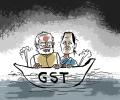
CAG recommended fixing a definite time frame for rolling out simplified GST return forms.
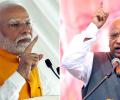
Kharge's remarks came after Modi on Friday said the Congress stands "badly exposed" in front of people for promising to them what the party knows it will never be able to deliver.
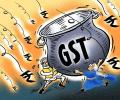
With most states on board to raise revenue so that they do not have to depend on Centre for compensation, the GST Council at its meeting next month is likely to consider a proposal to do away with the 5 per cent slab by moving some goods of mass consumption to 3 per cent and the remaining to 8 per cent categories, sources said. Currently, GST is a four-tier structure of 5, 12, 18 and 28 per cent. Besides, gold and gold jewellery attract 3 per cent tax. In addition, there is an exempt list of items like unbranded and unpacked food items which do not attract the levy.

Goods and Services Tax (GST) collections at Rs 95,480 crore in September touched the highest level so far this fiscal, the finance ministry said on Thursday.

The output of eight key infrastructure sectors expanded by 2 per cent in September, though the growth was slower than the 9.5 per cent registered in the same month last year, according to official data released on Wednesday. The output of these sectors had contracted by 1.6 per cent in August. Out of the eight key sectors, three -- crude oil, natural gas and electricity -- recorded negative growth in September.
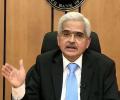
Reserve Bank Governor Shaktikanta Das on Tuesday said the fiscal-monetary coordination was at its best during the last six years even as he thanked Prime Minister Narendra Modi for giving the opportunity to head the monetary authority of the country. Das, in a series of posts on X, on his last day of his six-year term as RBI Governor, also thanked the Finance Minister, various stakeholders and his colleagues at the central bank.
With Goods and Services Tax (GST) officers under pressure to exceed the Rs 1-trillion collection mark per month, industry has faced a barrage of recovery notices and summons issued over the last one month across sectors, according to company executives. Industry bodies have claimed harassment by field officers, blocking of input tax credit, cancellation of GST registration, threats of arrest and steep penalties, impacting their working capital and operations. Company executives pointed at an atmosphere of apprehension and fear due to such notices and summons.

The demand for extension of the GST cess regime among others was made by several state finance ministers at a pre-budget consultation called by Union Finance Minister Nirmala Sitharaman in New Delhi. Besides, many states also demanded raising the share of the Union government in the Centrally Sponsored Schemes (CSS). Currently, the central government and state government share in some CSS is 60:40 while in others it is 75:25.
'We have already given Rs 1.59 trillion to states.' 'So, there is no question of giving them more.'

Proliferation of home chargers of around 7 KWh and above, which take six to seven hours to fully charge a car depending on the model, bring running costs down by a third or so. That, coupled with the increasing range of modern electric cars, can lead to a massive increase in sales.

Finance ministry sources have countered CAG audit finding of central government wrongly retaining Rs 47,272 crore of GST compensation cess meant for states, saying temporary retention cannot be termed as diversion.
The GST collection in April touched the highest ever level of about Rs 1.68 lakh crore, up 20 per cent from the year-ago period, on improved compliance and recovery in business activity, the Finance Ministry said on Sunday. During the month, 1.06 crore GST returns from GSTR-3B were filed, of which 97 lakh pertained to March 2022. The gross GST revenue collected in April is Rs 1,67,540 crore, of which CGST is Rs 33,159 crore, SGST Rs 41,793 crore, IGST Rs 81,939 crore (including Rs 36,705 crore collected on import of goods) and cess Rs 10,649 crore (including Rs 857 crore collected on import of goods), the ministry said.

For every rupee in the government coffer, 58 paise will come from direct and indirect taxes, 34 paise from borrowings and other liabilities, six paise from non-tax revenue like disinvestment and two paise from non-debt capital receipts, according to the Budget documents for 2023-24.

'Perhaps GST was too complex a system for the Indian economy at its present stage of development,' argues T N Ninan.
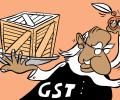
The Centre has cleared the entire GST compensation payable till date by releasing Rs 86,912 crore to states, the finance ministry said on Tuesday. Of this, Rs 25,000 crore is released from the GST compensation fund and the balance Rs 61,912 crore is being released by the Centre from its own resources pending collection of cess. Of the total compensation released, Rs 17,973 crore is towards April and May dues, Rs 21,322 crore towards February-March dues and Rs 47,617 crore is the balance of compensation payable up to January 2022.

The Centre and states are looking to further tighten the GST registration process and legal measures to deal with the rising cases of fake invoicing. A meeting of the law committee of the GST Council has been convened on Wednesday to discuss these issues, finance ministry sources said. The committee, comprising senior central and state tax officers, would also discuss the GST fake invoice frauds, further tightening of the GST registration process and work out other legal measures including necessary law amendment required in the GST Act to curb the menace of fake invoicing, they added. Also the provisions related to deemed registration under Goods and Services Tax (GST) law may be tightened to prevent the misuse of such provisions by fake dealers and the provisions related to suspension of registration may also be streamlined to make the procedure of suspension and cancellation of registration more efficient and faster, so that such fraud operators can be prevented in time from continuing to pass on fake credit down the chain.

Notwithstanding protests by the opposition Bharatiya Janata Party, he said the first session of the newly elected Jammu and Kashmir Assembly is "short in duration but historic in terms of agenda".

Heeding to demands made by several states, the GST Council on Friday put on hold a decision to hike the tax rate on textiles to 12 per cent and referred to a panel of state ministers to recommend rate by February, Union Finance Minister Nirmala Sitharaman said. The panel, the highest decision-making body for indirect taxes, met under emergency provisions after states made a request for deferring the tax rate hike on textiles, from the current 5 per cent, to be effective from January 1, 2022. Currently, the tax rate on manmade fibre (MMF) is 18 per cent, MMF yarn 12 per cent, while fabrics are taxed at 5 per cent.

Average household now saves 4 per cent in monthly expense after the rollout of GST: Sitharaman.

Headline growth was quite weak heading into the Covid period but averaged 6.4 per cent and 6.7 per cent in the five years between FY16 and FY20 for GVA and GDP respectively, points out Abhishek Upadhyay.
GST revenue remained above Rs 1 lakh crore for the second straight month in August at over Rs 1.12 lakh crore, 30 per cent higher than the collection in the year-ago period, the finance ministry said on Wednesday. "The gross GST revenue collected in the month of August 2021 is Rs 1,12,020 crore of which Central GST is Rs 20,522 crore, State GST is Rs 26,605 crore, Integrated GST is Rs 56,247 crore (including Rs 26,884 crore collected on import of goods) and Cess is Rs 8,646 crore (including Rs 646 crore collected on import of goods)," the finance ministry said in a statement. The mop up in August is, however, lower than Rs 1.16 lakh crore collected in July 2021.

Gross GST collection in March touched an all-time high of over Rs 1.42 lakh crore, the Finance Ministry said on Friday. The gross GST revenue collected in March 2022 is Rs 1,42,095 crore, of which CGST is Rs 25,830 crore, SGST is Rs 32,378 crore, IGST is Rs 74,470 crore (including Rs 39,131 crore collected on import of goods) and cess is Rs 9,417 crore (including Rs 981 crore collected on import of goods).
The GST Council, chaired by Finance Minister Nirmala Sitharaman, will meet on December 31 and discuss, among other things, report of the panel of state ministers on rate rationalisation. This will be a physical meeting, which will also discuss correction in duty inversion in certain goods. The 46th GST Council meeting will be held on December 31 in Delhi, an official said, adding that it will be an extension to the pre-budget meeting with state finance ministers on December 30. The Group of Ministers (GoM) on rate rationalisation will submit report to the Council.
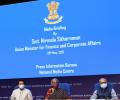
The GST Council on Friday left taxes on COVID-19 vaccines and medical supplies unchanged after the BJP- and Opposition-ruled states sparred over whether tax cut benefits will reach the common man. Congress and other Opposition ruled states have been demanding a reduction in taxes but the central government felt the move may not result in tangible gains for people. "It is one thing to rush to say - do this, it will benefit the common man. But when the technical, fitment and law committees go into the details, you realise that that could have collateral impact on many others," Finance Minister Nirmala Sitharaman said. "I am not talking about the revenue generation aspect, but how many other items will get included in it as a result of which how you are going to implement it," she added.

Banerjee asked Modi not to allow "an insufferable blow to the federalist polity of the nation" by depriving the states of the GST compensation. "I am deeply anguished by the Goods and Services Tax imbroglio which tantamounts to a betrayal of the trust and moral responsibility of the Government of India towards the states, violating the very premise of federalism."

'Spend, but create assets, spend but make sure that people benefit from it.' 'This has been a beautiful guiding principle. And I think as a finance minister I owe so much to the prime minister for keeping this path clear before us.'

Kerala Finance Minister K N Balagopal has sought systemic changes in the GST structure, saying every state and consumer has lost because of its basically flawed architecture that has also led to rampant revenue leakage for the states. The Goods and Services Tax (GST) regime came into force in July 2017. Even though the framework is focused on having a one-nation-one-tax model, quite a few items, including petroleum products and liquor are still out of the GST purview.

India SME Forum, an organisation for small and medium businesses, has called for creating a dedicated fund of Rs 5000 crore for the export capacity development, promotion, and marketing of Micro, Small & Medium Enterprises (MSMEs) in its Budget recommendation. The forum for MSMEs with over 98,000 members said that to enhance India's global competitiveness and increase its market share in global exports, it was "crucial to increase the number of active exporters and enable at least 3-4 lakh first-time micro, small, and medium exporters while supporting them in promoting Indian products globally."

The October 5 meeting assumes significance as the Centre and states are at loggerheads over the issue of funding Rs 2.35 lakh crore GST collection shortfall.

Certain clarifications by the GST Council, such as tax rates on ice cream parlours and royalty paid to state governments over mineral rights, may turn out to be contentious and lead to litigation, feel some experts. The council, at its meeting in Lucknow on Friday, had clarified that ice cream parlours will attract goods and services tax (GST). The clarification said these parlours sell already manufactured ice cream and such supply would draw 18 per cent tax.

The question on who should borrow from the market and whether the borrowing will be under two buckets should be decided by the GST Council, and not by the Centre. If there is no consensus, there has to be a vote, says A K Bhattacharya.

The shortfall in GST compensation payable to states in the current fiscal is estimated at Rs 2.69 lakh crore, of which Rs 1.58 lakh crore would have to be borrowed this year. The Centre expects to collect over Rs 1.11 lakh crore through cess on luxury, demerit and sin goods which will be given to the states to compensate them for the shortfall in revenue arising out of GST implementation. The remaining Rs 1.58 lakh crore would have to be borrowed to meet the promised compensation to states under the Goods and Services Tax (GST) regime.
