
Air India Group has accumulated losses of about Rs 47,821 crore since its takeover, leaving its prolonged transformation among the biggest unfinished projects of N Chandrasekaran's tenure.

Analysts predict a surge in gold and silver prices as investors seek safe-haven assets due to escalating tensions in the Middle East. The impact on domestic prices will depend on the conflict's duration, with geopolitical factors and macroeconomic data also playing a role.

For India, the guiding principle should remain clear: Engage Bangladesh as a sovereign nation and society rather than through the prism of any individual leader or political party, suggests Manoj Mohanka.

The Reserve Bank of India has marginally increased its GDP forecast for the current fiscal to 6.7 per cent while slightly lowering the inflation projection to 5 per cent. The central bank noted that while domestic economic activity shows resilience, global turbulence, particularly re-escalating conflicts and volatile oil prices, continues to pose risks to the inflation outlook.

Indian benchmark indices Sensex and Nifty saw gains in early trade, driven by a decline in crude oil prices due to easing geopolitical tensions in West Asia and strong buying interest in the IT sector.

'I don't see fear becoming a dominant factor for retail investors.'

Indian benchmark indices Sensex and Nifty experienced a significant slump in early trade, driven by escalating tensions in West Asia and a sharp rise in crude oil prices, alongside a bearish trend in other Asian markets.
Indian equity benchmark indices Sensex and Nifty plummeted over 2 per cent following US President Donald Trump's declaration that the interim agreement with Iran is 'over', which led to a sharp rally in crude oil prices and heightened geopolitical tensions.

InterGlobe Aviation (IndiGo) is experiencing significant financial pressure, with its stock falling 18 per cent since the start of the Iran war, due to rising Brent crude prices, a weakening rupee, and disruptions to its West Asia and European flight networks caused by geopolitical tensions.

Maruti Suzuki India (MSIL) reported a mixed Q1 FY27, with record quarterly sales driving strong revenue growth, but operating performance was below expectations due to higher commodity and other costs impacting margins. Brokerages anticipate sustained sales growth for the company in the current fiscal year, supported by new launches, robust demand, and significant capacity expansion.

Gold and silver prices are expected to remain range-bound this week as investors await crucial US economic data, including the non-farm payrolls report, and further signals from the Federal Reserve regarding its interest rate policy.

Indian companies' overseas expansion plans are holding strong despite geopolitical tensions in West Asia, driven by structural factors like supply-chain diversification, free trade agreements, and market expansion, according to Ajay Sharma, managing director and head of banking at HSBC India.

Indian stock markets ended a five-day losing streak, with the Sensex surging 776 points and the Nifty gaining 228 points, driven by a significant drop in crude oil prices and easing geopolitical tensions in West Asia.

Former PepsiCo CEO Indra Nooyi asserts that India and the United States are natural partners, crucial in the geopolitical competition with China. She highlights India's pivotal role as the world's largest democracy with a young, English-speaking population, despite its "chaotic" nature. Nooyi also discusses the need for leaders to understand each other's perspectives to maintain strong bilateral ties.

Indian benchmark indices, Sensex and Nifty, staged a moderate rebound after a significant correction in the previous session, driven by foreign fund inflows and a largely positive trend in global markets, though geopolitical tensions between the US and Iran continued to foster caution.

Larsen & Toubro (L&T) reported a 14 per cent year-on-year increase in Q1 FY27 profit attributable to owners, reaching Rs 3,926 crore, surpassing analyst estimates, despite facing significant supply-chain disruptions in West Asia.

India's passenger vehicle industry is poised for a record-breaking year in 2026, propelled by robust dispatches in the first half of the calendar year and strong demand for utility vehicles, despite facing several economic challenges.

Japan is deepening its defence relationship with India while simultaneously expanding its economic, infrastructure and security engagement with countries around India -- particularly Bangladesh. The result is an emerging Japanese conception of South Asia in which India remains the strategic anchor, but the geography surrounding India is becoming increasingly important, points out Varun Arya.
Indian benchmark indices Sensex and Nifty saw a significant rebound in early trade, driven by a sharp decline in crude oil prices and easing geopolitical tensions in the West Asia, which improved market sentiment and reduced inflation fears. Track Sensex, Nifty on July 27.
Investor interest in precious metal exchange-traded funds (ETFs) rebounded sharply in June, with silver ETFs attracting an estimated 4,900 crore and gold ETFs around 2,900 crore in net inflows, following a significant correction in gold and silver prices.

'Islamabad feels it has no alternative, but to address the challenges from the Afghan-Taliban through an open war.'

India's fresh investment plans in Q1FY27 surged 71 per cent to 14.77 trillion, primarily driven by four large nuclear power projects worth 6.5 trillion, according to investment monitoring firm Projects Today. Excluding these nuclear projects, fresh investment plans actually declined 4.27 per cent quarter-on-quarter.

Understanding the most common mistakes during market downturns can help you protect your investments and stay focused on your long-term financial goals, says Ramalingam Kalirajan

'Periods of heightened volatility, driven by global events such as tariffs and geopolitical tensions over the past year-and-a-half, can make some investors pause or discontinue their investments.'

India's position appears to be anchored around three red lines: Hasina's safety and the guarantee of a fair trial; assurances that Bangladeshi territory will not be used for activities hostile to India; and the restoration of an inclusive democratic process in Bangladesh.

'The market is currently neither cheap enough to be exciting about nor expensive enough to worry about.'

Dubai-based Danube Group plans to launch projects with a combined sales potential of approximately $4 billion in fiscal year 2026-27 (FY27), adopting a more selective approach to new developments as the Emirati property market enters a correction phase.

Indian startup funding plummeted by 43 per cent year-on-year to $7.81 billion between March 1 and June 15, 2026, largely due to the West Asia conflict, which has amplified global risk perceptions, tightened liquidity, and led to rupee depreciation, making global investors cautious.
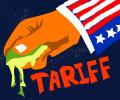
The bill, introduced on Thursday, was conceived by Democrat Senator Richard Blumenthal and late Republican Senator Lindsey Graham and has the support of over 60 lawmakers.

Indian benchmark indices, Sensex and Nifty, experienced declines in early trade due to a surge in crude oil prices and significant selling pressure on bank stocks, impacting overall investor sentiment. Track Sensex, Nifty on July 22.
Indian benchmark indices Sensex and Nifty experienced a significant decline in early trade, driven by renewed tensions between the US and Iran and a subsequent spike in global crude oil prices, creating uncertainty in the market. Track Sensex, Nifty on July 8.

Indian benchmark indices, Sensex and Nifty, extended their losses for a second consecutive day, primarily due to HDFC Bank's disappointing quarterly earnings and escalating tensions in West Asia, coupled with persistent foreign fund outflows.

The American military's air-defence missile inventories, including Patriot and THAAD interceptors, are significantly depleted due to the ongoing five-month confrontation with Iran. A CSIS assessment reveals a steep drop in reserve stocks, raising concerns about the US's capacity to maintain Middle East operations and address other global security challenges. This depletion could force the US and its allies to take higher operational risks.

After four consecutive months of outflows, foreign portfolio investors (FPIs) have turned net buyers in Indian equities in July, investing over Rs 15,157 crore, driven by improving domestic macroeconomic indicators, a stable rupee, and better global risk sentiment.

India's merchandise exports experienced a slight decrease in February, while imports surged due to increased gold and silver purchases, leading to a widened trade deficit. The West Asia crisis is expected to further impact trade in the coming months.

India's finance ministry anticipates inflation will remain relatively contained in the coming months, supported by a correction in crude oil prices and softening input costs following the cessation of the West Asia conflict, despite earlier spikes in wholesale and retail inflation.

Malaysia's Sepang circuit will host the rescheduled 'Gulf Air Bahrain Grand Prix in Malaysia' on October 4, Formula One announced, stepping in after the original April races in Bahrain and Saudi Arabia were cancelled due to the Iran war and Middle East situation.
Indian benchmark indices Sensex and Nifty rebounded in early trade on Thursday, recovering from a sharp fall in the previous session, driven by foreign fund inflows and buying in key blue-chip stocks. Track Sensex, Nifty on July 9, 2026.

Gold has emerged as the most stable asset during episodes of geopolitical stress, and crude oil has been more sensitive than others when it comes to regional conflicts and sanctions, according to a report in the Reserve Bank of India's (RBI's) monthly bulletin. Silver and the United States Treasury have showed moderate reactions.

Nearly 50 per cent of the stocks that comprise the Nifty 50 are trading below their respective 200-DMAs.
