
India and China on Monday decided to deepen bilateral defence ties and maintain peace and tranquillity at the Line of Actual Control besides strengthening cooperation against terror, including at the international level.

Dawn's Cyril Almeida said he had triple checked the facts on his story, which reported about the rift between the civilian government and the military in Pakistan.
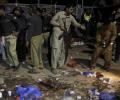
Pakistan on Monday launched a massive military operation in Punjab province in the wake of the deadly Taliban suicide bombing in Lahore, conducting raids and making several arrests.

Security Expert Bruce Riedel, who in an interview with rediff.com shortly after the Pathankot terror attacks began said that the attack underscored the determination of jihadist groups in Pakistan to sabotage any attempt at detente with India, writes in the Daily Beast that despite the US putting the Jaish-e-Mohammad on the terrorist sanctions list years ago, the outfit continues to coddle the Pakistani army.

Chinese President Xi Jinping arrived in Islamabad on Monday on his first visit to Pakistan where he is expected to sign a deal for an economic corridor worth $46 billion and other agreement.

Pakistan's powerful army chief has stepped in to mediate between the embattled government and the protesters seeking resignation of Prime Minister Nawaz Sharif, bringing the military back into the centre stage and signaling a possible end to the high-political drama.
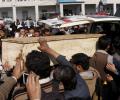
Extensive firing continues in the area and heavy contingents of elite force have been deployed.

With Pakistan's powerful army chief Gen Ashfaq Parvez Kayani's term coming to an end in November, names of top generals who are likely to succeed him are being discussed in the political circles and in the corridors of power.

Confrontation between Pakistan government and the opposition escalated on Wednesday with Prime Minister Nawaz Sharif rejecting demands for his resignation and Imran Khan calling off the dialogue with his regime until he quits.

Brushing aside India's concerns, China on Monday cemented its "all-weather ties" with Pakistan by agreeing to build a strategic $46 billion (Rs 2.9 lakh crore) economic corridor through Pakistan-occupied Kashmir as part of 51 deals signed, expanding the communist giant's influence in the region.

The attack on the Balochistan Police College, 20 km from Quetta city began around 11:10 pm on Monday night, triggering an operation by Pakistani security forces who rescued hundreds of cadets from the academy.

Describing the protests as a "mutiny against Pakistan", the government on Tuesday turned to Parliament for support as demonstrators continued to put pressure on a defiant Nawaz Sharif to quit as prime minister.

General Qamar Bajwa, his colleagues say, is a firm opponent of extremism and terrorism. He may prove even more forceful in the fight against terrorism than his predecessor, who is credited with launching Operation Zarb-i-Azb, which helped lower the frequency of terrorist attacks.

The outcome of the Bangkok NSA-level talks underscores that Pakistan has got exactly what it wanted -- talks at different levels, talks on Kashmir, talks on mutual concerns regarding terrorism, talks on ceasefire on the border. What if any has been India's gains remains unexplained, says Ambassador M K Bhadrakumar.
By weakening Sharif, the corps commanders could have a final say in important matters like relations with India, dealing with Taliban militants, interacting with Americans and once again achieving strategic depth in post-NATO Afghanistan. Which is why they may be behind the unrest in Pakistan led by Imran Khan and Dr Tahirul Qadri, says Shahzad Raza.
.jpg)
Pundits in Pakistan and also some western diplomats are predicting that the next army chief will be forced, partly by institutional pressure and partly by circumstances, to indulge in some tough talking with the civilian leadership. How the civil-military equation settles in this sort of a situation is something that will determine the future of Pakistani politics, and also Pakistan's relations with rest of the world, says Sushant Sareen.

After weighing all the costs and benefits, the next administration is likely to reduce and restructure assistance to Pakistan but not to end it altogether, says Daniel S Markey.
 © 2026 Rediff.com - Investor Information - Advertise with us - Disclaimer - Privacy Policy - Sitemap - Feedback - About us - Terms of use - Grievances