
The Union Cabinet, meeting at the new PMO complex 'Seva Teerth', resolved to prioritize citizen empowerment and service in all its decisions, guided by the principle of 'Nagrik Devo Bhava'.

She added that the government has extended the PM Garib Kalyan Anna Yojana for five years which is benefiting 80 crore people of the country.
'It is good for us if the JMM contests. That will divide the Opposition and give us the upper hand.'
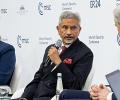
India's External Affairs Minister S Jaishankar countered a US senator's claim that democracy does not put food on the table, citing India's PMGKAY program which provides food to 800 million people. Jaishankar argued that different parts of the world have different experiences with democracy and that the model of globalization has contributed to issues with democracy in some regions. He emphasized that India's democratic system effectively delivers food security, highlighting the PMGKAY program as an example.

'If a poor voter sees Modi's picture on ration bags, it is natural he will vote for Modi and the BJP.'

Prime Minister Narendra Modi on Saturday said the government will extend for five years the free ration scheme, Pradhan Mantri Garib Kalyan Anna Yojana, covering 80 crore poor people.

The government has extended the PMGKAY scheme to provide 5 kg free foodgrains per month to around 80 crore poor people for another five years. A decision in this regard was taken in the meeting of the Cabinet, chaired by Prime Minister Narendra Modi, on Tuesday. Giving details on Wednesday, Information and Broadcasting Minister Anurag Thakur said the Pradhan Mantri Garib Kalyan Anna Yojana (PMGKAY) has been extended for another five years from January 1, 2024.

The government has extended the Pradhan Mantri Garib Kalyan Anna Yojana (PMGKAY) scheme to provide 5 kilogrammes of free foodgrains per month to around 80 crore poor people for another five years.
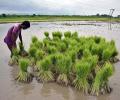
India's rice production could fall by 10-12 million tonnes during the Kharif season of this year, due to a fall in paddy sowing area, the government said on Friday. However, food secretary Sudhanshu Pandey asserted that the country will have surplus production in rice. He pointed out that the paddy acreage is lower by 38 lakh hectare so far this kharif season, because of less rains in many states.

The government, they said, will launch a mega drive, Viksit Bharat Sankalp Yatra, across all 2.7 lakh panchayats in the country to reach out to beneficiaries and enrol them.
"The Congress government and the chief minister should tell the people of Chhattisgarh what link they have with the accused in this scam sitting in Dubai," he said.

Here are the key highlights of the BJP's 'Sankalp Patra' for the 2024 parliamentary polls.

Prime Minister Modi will invite all Olympics participants to his residence for the interaction, in addition to the programme at the Red Fort.
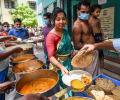
The government on Wednesday extended by three months its programme to provide free rations to the poor at a cost of Rs 44,762 crore as it looked to ease pain from high inflation and make political gains in the upcoming Gujarat elections.

Taking both direct and indirect taxes, the gross collection is expected to grow 10.45 per cent to Rs 33.61 trillion in 2023-2024.
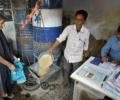
The Pradhan Mantri Garib Kalyan Anna Yojana (PMGKAY) was launched in March 2020 to provide free 5 kg foodgrains per person per month to about 80 crore beneficiaries covered under the National Food Security Act (NFSA) to reduce their hardship during the lockdown period. This was over and above the general allocation under the NFSA.
Initially, the additional free benefit under the PMGKAY was provided for a period of three months (April-June 2020) to ameliorate distress caused by the COVID-19 pandemic. However, with the crisis continuing, the programme was extended for another five months (July-November 2020).

But the government will present a second tranche of Supplementary Demands for Grants during the Budget session of Parliament in February, when it can seek additional spending.

This is the full text of the address to the nation by President Droupadi Murmu on the eve of India's 78th Independence Day.
'We now look at divestment as an opportunity for maximising the value of public assets, not necessarily as a short-term resource-raising measure.'

Speaking during a video interaction with Pradhan Mantri Garib Kalyan Anna Yojana beneficiaries from Madhya Pradesh, he also said that there was 'vikriti' (distortion) in the system of the previous government.
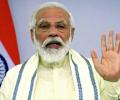
On the extension of the PMGKAY, he said it will cost the government Rs 90,000 crore more.
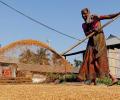
Stating that the food subsidy bill is becoming "unmanageably large", the Economic Survey 2021 on Friday suggested the government to increase the selling price of foodgrains provided through ration shops to over 80 crore beneficiaries. Foodgrains via ration shops are supplied at highly subsidised rates of Rs 3 per kg for rice, Rs 2 per kg for wheat and Rs 1 per kg for coarse grains through Public Distribution System (PDS) as per the National Food Security Act (NFSA). "While it is difficult to reduce the economic cost of food management in view of rising commitment towards food security, there is a need to consider the revision of central issue price (CIP) to reduce the bulging food subsidy bill," the survey said.

Is it a case of poor targeting of a welfare scheme, or is it a reflection of the government's desire to expand the scope of this benefit to secure greater electoral dividends? asks A K Bhattacharya.
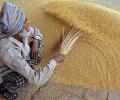
India's opening stocks of wheat in the central pool are expected to be 19.5-20 million tonnes as on April 1, 2022, the lowest in the last three years, but much higher than the normative level required for maintaining a buffer and strategic reserve, trade and market sources said. In accordance with the buffer and strategic reserve norms, India should have a wheat stock of 7.5 million tonnes in the central pool as on April 1 each year and this year's stocks, though the lowest in the last three years, will still be over 160 per cent more than what is required. On the export front, both government and trade sources are unanimous that this year (FY22) they will be 7-7.25 million tonnes, a record, while in the next financial year, they might touch even 10 million tonnes if the current momentum is maintained.

Union finance secretary T V Somanathan recently said the Centre had saved Rs 10,000 crore in FY22 on interest payments after adopting new accounting mechanisms for central government agencies and centrally sponsored schemes (CSS) for state governments. Speaking at an event, Somanathan said due to these, there was an unspent balance of Rs 1.2 trillion with state agencies from CSS as on March 31, 2022. This means this amount will be reduced from the Centre's borrowing for now and it can be considered a short-term saving for the exchequer.
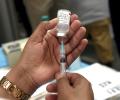
Union Home Minister Amit Shah on Monday expressed concern over vaccine hesitancy in some communities and urged people to spread awareness about the benefits of inoculation to win the battle against coronavirus.
The area under paddy - the biggest foodgrain during the kharif season - was almost 13 per cent lower in the week ended August 5 as compared to the same period last year despite a slight pick-up in rains in the main growing regions, triggering fears of a 10-12 million-tonne drop in final output. Sources said with the peak sowing season for paddy almost coming to an end in the big-growing states, any uptick in coverage from here onwards may not give the desired yields. With 30 per cent of normal average area in which paddy is grown every year remaining unsown till early August, there is a limited chance of a big uptick in output, trade and market sources said.

In the coming few weeks, agriculture markets in North and Central India will be full of wheat, mustard, and chana - the three main rabi crops grown in these parts. Not only will the price trajectory of these determine the course of food inflation in the months to come, but it could also have a wider impact on the rural economy in the main growing states for these crops. Wheat and chana are largely grown in Madhya Pradesh (MP).
A decision in this regard was taken in the Cabinet meeting chaired by Prime Minister Narendra Modi.

'It has been an ongoing process, talking to the relevant ministries about eliminating leakages and curbing non-core expenditure in various schemes.'
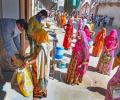
The government's food subsidy in the ongoing fiscal year is expected to be a little less than Rs 4 trillion.
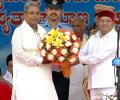
Why did Karnataka's economic prosperity fail to influence the nature of electoral promises made by political parties in the run-up to the assembly elections? asks A K Bhattacharya.
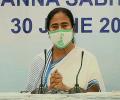
The announcement by Banerjee, who is also the chief of the ruling TMC, comes just months ahead of the assembly polls, due in April-May.

The Supreme Court on Wednesday said there must be a "debate" on the "serious" issue relating to the practice of political parties promising freebies and asked why cannot the Centre call for an all-party meeting on it.
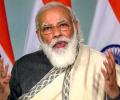
The sole intention of the opposition parties is to create roadblocks on the path of development, the prime minister said, as he termed their action "anti national".
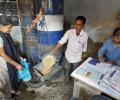
The free food scheme is driven by electoral considerations, but its long-term fiscal risks outweigh the short-term gains, cautions A K Bhattacharya.
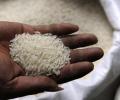
A 6-7 million tonnes shortfall in rice production due to a fall in paddy sowing area is likely to keep rice prices at elevated levels, adding to the inflationary pressure that the slowing economy is already grappling with. Elevated food prices, including that of cereals, had led to retail inflation reversing a three-month declining trend, to touch 7 per cent in August. Similarly, the wholesale price inflation, which declined to 11-month low, also showed price pressures from cereals resulting from wheat output being impacted by severe heat waves in some parts of the country.
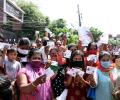
Both prime ministers believed in crafting schemes to help the common man. Modi used quite effectively the instruments Dr Singh introduced. In assessing Modi's success with many schemes, Dr Singh's fundamental work should not be ignored, points out A K Bhattacharya.

Prime Minister Narendra Modi on Friday said India's growth story is being disrupted by forces with a colonial mindset, including in the name of freedom of expression.
 © 2026 Rediff.com - Investor Information - Advertise with us - Disclaimer - Privacy Policy - Sitemap - Feedback - About us - Terms of use - Grievances